Now that I am officially on the dole, I have a duty to apply for a new job. I do not mind that at all. In fact, I would prefer to have a new job lined up already, which is why I tried to get through to the European Commission even while I was on vacation. I recognise how much of my identity I derive from my work, as I spend more time on it than anything else.
But there is something that bothers me about my current situation: I now serve not one, but two masters. One is the university that still needs a dissertation before I am done with them, which will take a few months. The other is the government that also expects the economy to worsen a lot after the summer. My timing is exquisite, as usual.
At the same time, I feel a growing need to have some autonomy in my work. I cannot truly tell if I am ready to be completely responsible for my own direction. If I were, I would go into business for myself. And it is not because I think I can't do something very useful. It is more that I have very little idea of where in our ecosystem of goverment, enterprise and NGOs my skills and interests can find a niche: I have direction (I have always had that, like a fairly reliable inner compass), but no map or view of the landscape.
I suspect that is something that people develop as they move up the ladder. In a higher position, you have more overview and space to maneuver. But if it is, how do I find a position where I can develop long range vision and reach, and yet have some room to stumble or a safety net that does not constrict?
My position at the university was good for this in a knowledge sense, but I didn't get out as much as I need to. Before that, my position at SIRA should have done it, but turned into a disaster. I did pick up some skill in this area from these jobs, but most of it is from my time working with NGOs during my studies.
In good economic times, it would be possible to pick my next job to address this need. So the main thing about this crisis that worries me now (I am pretty financially solvent) is that it will restrict my opportunities to grow professionally.
Sunday, 31 May 2009

Friday, 29 May 2009
Stockholm vs. Petersburg - atmosphere and dance
In many ways, these two cities are polar opposites. Stockholm is orderly, clean, quiet and almost rustic for a capital city, while Petersburg is loud, grimy, and pompous.
The first thing I noticed about St. Petersburg is the neglect of public spaces. Except when there are tourism or official reasons to maintain them, they degrade through lack of maintenance and public spirit. It strikes me as odd for a place that was collectivist until recently. The touristic areas, and anywhere that a senior official is likely to see, are kept well but the rest is not. In one place, the road was clean, but a footpath behind a hedgerow had piles of refuse. Also, the air quality is pretty horrible, especially after the clean air in Stockholm.
The people also go about their business with a neutral to sad look on their faces, which is apparently a way to preserve personal space. But it isn't doing the people great favours as a whole. I noticed this most clearly in the women.
Now, I have a thing for slavic women in general, but I am pretty impressed with the local young women. Unlike the swedish girls, whom I found generally bland despite their legendary status of leggy, busty blondes. But most of the middle aged women in St. Petersburg look worn, troubled and a bit chubby, without any of the grace they too must have once posessed.
My pet theory is that people do not laugh enough because of living conditions and bad weather (including really long and dark winters). On the other hand, many of the people I interacted with readily responded to cheerfulness with smiles of their own.
You notice it in another way: Stockholm is full of parents with children. I hardly saw any in St. Petersburg.
On the other hand, there is more than plenty to do here. In Stockholm, I tried to go tango twice: The first time, I ended up with a bunch of middle aged people of not very high skill. The second time there was simply nobody there at 21:30. In St. Petersburg, I got tango on my first night. Then my very first contact improvisation lesson on monday (great fun, and I have a nice abrasion on my arm to prove it), and a little milonga on thursday.
As it stands, I would recommend Göteborg over either of them as a place to live.
St. Petersburg IV - Hermitage
Natalia had taken a day off, so we both slept late and had a quiet breakfast. I tried to get through to the European Commission in Brussel for a job, but when I finally did, the man I was looking for was busy.
So we went to the Hermitage museum. It is located in the Winter Palace of St. Petersburg, the former residence of the Russian Czars from 1730 to 1917. As a former palace, the decoration of the interior is intense. Most of the floors have lovely wooden floors (I'd love a milonga on one of these) and the upper walls and domes are covered in ornaments. The collection is as vast as the palace, spanning ancient art from all over the world, palace items, and sculptures and paintings from all over Europe.
 After hearing horror stories about getting in, I was pleasantly surprised. Within five minutes, we had very reasonably priced tickets and were on our way up. We didn't try to see all of the collection, and we didn't even set foot in half of the rooms. We did see many of the paintings, including most of the modern collection. Natalia and I had good fun discussing the works and trying not to get lost.
 Update: as of June 20th, the Hermitage will have a new venue in Amsterdam.
After several hours, we got very hungry and left the Hermitage to get some blini. We walked to the Aurora, but it was closed. So we went home for food and to prepare for a milonga. The tango was in a little place off Nevsky Prospekt, but I spoiled the mood by stupid forgetfulness. After dancing, we walked around for a long time, and I got to see the open and lit bridges over the Neva.
And then it was back home for a short sleep until I had to fly out. I took Air Baltic and the flight was through Riga, which is (oddly enough) a larger airport than Pulkovo. The major benefit was that the first leg was in a Dutch-made Fokker 50, which is a pleasant aircraft and flies much closer to the ground because it is a turboprop.
So we went to the Hermitage museum. It is located in the Winter Palace of St. Petersburg, the former residence of the Russian Czars from 1730 to 1917. As a former palace, the decoration of the interior is intense. Most of the floors have lovely wooden floors (I'd love a milonga on one of these) and the upper walls and domes are covered in ornaments. The collection is as vast as the palace, spanning ancient art from all over the world, palace items, and sculptures and paintings from all over Europe.
 Update: as of June 20th, the Hermitage will have a new venue in Amsterdam.
After several hours, we got very hungry and left the Hermitage to get some blini. We walked to the Aurora, but it was closed. So we went home for food and to prepare for a milonga. The tango was in a little place off Nevsky Prospekt, but I spoiled the mood by stupid forgetfulness. After dancing, we walked around for a long time, and I got to see the open and lit bridges over the Neva.
And then it was back home for a short sleep until I had to fly out. I took Air Baltic and the flight was through Riga, which is (oddly enough) a larger airport than Pulkovo. The major benefit was that the first leg was in a Dutch-made Fokker 50, which is a pleasant aircraft and flies much closer to the ground because it is a turboprop.
Thursday, 28 May 2009
St. Petersburg III - Lavra
Unfortunately, we had to take care of administration first. It seems a visiting foreigner must be registered within three days of arrival. That meant filling in a form, without any corrections, and then having the post office clerk tell Natalia something was wrong. It took seven tries and two hours for the form to be finished, copied and sent.
After that I went to the Alexander Nevsky lavra. The difference between Nevsky Prospekt and the monastery is uncanny. Once you step through the gate, the noise dies away and I felt more relaxed immediately.
In Orthodox Christian churches, there are no rows of benches and sunday morning mass like in Catholic or Protestant ones. Instead, (as far as I know) people come to the church when they feel the need to do so, and take part in the services going on. In this sense, the Holy Trinity Church at the lavra was more like a community centre. People were praying in alone, in pairs or in small groups. Pictures of saints, framed in gold, were on every wall and pillar. Some priests were on hand to assist, and one was chanting with a group of visitors. Outside in the garden there was a charming scene:
Founded in 1703, 27th of May is the city's birthday.
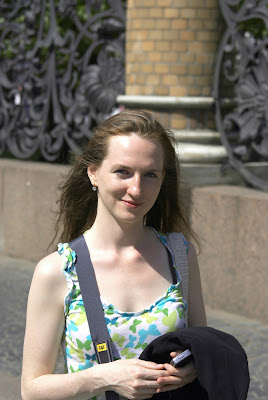 And that meant a few celebrations, though most are postponed until the weekend. So in the afternoon, Anna took me around the city centre again. We started at a charming exhibit in the Mikhailovsky garden. From then it was walking all over until we had some food on a nice pedestrian street on Vasilievsky Island.
Then we visited another cathedral before going home to meet Natalia, for a lovely pasta meal that she had picked up in Italy. And while cooking, we taught Anna some tango. She was pretty good, and pretty nervous about it. After that, we went for a drive to see the nightly sights. Unfortunately, the White Nights festival was not in swing yet, even though the night refused to get properly dark. At best, half the sky was dark blue, while the other half was still in twilight. As a result, the bridges weren't lit so nicely, and St. Isaacs was closed at night.
After that I went to the Alexander Nevsky lavra. The difference between Nevsky Prospekt and the monastery is uncanny. Once you step through the gate, the noise dies away and I felt more relaxed immediately.
In Orthodox Christian churches, there are no rows of benches and sunday morning mass like in Catholic or Protestant ones. Instead, (as far as I know) people come to the church when they feel the need to do so, and take part in the services going on. In this sense, the Holy Trinity Church at the lavra was more like a community centre. People were praying in alone, in pairs or in small groups. Pictures of saints, framed in gold, were on every wall and pillar. Some priests were on hand to assist, and one was chanting with a group of visitors. Outside in the garden there was a charming scene:

Sparrow drinking fromThe young monk at the gate told me that they had a found an almost ruined monastery a decade earlier after communism receded, but were making little improvements every day. While they have some way to go, I think they found the spirit at least.
a pitted fountain basin
Monk chants from the kiosk
Founded in 1703, 27th of May is the city's birthday.
And that meant a few celebrations, though most are postponed until the weekend. So in the afternoon, Anna took me around the city centre again. We started at a charming exhibit in the Mikhailovsky garden. From then it was walking all over until we had some food on a nice pedestrian street on Vasilievsky Island.Then we visited another cathedral before going home to meet Natalia, for a lovely pasta meal that she had picked up in Italy. And while cooking, we taught Anna some tango. She was pretty good, and pretty nervous about it. After that, we went for a drive to see the nightly sights. Unfortunately, the White Nights festival was not in swing yet, even though the night refused to get properly dark. At best, half the sky was dark blue, while the other half was still in twilight. As a result, the bridges weren't lit so nicely, and St. Isaacs was closed at night.
Tuesday, 26 May 2009
St. Petersburg II - Peterhof
While the weather in NL is apparently dysmal, St. Petersburg had a bright day of sunshine and intermittent light cloud cover. I even managed to get slightly sunburned. The forecast is bright and sunny for the rest of the week..
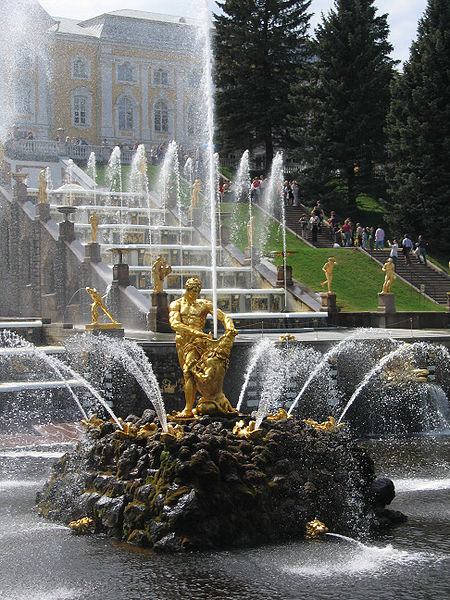 I started the day in Peterhof, the palace Peter the Great built as a stopover on the way to his naval base in Kronstadt. The gardens and cascades alone are phenomenal. I have rarely seen grandeur executed so nicely. The place is meticulously maintained by a small army of gardeners and builders, and while prices are proportionally high, the result is very impressive.
Then I took the bus back to the Avtovo metro station, a fine example of pompous communist architecture at its best/worst (depending on your taste).
There I called Natalia's friend Anna, who came over for tea with her husband last night. She had graciously offered to walk me around the city for a bit and I gratefully accepted. We started on Vasilievsky Island, visited the Peter and Paul fortress, walked by the mosque, across the river and into the Summer Garden and walked down the Fontanka to the white church near the Tekhnologichesky Institut.
In addition to being a gorgeous and charming company, Anna is also a tea-enthusiast. She brought a thermos with some lovely oolong tea and two clay cups for drinking, which we drank in various pretty locales. To get more traditional, we went into a blini restaurant on Nevsky. Fast food places have the same feel everywhere, but the little pancake with mushrooms and creams and the beet salad were pretty nice.
If all days were as pretty as this one, I would like to live in St. Petersburg. Even the natives managed to smile in the sunshine. But the fact remains that spring comes here a month and a half later than in NL, and winter comes a month and a half earlier.
 I started the day in Peterhof, the palace Peter the Great built as a stopover on the way to his naval base in Kronstadt. The gardens and cascades alone are phenomenal. I have rarely seen grandeur executed so nicely. The place is meticulously maintained by a small army of gardeners and builders, and while prices are proportionally high, the result is very impressive.
Then I took the bus back to the Avtovo metro station, a fine example of pompous communist architecture at its best/worst (depending on your taste).
There I called Natalia's friend Anna, who came over for tea with her husband last night. She had graciously offered to walk me around the city for a bit and I gratefully accepted. We started on Vasilievsky Island, visited the Peter and Paul fortress, walked by the mosque, across the river and into the Summer Garden and walked down the Fontanka to the white church near the Tekhnologichesky Institut.
In addition to being a gorgeous and charming company, Anna is also a tea-enthusiast. She brought a thermos with some lovely oolong tea and two clay cups for drinking, which we drank in various pretty locales. To get more traditional, we went into a blini restaurant on Nevsky. Fast food places have the same feel everywhere, but the little pancake with mushrooms and creams and the beet salad were pretty nice.
If all days were as pretty as this one, I would like to live in St. Petersburg. Even the natives managed to smile in the sunshine. But the fact remains that spring comes here a month and a half later than in NL, and winter comes a month and a half earlier.
Monday, 25 May 2009
St. Petersburg I
It was altogether more easy to get in than I expected. The customs officers were quick and efficient, and Serge was waiting for me at the airport. We dropped off my stuff, hung around and went into town together, while Natalia was out working (on sunday night!).
The next morning, Serge left for a conference in San Fransisco, Natalia went to work, and I ventured out into the city. I walked around the south bank of the Neva, to the Mariinsky Theatre, to New Holland (which doesn't look very Dutch at all and is now being redesigned by Norman Foster), to the Admiralty and the Bronze Horseman, past Palace Square and under the General Staff building.
 By then I was hungry and had an excellent meal at the Gourmet Club. I continued on to the art nouveau Singer House bookstore, and up the Griboyedova canal to the Church of the Savior on Spilled Blood, around the Mikhailovsky garden and back down to Nevsky Prospect.
I walked down that for a few blocks, also going into the serene gardens of the Anichkov Palace. Then I called it a day and to the metro back to elektrosila to meet up with Natalia.
Saturday, 23 May 2009
Stockholm III - Moderna Museet
It is a couple of days of pictures. Yesterday, I went to see Coraline in 3D with Mirte and we enjoyed it very much. While comparisons with The Nightmare Before Christmas are obvious, the whole feel of it, and especially the cryptically benign role of the cat, reminded me most of the computer game, American McGee's Alice.
I usually go to the local modern art museum when I am in a city, so in Stockholm it was the turn of the Moderna. I had tried it on Monday, but had forgotten that the museum is closed that day.
 Their permanent collection is pretty nice, at least for the 1900-1940 era. Take, for instance, a set of ladies shoes that end up looking like a fried chicken, and is titled my nurse. Which makes charmingly clear what associations Meret Oppenheim must have had with her nanny.
The only real downside was a boatload of post-1910 works by Marcel Duchamp, which I found pretty boring and most of which were copies signed by Duchamp in the 1960s - I suspect he needed some money at the time or got flattered into it.
The 1940-1970 collection was OK, but more of a hit-and-miss proposition. The contemporary collection was really mixed (in quality and in medium, such as the Ketchup Sandwhich). I still don't know what to make of this period in general. For the most part I preferred the Konstfack exhibition. They also had temporary exhibit with hundreds of photos of all kinds, including some really stricking scenes.
I also visited the adjacent Arkitekturmuseet. There is quite a lot of interesting architecture in Sweden, but I thought the descriptions were biased in two ways:
I usually go to the local modern art museum when I am in a city, so in Stockholm it was the turn of the Moderna. I had tried it on Monday, but had forgotten that the museum is closed that day.
Their permanent collection is pretty nice, at least for the 1900-1940 era. Take, for instance, a set of ladies shoes that end up looking like a fried chicken, and is titled my nurse. Which makes charmingly clear what associations Meret Oppenheim must have had with her nanny.The only real downside was a boatload of post-1910 works by Marcel Duchamp, which I found pretty boring and most of which were copies signed by Duchamp in the 1960s - I suspect he needed some money at the time or got flattered into it.
The 1940-1970 collection was OK, but more of a hit-and-miss proposition. The contemporary collection was really mixed (in quality and in medium, such as the Ketchup Sandwhich). I still don't know what to make of this period in general. For the most part I preferred the Konstfack exhibition. They also had temporary exhibit with hundreds of photos of all kinds, including some really stricking scenes.
I also visited the adjacent Arkitekturmuseet. There is quite a lot of interesting architecture in Sweden, but I thought the descriptions were biased in two ways:
- It was nationalist, in describing many foreign influences and repeatedly focussing at 'back to Swedish roots' movements. I feel that foreign influences (including, it seems, a lot of Dutch architecture), by virtue of having been adopted, became part of Swedish architecture.
- It absolved architecture of its failings, for instance by describing bad post-war housing as being very well designed but doomed by shoddy workmanship. If the post-war housing in the Netherlands is anything to go by, some of these designs probably did not go well with their surroundings and also made it rather easy to do a shoddy job in construction.
Friday, 22 May 2009
Stockholm II - Konstfack 2009
Mirte and I went to the degree exhibitions of the Stockholm school of art and design.
 There had been something of a local media storm around it because of the staged forced psychiatric admission of one of the students. She had been forcibly admitted 13 years earlier when experiencing a real psychosis and wanted to start a debate on how powerless people are made in such a situation.
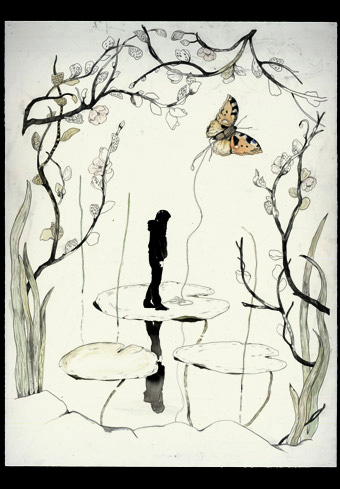
We didn't find that work (though Anna Odell was walking around), but we did see some pretty good stuff, especially from the master students:
There had been something of a local media storm around it because of the staged forced psychiatric admission of one of the students. She had been forcibly admitted 13 years earlier when experiencing a real psychosis and wanted to start a debate on how powerless people are made in such a situation.We didn't find that work (though Anna Odell was walking around), but we did see some pretty good stuff, especially from the master students:


Thursday, 21 May 2009
Göteborg
As I was in the neighbourhood anyway, I took the train to Göteborg to visit the dissertation of Julia Hansson at the department of physical resurce theory in Chalmers technical university. She did a thesis on bioenergy use and trade and did part of her work at my department in Utrecht.
The defence was a pretty informal event, staged in an ordinary lecture hall and without any gown and no bedel involved. A visiting opponent questioned her for about 45 minutes, then the evaluation comittee asked some questions and then the audience could have a go. All in all it took two hours. Then the comittee withdrew for discussion, and we all left the lecture hall for the department's coffee corner.
About a quarter of an hour later, Julia was awarded the title without much ceremony. A few bottles of cava were opened and everyone was very cheerful.
I left when everyone started to go back to work, but not until Julia's office mate Maria Grahn gave me her own Ph.D. thesis, entitled Cost-effective fuel and technology choices in the transportation sector in a future carbon constrained world. Which is a lot like the work I am doing. The book made interesting reading on the way back to Stockholm and will be of some use for my final study.
I also walked around the city for quite a bit and found it very much like it was when I first went there in 2001, for a climate symposium and the subsequent EU summit that ended in riots. The extent of the riots was vastly overstated in the international media at the time: I flew home on the day of the riots and all you could see was two banks and a McDonalds restaurant boarded up. The next morning the papers in NL proclaimed the 'centre of Göteborg on fire'.
Mostly I liked the parks and the more energetic feel than Stockholm.

Sunday, 17 May 2009
Eurovision in Stockholm
Now that my contract is finished, I decided I needed a little break. Tension builds over a four year contract, and at some point you need to deflate a little to get ready for the Summer sprint to the finish.
Roald and Mirte left for Sweden a couple of months ago,and I had promised to visit them. So I arrived in Stockholm just in time for the finale of the Eurovision song contest. I have never watched a complete Eurovision before, because I always got heavily bored at some point (usually quite early on). I hadn't even bothered to watch for years.
 So I watched the live broadcast with my hosts and a friend of theirs. I missed the semi-finals, so I was spared the humiliation of seeing the Dutch entry fail miserably for the fifth year running. In the event, we had good fun commenting on the artists after watching the first half of the act. For instance:
Roald and Mirte left for Sweden a couple of months ago,and I had promised to visit them. So I arrived in Stockholm just in time for the finale of the Eurovision song contest. I have never watched a complete Eurovision before, because I always got heavily bored at some point (usually quite early on). I hadn't even bothered to watch for years.
So I watched the live broadcast with my hosts and a friend of theirs. I missed the semi-finals, so I was spared the humiliation of seeing the Dutch entry fail miserably for the fifth year running. In the event, we had good fun commenting on the artists after watching the first half of the act. For instance:- The poor Lithuanian boy who went first and didn't leave enough impression for votes at the end.
- Portugal having by far the most cheerful entry, and Russia the most downcast one.
- Romania, Turkey, Ukraine, Moldova and Spain relying on scantily clad female charm rather than vocal talent.
- Albania going for the vote of the underage demograhic.
- Iceland, Sweden, France, Matla, UK and Russia going for a (mostly) solo woman act, with rather varying degrees of success.
- Greece going flat-out for the Gay vote. I think that the Greek entry will be the big summer hit in the gay club scene for 2009. Germany's entry would make a good runner-up.
- Lots of regional support votes. Spain was rescued from complete humiliation only by Andorra giving them 12 points.
- Bosnia and Herzegovina (though the camera team missed the phot-op shot)
- Estonia (cute and technically proficient)
- Germany (the only show act that was actually good)
- Iceland (good singer, we thought she would look cute with the guy from Norway)
- Norway (unbeatable puppy dog charm, we thought he would look even cuter with the girl from Iceland)
- Russia (good performance, and intriguing visuals. I will have to have Natalia translate the song to me)
Saturday, 16 May 2009
Unemployed (sort of)
My contract has expired. I suppose I did make the most of it by working until 00:30 last night. I sent out 2 articles for final comments and approval to my co-authors and did a lot of paperwork.
It is rather common for Ph.D. researchers to run of of contract before they run out of dissertation to write, so I do not feel unduly burdened. Still, I feel a little disappointed that I didn't get as far as I wanted to. I still have to collect some data on transport demand projections and on fuel consumption of trucks. And then I still have to do a lot of writing.
Regrettably, my bosses did not want to extend my funding. There was funding left in the project, but that got used on my colleague Roald, who started earlier and so ran out of contract before I did. I can live with this but it is rather miserly, because the department runs a serious budget surplus and the extra money just gets bled away by natural sciences faculty to cover insolvent departments (and there's a lot of those). Also, the university gets €80000 for a succesful Ph.D. and are apparently unwilling to share a few months' salary for me. On the upside I do get to keep my desk, access to facilities and master students to supervise..
In addition, my boss was enthousiastic enough to suggest two weeks ago that we would extend the scope of the last study I was doing with Machteld. While I agree that it would be scientifically more interesting, the timing of this suggestion was rather bad and it drove my into a bit of a panic. After I managed to get myself out of a flight-or-flight response, André and I diffused the crisis in customary Dutch fashion of exhanging views and agreeing to take it one step at a time and postpone the hard decision.
In any case, I have signed up for unemployment benefits. The process of requesting this was much nicer than last time as they put it all online. I still have to meet with a job-seeking coach, but they are pretty overbooked and couldn't fit me in before mid-June.
Time to get back to finding a job with the European Commission. Or anywhere else that is interesting.
Thursday, 30 April 2009
Black Queen's Day
I was out dancing in Leiden when we heard that Queen's Day 2009 was cancelled. There was a mixed response from the people attending: On one hand, there was sunshine and defiance that one awful act by one awful person should destroy everyone's party. On the other hand, the mood was not quite as bright as it might have been and many felt it a shared sense of tragedy. And then there were some people who just felt it wasn't their business.
It was not until I got home that I found out the extent of bloodbath:
On the day that is supposed to be a national holiday, an obviously deranged man drove at high speed through a crowd watching the royal bus. Bodies were thrown into the air and landed all over the intersection. 2 men and 2 women were killed on the scene. Several more men, women and children are in hospital, and one more died in the evening. The perpetrator indicated he was acting against the royal family and is reported to be dying in hospital.
Her Majesty gave a statement on TV. I have never seen in her so distraught in my life. I sincerely hope that the informal and open atmosphere of Queen's Day will be maintained despite this tragedy. It is one of the few ways in which the royal family directly connects to the rest of the Dutch population and a proper party for the whole country.
Wednesday, 22 April 2009
Earth Day 2009
April 22nd is Earth Day, which I am celebrating by working at home to edit three draft articles that should increase our knowledge on what we must do to save our planet (and the society living on it) from oil depletion, air pollution and climate change. Outside, the sun is shining and the plants are beautifully covered in bright shades of green and flowers (the latter are inflicting hayfever on me and half of my department).
I also got the news that my friend Natalia Dimitrova is standing for election to the Bulgarian National Assembly and the EU Parliament for the newly-formed Bulgarian Greens party. Unfortunately, the existing parties decided to increase the deposit for new parties from €7500 to €25000 two weeks ago, and so new Greens need donations to make up the difference (donations by foreigners are limited to €10000).
Also sustainable, if not exactly environmentally conscious, is the newly launched World Digital Library, a project operated by UNESCO and the US Library of Congress, and aimed at expanding the variety of significant cultural content on the web.
Saturday, 18 April 2009
Imagine: AFFF 25
This time of year, the weather improves and I once more descended into the depths of human imagination at the Amsterdam Fantastic Film Festival (they renamed it; it is now called Imagine:).
This festival used to be more about horror, as is clearly visible in the poster archive. Here are my three favourite posters from past editions:


However, the festival has branched out and is trying to advertise itself as such (hence the name change, and the new poster).
Regrettably, the program this year was stuffed with carnography (also referred to as 'torture porn'). Just about everyone I spoke to or overheard on this felt that it is not a very worthwhile genre, or at least that it is getting really old really fast.
But there were a few other films on every day, so I managed to get my traditional five-films-in-a-single-day fix with just a single fright moment (and that was a good one).
I also finished Ernest Hemingway's classic Civil War novel, For Whom the Bell Tolls on the train. The book takes almost forever to describe three days of feelings and impressions in a war zone, without romanticising war and violence, and I am very impressed with Hemingway's literary style.
This festival used to be more about horror, as is clearly visible in the poster archive. Here are my three favourite posters from past editions:
However, the festival has branched out and is trying to advertise itself as such
(hence the name change, and the new poster).Regrettably, the program this year was stuffed with carnography (also referred to as 'torture porn'). Just about everyone I spoke to or overheard on this felt that it is not a very worthwhile genre, or at least that it is getting really old really fast.
But there were a few other films on every day, so I managed to get my traditional five-films-in-a-single-day fix with just a single fright moment (and that was a good one).
- Sleep Dealer: Memo Cruz longs to get out of his small village in Mexico and become part of the global networked society. One horrible day causes Memo to travel to the border. He meets Luz and Rodolfo, who help him find his way, but they both have their own reasons for getting involved. - Sleep Dealer is a brilliant science fiction film set in a near-future dystopia that combines a great production with incisive observations on social relations and technology.
- Let the Right One In: Oskar is a 12-year old who is bullied at school. Then Eli moves in next door, and Oskar is interested. Never mind that she hardly wears clothes in the freezing cold, only comes out in the evenings, and that her guardian walks around with a kit for draining blood from people. And that Eli can only enter a place whem invited. - Let the Right One In is the early front runner for winning the Silver Scream Award and with good reason. This romantic horror film is very well written and executed. Lina Leandersson does a particularly good job playing Eli.
- 11 Minutes Ago: Pack drops 48 years out of the future to get some air samples, and ends up in a wedding reception (in the same place as where his lab is going to be). It was supposed to be a simple 11 minute trip, but then he meets bridesmaid Cynthia, who awakens something in him that had long faded. - Last year I saw two films dealing with time, and I liked both very much. This year, I loved 11 Minutes Ago just as much. Very intricately written, with lovely attention to detail.
- From Inside: Cee is very pregnant and on an endless train through an endless post-apocalyptic landscape. - From Inside was the only disappointment of this year. The film moves glacially slow and seem to have no point whatsoever. It is atmospheric like a poem that is drawn out too long (Howl comes to mind). The ending is especially superfluous.
- I Love Sarah Jane: Jimbo's parents are dead because of the zombie infection. So he goes over to Sarah Jane and her brothers' place. - This 14 minute short is exactly what I like in zombie films. And I get what Jimbo sees in Sarah Jane. Keep an eye out for Mia Wasikowska, who plays the titular character and will do the same in the upcoming Tim Burton version of Alice in Wonderland. Watch 'I Love Sarah Jane' on Youtube.
- Lake Mungo: Alice Palmer drowned on a family picknick. That alone is horrible, but it seems like Alice hasn't quite left the house yet. But something is wrong here, because ghosts aren't real. Or are they? - Lake Mungo is a faux documentary with a few nice twists. I normally do not care for the genre, but I thought this one was very well done.
I also finished Ernest Hemingway's classic Civil War novel, For Whom the Bell Tolls on the train. The book takes almost forever to describe three days of feelings and impressions in a war zone, without romanticising war and violence, and I am very impressed with Hemingway's literary style.
Friday, 10 April 2009
Lignite and power
The day is called White Thursday in Dutch, but it had a distinctly gray tint for me: Some 25 staff and students of STS went to North Rhine-Westphalia, where we visited the Garzweiler open-pit mine and the Niederaussem power station. Both are run by the German energy giant, RWE (which took over Dutch energy company Essent in januari 2009).
We took a nice 30-person bus from Utrecht CS to the Paffendorf Castle, where we had lunch in the courtyard and a short tour of the visitor centre. Entire towns in the Rhein-Erft area have been rebuilt elsewhere and torn down to make room for the mines. The ground water is drained to avoid the pits from filling up, and ground water tables are affected up to the Dutch border. A substantial part of the local landscape was reclaimed with light woods and agriculture after the exhausted mine pits were filled in.
Then we visited the Garzweiler mine itself. It is hard to describe a 5x5 km hole in the ground. I expected it to look very sad. Instead it seemed at once sterile and like a corpse set upon by the occasional maggot, actually a 13000 tonne, 100 metre high excavator machine.


The strangest thing is that you hardly notice these huge mine pits until you get very close, because they go down into the landscape. Likewise, the giant machines are dwarfed by the landscape. Nevertheless, they dig up 1.5 metric tonnes of lignite per second, most of which is shipped to one of the four local power stations.
The scale of the Niederaussem plant was also impressive. We got a tour of the new BoA part of the plant with the experimental lignite drier, state of the art control room, steam turbines driving a 1 GW electric generator, and a look into the boiler. Their new cooling tower, the largest in the world, had a mild but distinctly noticeable breeze blowing into the bottom. The view on top of the 170 metre boiler house offered a nice view of Köln and Dusseldorf.
The new 43% efficient addition notwithstanding, the entire power plant is one of the worst CO2 emitters in Europe, with older parts working at efficiencies as low as 31%. This plant and the others in the area together produce 11 GigaWatts of electricity, and the cooling towers cause a warmer and wetter microclimate in the immediate area. But it is profitable without any subsidies (unlike hard coal mining elsewhere in Germany)...
Interestingly, there are many windmills and even a solar power testing facility in the area, but none of them are owned by RWE (the windmills are owned by farming cooperatives).
After our visits, we had a satisfying dinner in the sunshine at a nearby village and rode home.
I discussed the whole setup with my colleagues on the bus. On one hand, the local area is totally used to this, Germany needs the power, and they do reclaim the ground when they are done. On the other hand, they use 30GW or so of lignite, mess up the groundwater and emit staggering amounts of CO2.
RWE is working on an experimental carbon capture and storage (CCS) facility at the Niederraussem plant, but it will only capture a little bit of their emissions and will be used for two years of testing only. My colleagues have calculated that equipping a powdered coal plant with CCS will require so much power that efficiency will be reduced by 8%. It is inconceivable that RWE will agree to bear the cost of this. So even if regulations are put into place to make capture-ready plants actually capture some CO2, we can look forward to 20 years of lawsuits and lobbying for financial support and partial implementation and other delaying tactics.
It was a very nice day (kudos to the Ric, Martin and Deger who organised it) but in the grand scheme of things, what I saw did not make me very happy.
Wednesday, 8 April 2009
Father of role-playing games dies
Last year, Gary Gygax died and I wrote a small piece. Now the father of role playing games in general, David Arneson, died as well. He co-wrote D&D with Gygax, but before that he started modern role playing games with his Blackmoor world and rule system.
Ironically, the genre has come full circle: after wargames led to RPGs, these led to story driven computer role paying games, which led to first person adventure/combat games on the computers. These last ones are now huge business (e.g. World of Warcraft). The computer games are not much like true role playing games and mostly feature solo or group combat against all sorts of fictional creatures. And then the fourth edition of D&D was released that resembles these computer games, largely turning this game back into a wargame from which it once evolved.
Ironically, the genre has come full circle: after wargames led to RPGs, these led to story driven computer role paying games, which led to first person adventure/combat games on the computers. These last ones are now huge business (e.g. World of Warcraft). The computer games are not much like true role playing games and mostly feature solo or group combat against all sorts of fictional creatures. And then the fourth edition of D&D was released that resembles these computer games, largely turning this game back into a wargame from which it once evolved.
Wednesday, 1 April 2009
The cutting edge of research
Yes, I still live there, and I completed the draft of my third paper last Saturday. However, I have done little work out of sickbay in the last two days. I wonder how I manage to have a dripping cold in the week that spring finally breaks through..
But on to two interesting studies I learned about in the last few days:
But on to two interesting studies I learned about in the last few days:
- Edward Glaeser et al. found that living in cities is actually greener than living in suburbs or rural areas. This is due to smaller housing and use of public transport.
I think I shall continue my low-carbon lifestyle (bike, train, compact fluorescent bulbs, district heating) a little longer.
- Karen Pine et al. found that women are much more likely to go on a shopping spree in the luteal phase of their menstrual cycle, some 10 to 0 days before their period is due.
I think it is fortunate that the latter study has been done by a woman.
- An interesting BBC reports from last year on a species of flying penguins.
- A 1957 Panorama item by Richard Dimbleby about the spaghetti harvest in southern Switzerland.
- A man stabbed and killed the mother of his children because she kicked him out of the bedroom to indulge her Grand Theft Auto audiction.
Sunday, 22 March 2009
Spring
This week was both de jure and de facto the start of spring. I enjoyed walking around in the sunshine and it seems to be having a brilliant effect on the mood of my friends and colleagues.
I am also trying to arrange for a visit to Stockholm, Göteborg and St. Petersburg at the end of May. It will be right after my current contract expires and I will need some time to breathe before I start the final run towards my dissertation.
I must say that arranging a visum for Russia is more convoluted than I have ever seen in my life: I have to write my friend there with my passport details, then she has to arrange an invitation with the foreign ministry, then I have to take that invitation to the Russian consulate and give them a few days to put the visa in my passport. The whole procedure is going to take over a month.
A lot of travellers do not notice this mess, because their travel agency arranges for the invitation. I've never seen such a conplicated system and it is almost like the Russian government doesn't want tourists, at least not the freewheeling backpacker sort. Even in Zimbabwe they wanted me to give an address where I would be staying, but didn't mind if it wasn't booked yet. For Russia, they hotel needs to be paid in advance (if you're staying at a hotel)..
I hope it will all go smoothly and also that most of the research work will be done by then, just leaving a lot of writing for the summer.
Monday, 16 March 2009
Frontline medical science
The BBC reports that
So that means I am getting more stupid already (my writing skills certainty could be better - ask my professors), but have less chance than the average Joe to die from my own body growing in places where it is not supposed to...
So that means I am getting more stupid already (my writing skills certainty could be better - ask my professors), but have less chance than the average Joe to die from my own body growing in places where it is not supposed to...
Wednesday, 4 March 2009
Another wedding
Not me, and not yet. Patrick and Femke have decided to tie the knot. He proposed to her on their trip to Australia a few months ago and they asked me as a witness on sunday. I feel it is great honour to be asked to for this role.
I am very much looking forward to their big day. The ceremony will be at castle Wijnenburg, at the end of april 2010.
I am very much looking forward to their big day. The ceremony will be at castle Wijnenburg, at the end of april 2010.
Thursday, 12 February 2009
Working with the MacBook
It is pretty and solid and easy to carry, no news there. But what else did I notice after working with my new machine for two weeks?
- It is both fast and very quiet. I had it convert a DVD that I first ripped to disk to an mp4 video. It completed the task in 2.5 hours (it took nearly a day on my iBook) and I had to hold my head close to the keyboard to hear anything more than the noise level of my own breathing. Quite a change from the disturbingly noisy Dell machine in my office.
- The trackpad is really sweet. It is not as accurate as a mouse but I do not need to bend my fingers in the same way that I would with a mouse. The only drawback is that the pinch gesture is too easily triggered and causes erratic zooming in NeoOffice.
- I set up Spaces together with a virtual machine so that I can run Windows in full screen mode without interfering with my other programs. It is like turning your head to another monitor, except that the screen is swapped. It also works pretty well with the larger screen I have in my office. So I moved all of my work PC onto my Mac, so I can now work when and where I choose to.
Sunday, 8 February 2009
From IKEA to tango
I finally got a replacement for the horrible pieces of furniture that housed my stereo and TV. It had been an eyesore forever, but I couldn't find a fitting replacement. Literally so, as the space was 110 cm wide and most such furniture is 120 cm wide.
On the web it looked like IKEA had one, but when I went to see it for real it turned out to be ugly and impractical. Despondent and on my way out, I stumbled upon a different item in the office furniture section. I went home, checked it, and went back to buy a set.
I couldn't arrange for a car, so I had to walk the stuff home. Then the elevator was broken, so I had to carry the packages up five flights of stairs. Then I walked back to IKEA and got my bike. In the mean time, I had almost sufficient exercise to exorcise my planning setback from the day before.
So I ate and cleaned myself up for a tango party. On of the four tango schools in Utrecht had a birthday and celebrated in Trianon. It was busy but not too crowded, and they had live music performed by the Alejandro Ziegler Cuarteto. I especially like the demonstration by Hugo & Marieke, who turned it into a true performance.
Saturday, 7 February 2009
Friday..
I am taking a course in science communication with three other Ph.D. students. On friday, we presented our work at the Anna van Rijncollege in Nieuwegein. It turned out to be a hit. I got two evaluation forms from the students that said "you're awesome"...
Coming back to the office caused a bit of a let-down, however, when Machteld informed me her new article plans, in which there is precious little space for an article which we were going to do together and for which I've already collected the data. Needless to say, this will take some discussion with her and André to hammer out. I would prefer not to have to come up with an entirely new article concept just three months before my contract expires..
In the evening I visited a concert by the vocal ensemble Multipe Voice. They sang songs by Bach and romantic composers in the Pieterskerk. I had asked for a ticket as a birthday present from my friend Josephine, who is a member of the choir. I personally do not care much for the religious subject matter of the songs (I think few of the audience did), but the performance was excellent! I do not see choir performances very often so I have little material for comparison, but those who do assured me Multiple Voice sing at a very high artistic level.
Sunday, 1 February 2009
International Film Festival Rotterdam 2009
I went to final day of the IFFR this year. Because I do not live in Rotterdam and have a busy job and life, it has become standard for me to go with a few people and see a load of films in a single day. This year I went with Casper and Marije and say the following films:
California Company Town, a documentary about little town in California that were founded by companies and (most of them) later abandoned. The shared quality seems to be that they used to be little utopias of 100% employment and peace, until worker relations soured or the company went bust. Some of the ghost towns would do nicely as the set for a post-apocalyptic film.
Unfortunately, the narrator/director offers atmosphere but no synthesis, and makes no case after 77 minutes of slow shots.
Helen (IMDB), is about two girls who are lost and look very much alike. Helen disappears, and Joey is hired to act in a reconstruction. Joey has lived in state care since she was a child and finds herself drawn to the vacuum of the family life that Helen left behind.
I really liked the very open ending here, and that the director blurs the line between reality and the Joey's fantasy. The premisse is very nice, and the directing is passable, but some of the actors in this film were really quite bad. I think this would be hit in an indie-Hollywood remake.
Perpetuum Mobile, is about a group of middle aged people in Latvia who are stuck in a life of boozing and gambling. Eventually, the midlife crisis comes to a head when Ron and Dina fall in love, and run away with the money in an attempt to start a new life.
This film was pretty nice, but like most midlife crises, it doesn't really lead anywhere. Fortunately, Dainius Gavenonis and especially Julija Goyd are actors capable of holding my attention for most of the film.
I Sell the Dead (IMDB), is a horror-buddy movie. Arthur (Dominic Monaghan) has been sentenced to the guillotine for murder and grave robbing. He recounts his life to a liberal priest (Ron Perlman) who comes to hear his adventures in stealing corpses and trying to keep them still.
This film was the highpoint of the day and all three of us enjoyed it tremendously. We stayed for Q&A with the director afterwards and had a laugh with that as well.
Sois Sage (IMDB), about a young girl who takes a job delivering bread in the French countryside for reasons that are slowly explained. It has something to do with piano lessons, and two pillows neatly stacked on a bed.
This film is agonisingly directed. It moves on its own pace, slowly peeling back the layers and revealing the puzzle, until the inevitable dramatic end. It was well made and decently acted, but somehow it didn't quite work for me. Maybe it was movie fatigue because I had spent some seven hours in a cinema already..
Friday, 30 January 2009
Kenniskracht
After eight years of research into the energy transition phenomenon, NWO and SenterNovem decided to have a conference and hear the lessons learned. This one was interesting because this studies in this program had natural scientists work with social scientists for interdisciplinary research.
So NWO got lots of people to the Beurs van Berlage in Amsterdam, to show off what they had done and learned, and I was one of them. I presented with Marko Hekkert and Roald Suurs, who are the other people in my project (unkindly titled Quantified Back Casting: Methodological design of transition strategies in the area of sustainable transportation chains - subproject 1 is mine).
The day was interesting, and I think most of the researchers (myself included) found that though they didn't do much research and publishing together with their counterparts (natural scientists vs. social scientists), they did learn a lot from each other and valued their input and cooperation. This is very much the case for Roald and myself.
Another thing that struck me was that the older generation can't seem to wrap their minds around a transition as a process in motion. The grey haired men (there were lots of those) overwhelmingly cling to picking winners, making a plan and then carrying out that plan as best you can. Even if making a detailed plan is pointless. I do not know if this is due to age or due to advances in understanding that the younger scientists seem to have picked up.
After drinks I raced back to Utrecht for a quick dinner on leftovers. In the evening, I did a tango workshop with Kristina before the regular Taboe salon. The workshop was nice, and I think I finally got the hang of that 'rainbow pirouette'. I think Kristina (who can also lead) got it as well, though we will both need a little more practice. Salon afterwards was fun, but I was pretty tired and Paras was playing music that was often a little too fast and too traditional for my tastes. I did get to dance a bit with our new colleague Geertje, and found that she dances as lovely as she looks.
Saturday, 24 January 2009
Rianne died
I had my birthday party last night, which was very good fun. Thanks everyone for coming, especially Veronica. I also got my new MacBook today. I want it to be able to work from home in Windows, so I needed an Intel Mac. My old iBook, which is still a very nice machine that I use with joy, will soon be looking for a new home.
However, my joy is overshadowed by the news that Rianne died two nights ago. She was one of the nicest people in my martial arts group, and was diagnosed with terminal pancreatic cancer about half a year ago. In a beautiful gesture from Ward, she got married last december, but the news had been unsteady ever since. The funeral will be on Tuesday..
Update: Rianne would have turned 22 years old on januari 27th, the day of a her funeral. It struck me that she was born 12 days after my father died. I can't tell if that means that she died very young, or if Rick died long ago. Probably both..
Tuesday, 20 January 2009
Utrecht: 300 000 inhabitants
And it turns out that nr. 300000 is the baby daughter of Gert and Sandra, both tango dancers. I have danced with Sandra on occasion, and she is quite good, though I am sure she has other things on her mind now.
Such as the giant birthday party the municipality is throwing in their daughter's honour. They're going for a world record, so it seems everyone in town is invited. A bit of a twist for the parents, who had planned on a few quiet weeks after the baby was born..
Congratulations to the proud parents and welcome to little Helena!
Sunday, 18 January 2009
Tangation diner dansant
Anne, whom I met in Uffelte some months ago, suggested we go for a dance last saturday. We chose to go to the 2nd birthday party of Tangation in village of Culemborg. They had arranged for a buffet, demonstrations and live singing at a restaurant at the local marina.
The food was nice, and the dancing was pleasant. It turned out I was one of the best dancers on the floor, mostly because the average skill of tango dancers in 'the province' is not quite what it is in a city like Utrecht, Amsterdam, Rotterdam or Nijmegen. On the other hand, the atmosphere was very gently and warm, even to strangers like Anne and myself. We quite enjoyed ourselves.
In addition to dancing with me for about two hours, Anne was kind enough to drop me off in Utrecht on her way home, so I could get back to bed and fight that cold that has been plagueing me for about a month now..
Saturday, 17 January 2009
The Gaza conflict
It has been three weeks now since the Israel Defense Forces started bombing and shelling the Gaza Strip. The latter is a 40km by 10 km strip of land on the mediterranean, now under seige from the region's mightiest military force.
The official rationale is provide security from Hamas rocket attacks into Israel. They do this by breaking Hamas' infrastructure and to stop them from getting new rockets and other weapons.
To take action against these is justified, because firing rockets into Israel is a war crime by international law. However, I strongly object to the form this action has taken.
By now, airstrikes have averaged about 50 per night, which adds to about 1000, not including strikes by day and artillery fire. Over 1000 casualties have been reported, including many women and children, and the survivors are desperately hungy and exhausted. At this point, I wonder what could possibly still be standing in Gaza and be called a military target. I strongly suspect some of these claims will be a stretch, and therefore these assaults fall somewhere between using disproportionate force and collective punishment, both of which are a crime under international law.
This is not a rare thing. For example, when the Americans bombed Serbia during the Kosovo conflict, they destroyed a water treatment plant inside Serbia proper and the major road and rail bridges in Novi Sad, on the north side of the country. These did nothing to influence the situation in Kosovo but greatly inconvenienced the people of Serbia.
In addition, Israeli soldiers and commanders have committed war crimes, by not aiding civilians caught in the crossfire and by firing at known UN compounds and hospitals. Claims that Hamas militants may have fired from very nearby are not a carte blanche to use heavy weapons. 500 pound bombs, however smart, are not a surgical strike weapons in one of the most densely populated areas in the world. Even if attacks made from civilian areas by Hamas are in itself a war crime. Reported use of phosphorus munitions by Israeli forces is also a war crime.
On a deeper level, the military response was flawed from the onset. Hamas is more than just a paramilitary. It is a religious movement that also provides social services to the people of Gaza. Due to the heavy pressure put on civil life in Gaza, there is no opportunity for competing social safety nets to emerge, and thus Hamas is integral to life there, much like Hezbollah is in large parts of Lebanon. Eradicating Hamas in all its forms, is therefore removing most of the remaining structures underpinning civilisation in Gaza, which is tantamount to ethnic cleansing.
Furthermore, the smuggling tunnels that go between Rafah and Egypt do not only move rockets, but also fuel, food and livestock. Israel wants them closed, but given that it has repeatedly blockaded shipments of food and fuel into Gaza (which also constitutes collective punishment), I cannot blame Palestinians for wanting a backup system; One does not want to depend for vital needs on a government at war with you.
So what is the solution? Quite essentially, the Palestinians need to have something better to do than shoot rockets and smuggle. That requires borders that are open to commerce and aid. That requires farmers are able to get to their land to work it. And it means a perspective of building a better life, rather than facing the prospect of being bombed back into the stone age. Only in such an environment, competition to Hamas can flourish, and both Israelis and Palestinians get on with their lives.
Reverend Dr. Martin Luther King once said, "A riot is at bottom the language of the unheard." Hamas seems to be their voice now.
When it comes to approaching the solution, I get the distinct feeling that there are people in Palestine and Israel who see an opportunity for wealth and power in the continuing tensions, and who are not working to end hostilities. Most others do not seem to have the moral courage to stop this rolling train and prefer to be accessories to war crimes. As a result, both Israelis and Palestinians close ranks behind unsavory leaders. It will be telling to see if the Israeli public will condemn the people currently in charge in the upcoming elections this summer.
I am reminded of another of quote of Dr. King: "Our scientific powers have outrun our spiritual powers; we have guided missiles and mis-guided men."
My only positive observation is that I have noticed that media coverage is slowly sharpening. BBC newsreaders and interviewers for instance, have repeatedly cut off both Israeli and Palestinian spokesmen who answered questions about the conduct of their forces by pointing to behaviour of the other side. I strongly applaud curbing the useless blustering of these spokesmen. Real answers to real questions help break the endless cycle of hiding behind the opposition to obfuscate their own misbehaviour. Maybe some sense will sink in.
In the mean time, I am disgusted with leaders on both sides. I reserve my sympathy for the few Israeli and many Palestinian citizens caught in the middle, and my admiration for competent media and aid organisations who continue their work in difficult circumstances.
Update: Israel declared a uniltateral cease-fire after 22 days. Hamas was still firing rockets today..
Update again: There are mutual cease-fires. Before going any further, Israel wants the weapon smuggling to cease and Hamas wants the border crossings opened for food and fuel. No surprises there, and no surprises that neither side is listening to what the others are saying.
Libyan leader Muammar Qaddafi weighed in on the debate. His view will probably be very unpopular, but his arguments are rather lucid. As I am not very enamoured of religious states as a matter of principle, I would be happy to see Israel change from a Jewish state to a state that is safe for Jews..
Sunday, 11 January 2009
Kempo exchange seminar
I went to a seminar about exchanging kempo techniques today. Our style is a mix of Southern Chinese Kung Fu and Indonesian Pencak Silat. It came to the Netherlands through Carl Faulhaber, who served in (what were then) the Dutch East-Indies. Now, several lines of Kempo teaching have emerged over the years, resulting in an interesting family tree. So one of our kempo teachers, Rolf, organised a sort-of family reunion.
The seminar was held in De Meern, which was impractical because the city government has inconveniently forgotten to place street name signs in much this new district. I wandered for half an hour (I may yet need an iPhone)..
We started with demonstrations from all of the participating six schools. The original teachings have obviously diverged over time, giving rise to hard and soft, external and internal styles, and everything in between. For the first time, I got an impression of what we take from Chinese martials arts (take control of the centre line) and from Indonesian (triangle system). It seems like there is much more Indonesian influence than I first thought, or that the underlying principles are the same in all martial arts.
We did workshops after that with teachers from four of the schools. I particularly enjoyed he workshops by Henrie Vogel (Kuntao Matjan), Eric Gouda (Chu'an Fa) and Philip Davies (Flying Dragon Institute). Davies was especially interesting, as his line seems to derive the kihon waza from the internal movements, rather than teaching kihon first and adding the dynamics later. He was also supremely friendly and funny.
I found myself very much attracted to the more internal styles. Not because it is soft in the way tango is soft - you still end up on the floor and in pain - but because it is very elegant and you do not need a lot of stamina and muscle power.
Monday, 5 January 2009
Article accepted
A great new-year's present in my work inbox: notification from the journal, Energy Conversion & Management that my first thesis article (the one I worked on for far too long) was accepted for publication.
One down, three to go :). Certainly an auspicious start of the new year.
Update: more good tidings as I got to work today: one current and one former colleague are pregnant and another accepted a marriage proposal.
Just to amp up the cuteness factor, news has it that two German lovebirds got caught trying to elope. They were five and six years old, and had decided on New Year's Eve to travel to Africa to get married (because it is warm there). A police spokesman said they would have to postpone their plans. They did get a free tour of the police station before they were picked up by their parents..
*lots* of tango
Femke had been using her charms and most honey-themed voice to get me as a dancing partner to the Tango Magia festival in Amsterdam. We took workshops from Mariano 'Chicho' Frumboli and Juana Sepulveda, and from Özhan Araz and Serkan Gökcesu. We worked on various possibilities to embrace and connect. We had good fun, though I was a bit disappointed in Chicho's qualities as a teacher.
Then on Tuesday it was time for the Taboe Winter Camp in Austerlitz. I went by bike, which was hard work with my backpack and all in the freezing cold. I went early to help prepare the main hall and we worked for hours to turn it from a sobre scouting venue into a beautiful dancing hall. Participants started to come in from 12 countries and the atmosphere started building. The day program with workshops and started on the 31st. I did two technique workshops with Iwan and Isabel, one with Eric and Leanne, tango on ice with Hans, video feedback with Anja, Bart and Anja, and my own little "tango-fu" workshop. Aside from just dancing, there was a senses game on new year's day that I did with Marjan, new-year's bar duty with Nitya, and the last night featured a shadow theatre performance and an improptu music band from the camp participants.
I had been toying with the idea of bringing in some concepts and games from my martial arts into tango for some time, and Paras and Paul let me do it at this camp. It was a hassle to get it organised because I had trouble finding someone to assist me. Just a few hours before show time, the lovely Anja from Köln volunteered and we got to work fleshing out my concepts. Anja does contact improvisation, which makes it frighteningly easy for her to pick up new dance techniques (Natalia, whom I met at last year's camp, did the same and found she could instantly lead tango as well a follow). We had great fun preparing the workshop, with some exercises for balance, posture and breathing. Only two people showed up to actually take part, but it was good fun nonetheless and all three said they had learned something.
I think the best things I brought in were walking meditation (which Iwan also did in the morning) and using pushing hands to explore how far you can lean and push without losing your own balance. I am of the opinion that both dancers should always be safely balanced on their own unless a move requires it, like in a volcada or colgada.
The overall atmosphere took two days to build, but it became like the warm fuzzy feeling you get from spring sunshine. I hope it will stay with me for another couple of days. The dancing was also good. I improved significantly over the last year, to a point where the beginners are very happy to dance with me and the (semi)professionals smile and give compliments. I also need less energy to dance, to a point where I can apparantly lead even at 3 AM when I am about to keel over from need of sleep..
Physically, the camp was pretty taxing. I don't think I walked this much since I did the Nijmegen 4-day marches. I got a cold, but then again over half the people did and I am not nearly as ill as last year. I suppose that among 130 people from 12 countries, there's always one with a virus your body isn't familiar with. But I think with some extra sleep (12 hours from Sunday to Monday alone), I will be ready for work in no time at all.
Thanks again to everyone who organised and danced with me: Anja, Bart, Dominique, Edwin, Eline, Eric, Frida, Hans, Ilona, Iwan, Isabel, Josephine, Leanne, Leoni, Nitya, Manon, Paras, Paul, Rik, Roberto, Tom and especially to Marjan and Anja.
Monday, 29 December 2008
Stalin's ghost
"Double, triple the guard in front of this tomb,Joseph Stalin was voted the third-greatest Russian of all time in a recent poll. Critics said the vote was rigged to prevent him from getting first place. This for a man whose regime killed over 10 million Russians in purges and famines and had history rewritten to cover up some of it..
Lest Stalin should ever get out."
- Yevgeny Yevtushenko
From what I read, Stalin's ghost now has free reign over the Kremlin. It is ruled de facto by a man formed by the KGB, in the legacy of Stalin's NKVD. In addition to bringing a large section of the industrial sector back under state control, the Kremlin is now looking to expand the definition of treason to include talking to some foreigners. I am reminded of certain passages in The GULag Archipelago..
I sincerely hope I will not land anyone in trouble when I go and visit a friend in St. Petersburg in May.
Xmas 2008
As of the week before Christmas, our office became more and more quiet. By Tuesday, there were less than a dozen people left. The pace slowed down a bit, but I got some things nice things done. News also came in the my supervisor, André Faaij, has finally been promoted to full professor.
On Wednesday, I went to Rotterdam for a very agreeable lunch with Lin at the Café Floor. Then I went to my mum's to do the pre-xmas shopping and relaxation. Casper came late after work. We spent a very quiet Christmas Eve. The day itself was mostly quiet: we ggot up late, talked, played some games, and I made fresh pasta with four sauces for dinner. We settled in with one of my bottle of St. Emillion Grand Cru after dinner. The only bad part is that my mum has a inflamed hip joint, which is a continuously unpleasant and tiring injury. But the forced slow-down did not affect her good spirit.
After a quiet start on Boxing Day, I went back to Utrecht to attend Manon's dinner party. It was a very enjoyable six-course dinner for 15 people that ran from half past five to after eleven. I also finally met Tom's girlfriend Naomi. They served alcohol with every course so we were all pretty drunk and cheerful by the end.
This left me to sleep late on Saturday before going to Köln for 24 hours to meet Veronica. I hadn't seen her in a while, and she met me with her friend Isolde. We had dinner at a surprisingly good and cheap Italian restaurant, and proceeded for cocktails and Kölsch. After a long sleep and breakfast, she took my to climb the Dom tower (which I haven't even done in Utrecht after 14 years of living here) before dropping me off at the train station.
I decided to skip tango for that evening because I had six days of that coming up anyway.
Sunday, 21 December 2008
A near-perfect Sunday
I spent the first hour or so watching a late film, V for Vendetta. It was actually quite good, particularly for a comic book adaptation (most of which are utter junk). Hugo Weaving, Natalie Portman and the rest of the mostly British cast did a fine job there. Then I slept for a long time...
In the morning I did some housework and got the Xmas dinner sorted with my mum and my brother - not so easy when you are a vegetarian and your mother isn't very fond of vegetables.
Then I cycled up to Zeist, where my friends Nanda and Milan have recently returned after cycling to India. In all honesty, they skipped Iran and Pakistan for security reasons, but they were hard-core enough to bike in the Himalayas. They had good tales to tell about Italy, Turkey and India and we also discussed recent events and various facets of culture shock. It was very nice to see them again.
After that, I went for a bit of tango and I got very lucky. Aside from my usual favourites like Josephine and Femke, I took on two absolute beginners (hey, I too started out like that) and danced with a young lady called Eline whom I hadn't danced with since the end of the outdoor season. To top it off I got four good songs with Sandra, who is both a beautiful woman and one of the best dancers in Utrecht. I am usually too shy to ask her to dance but she is extremely gracious about it. Another highlight (almost literally) was Rafaela, who had just accepted a marriage proposal. If her grin had been any bigger there would have been no room to dance..
The only downside is that I am now far too excited to go to sleep...
Friday, 12 December 2008
From the trenches: Energy Conversion Technologies
Actually, I had a group of 40 or so students, some of whom were a bit late, but all of whom were very well behaved. I was lecturing on "Synthetic fuels" at 9 A.M. on a Friday morning, and they even showed up!
I talked about some theory on chemical equilibria and kinetics, about biodiesel, about Fischer-Tropsch fuels and some context like system boundaries, uncertainty, sustainability. Complicating matters was that some of my students had a background (i.e. bachelor degree) in chemistry, while others had no clue.
So I was happily talking away about dirty syngas and catalyst fouling and one student asks me how that works exactly. Now I know that what happens is that the active site on a heterogeneous catalyst, where the reactants go and have their reaction, can get occupied and blocked off by other compounds (sulphur, chlorine, nitrogen species).
Unfortunately, the student who asked the question had also indicated he knew very little about chemistry. So I made an analogy in which the catalyst is a pub, with seats at the bar, and at the bar on these seats men and women meet and go away together. Now the fouling agent is like the ugly regular drunk, who comes in, holds the seats occupied, and thereby makes it impossible for men and women to meet there and form couples.
I have no idea how I came up with that on the fly, but it worked like a charm. Afterwards I gave them some trick questions with trivial math, and they seemed to like those (if only because doing math on a Friday afternoon is not the world's most popular activity). I like interacting with students, but I am pretty happy that I do not have to teach them thermodynamics..
Sunday, 7 December 2008
SPORE
Sinterklaas was this Friday. I had the usual stress in getting the presents together and making poems at the last minute. We exchanged the gifts at a late dinner with my mum and my brother and had a nice time. I received a massive Philips Energy Light from the Sint, in a bid to reduce my tendency go into hibernation mode in winter. There were sleeves for my brother's MacBook and my future one, several other useful and entertaining items, and also a boatload of chocolate. We spent most of the weekend together in good spirits.
Casper has recently acquired a copy of SPORE. This game was made by Maxis, who were also responsible for hits like SimCity and The Sims. The game is a creature simulator in every way: You start with a clump of cells and then grow it into a land animal. This develops into a tribal species, then a city-dwelling and finally a space-faring one. They call it Creatiolutionism...
SPORE is surprisingly cute and addictive. Even my mother found it charming. It is also likely to trigger any latent God-complex in the player.
Oddly enough, SPORE is actually a fairly straightforward MS Windows game, supported on Mac OS X though the Wine compatibility layer. This is also used in other games and seems to be the preferred way of porting applications to the Mac right now.
Casper has recently acquired a copy of SPORE. This game was made by Maxis, who were also responsible for hits like SimCity and The Sims. The game is a creature simulator in every way: You start with a clump of cells and then grow it into a land animal. This develops into a tribal species, then a city-dwelling and finally a space-faring one. They call it Creatiolutionism...
SPORE is surprisingly cute and addictive. Even my mother found it charming. It is also likely to trigger any latent God-complex in the player.
| I built a creature up to the end of its Tribal phase, and this is what it turned out like: |  |  |  |
Oddly enough, SPORE is actually a fairly straightforward MS Windows game, supported on Mac OS X though the Wine compatibility layer. This is also used in other games and seems to be the preferred way of porting applications to the Mac right now.
Sunday, 23 November 2008
Snow
We had the first snow of this winter today in NL. Utrecht looked very pretty. Oddly enough, the BBC reported this morning that it was also snowing in the south of Australia, even though it is early summer down under.
Hell also froze over today. A group of Isreali teenagers (originally sort-of-Jewish immigrants from Russia) were sentenced to jail for neo-Nazi attacks on homeless people, gays, drug users and religious Jews. There is some really mind-blowing cognitive dissonance going on in that part of the world..
Hell also froze over today. A group of Isreali teenagers (originally sort-of-Jewish immigrants from Russia) were sentenced to jail for neo-Nazi attacks on homeless people, gays, drug users and religious Jews. There is some really mind-blowing cognitive dissonance going on in that part of the world..
Saturday, 15 November 2008
Young@heart
I used to go to the cinema a lot (>1/week), particularly to the sneak preview on tuesday night. These days I don't go quite so often because I also need to sleep and spend time talking to friends.
So I went to see Young@Heart yesterday with Marije. It is a documentary about a choir of septua- and octogenerians from Massachusetts, who sing modern music with surprising gusto. For an indication of how that works out, you can find their versions of the BeeGees' Staying Alive and The Ramones' I Wanna Be Sedated on Youtube.
Addendum: If you need more warmth for your chilly bones, try this BBC report about a chimpansee helping to raise two tiger cubs (WARNING: contains images of an extremely cute and fuzzy nature).
Tuesday, 4 November 2008
Who Killed the Electric Car
I just saw Chris Paine's Who Killed the Electric Car. It is a well-made documentary that describes how electric cars got a promising start and then thrown in the oubliette.
I went in somewhat sceptical, but the film pretty much matches with what I have seen while working on a Ph.D. in the field of alternatives cars and fuels. I can recommend the film. Paine did omit two important things: (1) the battery packs for electric cars are still pretty expensive and (2) providing enough electricity to power a fleet of electric cars is going to take some serious work. At the moment he's making a new film, combatitively titled Revenge of the Electric Car.
On the upside, today are the US elections. This marks the end of 8 years of policies ranging from negligently shortsighted to actively malignant. While I would personally prefer Obama to McCain, I'm confident either will be better than George W., who some people already consider the worst US president ever.
Hopefully, this means the last of the buttresses keeping the old way of business at the oil and car companies alive will be stripped away. I don't need to see these companies out of business (GM's almost managed that by themselves anyway), but they need to be pushed into change.
Soon.
Now.
And I am so relieved that this presidential campaign season is finally over...
Monday, 3 November 2008
LHUMP => Morgen
Back in the late nineties, I was very active in the Dutch national student environmental platform, which goes by the Dutch acronym of LHUMP. It doesn't sound very good, and even back in 1998 we were considering a new name. Now, a decade later, it is finally happening:
On November 27th (the anniversary of its founding, if I recall correctly), LHUMP will become Morgen.
They will be celebrating this events by handing out the Green Soapbubble award for the corporation most engaged in greenwash. My nomination was Royal Dutch Shell plc, for their GTL campaign. Shell claims that GTL is innovative and environmentally friendly. Though it does reduce urban air pollution somewhat, the innovation is 50 years old and GTL produces more greenhouse gasses than petrol or diesel from crude oil..
Sunday, 2 November 2008
Lewis Hamilton wins Formula 1
The setting: If Felipe Massa would win in São Paolo, Lewis Hamilton needed at least 5th place to automatically win the championship. Prior to the race, Massa took pole position.
In the event, Massa kept his lead all the way through. Hamilton spent most of the race in 3rd or 4th position. With 6 laps to go, it started raining. With 5 laps to go, most of the leading drivers went in to switch from dry weather to rain tires. The only leading driver not to switch was Timo Glock, who then moved into 4th place, moving Hamilton back to 5th. Tension started to mount.
In the penultimate lap, Hamilton is overtaken in the rain by wet-track expert Sebastian Vettel, putting Hamilton in 6th place and putting Massa in the lead for the F1 drivers' championship.
Massa proceeds to win the race and with Hamilton unable to catch up with Vettel, the Brazilians break out into a party.
Then, in the very last corner of the race, Hamilton catches up with, and passes Glock, who was struggling on the wet track with his dry-weather tires. This leaves Hamilton back in 5th, and makes him the youngest driver ever to win the Formula 1 championship. Massa is understandably crushed..
It was a truly nailbiting finish. A lot of people did not initially pick up on Glock being passed. Even the presenters on the Belgian channel I was watching thought Hamilton in 6th place and handed the championship to Massa, until they were surprised when the official race rankings came into view and quickly watched a replay of the final seconds.
Friday, 24 October 2008
Survived yet another week
Life is a very busy pastime, and it goes up and down. Last thursday, some of my colleagues and I visited our secretary, Siham. She had her second child last month and it turned out to be a very attentive little girl, if prone to bouts of crying. It was also nice to see Siham and her son again, with both of them in good health and excellent spirits.
This in contrast to one of my other colleagues. Her mother is suffering from brain cancer (again) and she has become eerily withdrawn. She was never really easy to get to know and more than one colleague is afraid of her razorsharp sarcasm. But of late, I can hardly bring myself to talk to her at all. She didn't tell me that her mother was sick again. Aside from the likelyhood that I've done something to offend her, she seems to project a numb wall that I instinctively back away from. At the same time I can see her anguish and I would like to just give her a hug and tell her it will pass.
On the plus side, my own health is fine. I went for a checkup this week in the Fit4UU event. It seems I am in pretty good health overall, with good blood pressure and safe cholesterol. I weigh in at 69kg now, which is more than I have ever weighed before. At the same time I am still pretty trim at 8.7% body fat. So in addition to keeping my sanity safe, three years of martial arts have inadvertently netted me some 10% increase of my body mass in muscle. The only thing in bad shape are my knees, but I am adapting my stances to lower the impact.
I ended the week with visting the opening of an art exhibition by my friend Jehuda de Jong . It will be on display in Kunsthuis Verse Vis for another three weeks. She has made a few very nice artworks, and I recommend having a look at them (drop in anytime on saturdays from noon to five).
Now for a quiet weekend so that I may gather the focus I need to finish the current revision of my multi-agent simulation paper next week.
Update: The research paper is nearly done, and I received a very nice picture Jehuda made of one of her drawings that was in the gallery:

Thursday, 16 October 2008
New generation MacBook
This tuesday, Steve Jobs announced the new line of Apple laptops. Speculation on sites like appleinsider and macrumors ran rampant with possible features and price cuts. In the event, the new MacBooks are more expensive than the old ones.
 It is pretty :). The new machine looks like a cross between the old MacBook Pro and the MacBook Air, with the screen more like on the latest iMacs. Which is not a bad thing.
On the technology front, they now have a mercury-free LED backlit screen, a much better graphics processor, and a trackpad that does all sorts of gestures (like the iPhone). They removed the FireWire port, but I only used that twice anyway.
Apple also brags about their environmental performance, and they have made progress since they got chastised last year by Greenpeace for having too many toxic substances in their products.
I do think the new MacBooks are overpriced by at least €100, especially when considering that Apple preceded the introduction of the new models with a 'State of the Mac' in which they showed they were making a fortune off these things. But I predict they will sell like hotcakes regardless.
Price aside, I am pretty pleased with this laptop. I think the question is when I will buy it. My brother ordered one last night..
Update: Anandtech and AppleInsider have posted extensive reviews of the new Mac laptops.
It is pretty :). The new machine looks like a cross between the old MacBook Pro and the MacBook Air, with the screen more like on the latest iMacs. Which is not a bad thing.On the technology front, they now have a mercury-free LED backlit screen, a much better graphics processor, and a trackpad that does all sorts of gestures (like the iPhone). They removed the FireWire port, but I only used that twice anyway.
Apple also brags about their environmental performance, and they have made progress since they got chastised last year by Greenpeace for having too many toxic substances in their products.
I do think the new MacBooks are overpriced by at least €100, especially when considering that Apple preceded the introduction of the new models with a 'State of the Mac' in which they showed they were making a fortune off these things. But I predict they will sell like hotcakes regardless.
Price aside, I am pretty pleased with this laptop. I think the question is when I will buy it. My brother ordered one last night..
Update: Anandtech and AppleInsider have posted extensive reviews of the new Mac laptops.
Subscribe to:
Posts (Atom)