Muscat is on the North-Eastern end of the Arabian peninsula, where the Gulf of Oman widens out to the Arabian Sea. The climate is hot, at 35-40°C Celsius in early May and, by the coast, rather humid.
Muscat proper is a few square kilometers of royal palace and administration buildings with small residential quarters on the sides. The capital area is a combination of connected village-sized areas between dry hills like Muscat, Mattrah and Al Bustan, the town-sized commercial heart of Ruwi, and a vast low-lying area that stretches for miles between Shati al Qurum and Seeb. One obviously needs a car to get around.
The dominant architecture is that of large, walled, airconditioned footballer mansions in Arabic style, with matching Chelsea tractors parked in front. Omanis have large families (8 kids is not exceptional), and prefer lots of space. As a nation, they have only come into (oil) wealth in the last 40 years, and skills as gardening and living in dense cities are still rather foreign to them. Admittedly, the Omanis do like to go into the wilderness over the weekend on a recreational basis (much like Finns, really), so the large 4x4 cars may actually have a purpose.
We stayed with Markku at The Wave, the luxury garden settlement for expats just north of the airport. It is not walled, but it has only one entry road and few Omani wander in. Few Omani live there, because the 300 m2 villas are too small for them. The area is not finished yet, and construction continues day and night. We had oodles of space in the villa, and between the airconditioning and the pool were little bothered by the heat or the humidity.
Wednesday, 27 April 2011

Tuesday, 26 April 2011
The Honeymoon I - München
Our first foray into the unknown started with a train ride to Munich, which was thankfully uneventful though a bit slow in the early bits - Lower Austria seems to be a bit on the cheap side when making train tracks.
Munich was an interesting surprise. It started at the train station, where we noticed the Asia*hung* fast food restaurant. It was tastefully decorated in bamboo and cream leather, and the food was quick, fresh, tasty and affordable. Imagine my surprise at finding an actually good fast food place, and in München Hauptbahnhof no less..
We continued for a walk through the centre of town, starting dead straight from the station to the Rathaus where we happened upon a small group of black-clad men surrounded by riot police, surrounding in turn by punks and other alternatively styled people. The black-clad men were silently holding banners proclaiming that the German, Austrian and Swiss people should awaken to something exalted and such. We moved on quickly, but afterwards I wished that somebody would have organised a flash chorus to sing the 4th movement of Beethoven's 9th symphony, 'Ode to Joy'.
Taking a few twists through the quieter streets we happened on a statue that had been converted to a shrine to Michael Jackson. A few dedicated fans covered a statue of a 'tone poet' with pictures of the late king of pop. While I respect their devotion, in all honesty I thought that the result looked a bit pathetic.
Overall, Munich has a very different feel than Vienna. Much more businesslike and less gothic. Functional, but not necessarily a place I want to live.
With that, we returned to the station, took the train to the airport, met up with my new uncle Markku and boarded our comfortable Oman Air flight to Muscat.
Sunday, 24 April 2011
The Wedding
We got up at a reasonable hour and after all the preparations were done (bride's hair), we set out for Laxenburg around noon. We dealt with last-minute issues, but overall the venue was in good shape. Guest started to arrive early, but mostly had a quick peek inside and then waited outside and relaxed in the sunshine while the crew took care of details.
Around the scheduled time of 15:30, we invited people in for coffee, tea, cupcakes (crafted by Manon) and prosecco, and the party got underway properly. Everyone looked splendid and smiling.
At 16:30, the Finnish Reverend Marianna Saartio-Itkonen waited for us at a makeshift altar under a tree in the garden and bright blue heaven. It was her first marriage and she did the blessing with great charm; several people remarked she was the coolest clergyperson ever. A violin and song accompanied the ceremony, though the wind did its best to take away the sheet music. Our attempt to record the blessing and broadcast live on Skype unfortunately ran into technical difficulties.
Around 17:00, we moved inside for the speeches. Arto delivered a very moving speech the brought tears to much of the audience. After that we confessed our elopement to the crowd and gave the floor to Casper, who gave another eloquent and charming speech.
More mingling followed until at 18:00, we moved to the Green Room for dinner. Joshua and I had constructed a menu, and he delivered almost flawlessly; the food was probably the most praised part of the day. It took a bit longer than planned, but nobody seemed to mind much, as there was wine and good company. Terhi and I independently switched tables between courses, so that we could talk more to all the people whom we see too rarely.
Around 20:30, we moved back to the Oval Room where Sidestep had set up their gear. They had studied Volver, by Carlos Gardel, for our opening tango. Some people who were not familiar with the fact that Argentine tango is entirely improvised commented that we rehearsed it well. Others mentioned it was the first time they saw a couple enjoy an opening dance and make it look good. After that, the band played various kinds of music while the dessert buffet was served. It was not until the delicious desserts had subsided somewhat that the crowd to the floor in large numbers.
Terhi and I saw off most of the people and left around 23:30. Casper and Tuukka stayed to take care of the last details and slept at the IIASA guest rooms. I was tired, but I had seen nothing but happy, smiling faces for eight hours and I was very content. And I (now publicly) have a wife!
note: photos forthcoming
Saturday, 23 April 2011
The Pre-Wedding Party
 Terhi, Tuukka, Casper and myself spent much of Good Friday trouncing around Vienna for the official photographs. On the eve of the wedding, I had arranged for some space at the Österreicher in MAK café, so that we could welcome people to Vienna and also give them an early chance to mingle.
As luck would have it, the weather was fine and the everyone moved outdoors to the terrace. Prosecco flowed freely and some people stayed until closing time. The Finns were particularly pleased with the (comparatively low) prices of the wine. For Terhi and myself, there was a first opportunity to meet relatives and friends from the other side, which was interesting. The guests from Vienna were noticeably absent, but most of the people who flew or drove in made it (though some had considerable trouble finding the way).
We made information available on a need-to-know basis, and combined with the foreign surroundings, people seemed somewhat uncertain of what to expect. This also applied to our families who had been poking us with suggestions and questions for months, while we reacted mostly non-committal or by deflecting the question.
Our parents and siblings learned the biggest secret about the wedding on the night before at dinner: Terhi and I quietly eloped and got legally married on 30 December 2010, with only Katja and Saija as witnesses (and those two were not invited to that wedding until the evening before). Everyone was surprised and a little miffed, but Arto was despondent that he had not been present for his daughter's marriage.
Our reasons were several: first, it seemed pointless to involve the Austrian legal system in an already international marriage; second, it was cheaper this way; third, it meant we could fulfil the request for a church bit without cluttering our informally-intended wedding with ceremony; fourth, we wanted to get married ASAP anyway; and fifth, it would mean less hassle and stress for the wedding day. All things considered, I recommend it to any couple.
As host, I didn't get to speak to anyone for very long at the MAK café, but the atmosphere seemed to be building.
Tuesday, 5 April 2011
The doctor is coming
As this is the first season since I myself became a doctor, I can do a bit of advertising.
For warmup, watch these brilliant four-minute shorts that were made for Red Nose Day:
For warmup, watch these brilliant four-minute shorts that were made for Red Nose Day:
| Space | · | Time |
Sunday, 3 April 2011
Xi'an II - AME meeting and sightseeing
The AME meeting itself was a fairly pleasant affair as conferences go. The presentations came in two types: model presentations, where participants described what was noteworthy about their model configuration and results, and overview presentations, where topic leaders presented cross-comparisons of all the participating models on a given topic. All are supposed to lead to journal articles in a special issue.
This being the fourth meeting, and after everyone already submitted abstracts for an article, the presentations got pretty concrete. On the whole, the overview presentations were more interesting than the model presentations, but lots of insightful and interesting comments were made from all sides.
Outside the conference room, we had a Chinese banquet on Tuesday and Thursday, organised by our hosts of the Xi'an University of Science and Technology (XUST). On Wednesday, we had the opportunity to go off on our own for dinner and seven of us went to a famous dumpling restaurant near the Bell Tower in central Xi'an. Afterwards we did some souvenir shopping.
I missed most of Thursday's sessions because I wanted to go for a quick nap, and then slept like a rock for five hours. Unfortunately, that was the last good sleep I had before arriving home on Saturday. After that we joined XUST vice-presidents for another banquet.
I have to say that the Chinese are not very much into vegetarian food, but after a day or two one can sort-of get used to the food on offer. Still, noodles for breakfast is probably not for everyone and after a week, oily vegetables start to become really unpleasant.
Friday morning we left Xi'an proper to go to the Lintong district and see the Terracotta Warriors and Horses. These are a funeral goods for the First Qin Emperor, though much of it was ransacked after he died.

The army is found in three buried pits, and only pit 1 has been excavated significantly. Pit 2 and 3 have huge pompous buildings over them, and soldiers beautifully showcased, but there is little to see in the ground.
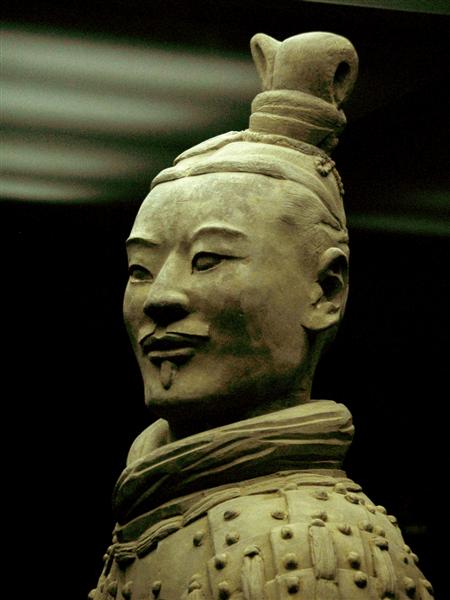 The excavation site has not been opened widely to protect most of the terracotta soldiers from oxidation and further decay. Only about 1080 warriors have been recovered so far and some 5000 remain buried. The actual mausoleum is in a mound 1.5 km away, but that has high concentrations of mercury and has therefore not been opened.
The army was not as impressive as I expected it to be, but that might be due to the way it is presented. However, when examined up close, individual soldiers (and each one looks different) are beautiful pieces of lifelike craftsmanship.
We stayed for two hours at the site, and then returned to the hotel, where we proceeded with a smaller group to have lunch. Chinese professor Chian Kejun, took on the role of most delightful host and walked us to a little restaurant where we had a bowl of noodles in broth for some 3.5 Yuan (about 40 €cent) each.
Afterwards we visited the city walls and the Great Mosque of Xi'an. The mosque was especially nice in that it was the first quiet place I had been to in a week.
The flight home that followed was not extremely eventful. We flew to Beijing together with organiser Susan Sweeney and Chiang Kejun, who promptly took us to the first class lounge and got us to our hotels in Beijing.
Our hotel was the Crowne Plaza and that had all the details done just right. I would have really liked to sleep late and have breakfast there, but we had to get up around 5:30 to catch our flight to Vienna. Again, an uneventful flight with little or no sleep and a meal going wrong. I watched True Grit , Tangled and Morning Glory, none of which was particularly good, though I may have simply been too tired to enjoy them properly. I slept for 15 hours after I arrived home, which was a new personal record..
This being the fourth meeting, and after everyone already submitted abstracts for an article, the presentations got pretty concrete. On the whole, the overview presentations were more interesting than the model presentations, but lots of insightful and interesting comments were made from all sides.
Outside the conference room, we had a Chinese banquet on Tuesday and Thursday, organised by our hosts of the Xi'an University of Science and Technology (XUST). On Wednesday, we had the opportunity to go off on our own for dinner and seven of us went to a famous dumpling restaurant near the Bell Tower in central Xi'an. Afterwards we did some souvenir shopping.
I missed most of Thursday's sessions because I wanted to go for a quick nap, and then slept like a rock for five hours. Unfortunately, that was the last good sleep I had before arriving home on Saturday. After that we joined XUST vice-presidents for another banquet.
I have to say that the Chinese are not very much into vegetarian food, but after a day or two one can sort-of get used to the food on offer. Still, noodles for breakfast is probably not for everyone and after a week, oily vegetables start to become really unpleasant.
Friday morning we left Xi'an proper to go to the Lintong district and see the Terracotta Warriors and Horses. These are a funeral goods for the First Qin Emperor, though much of it was ransacked after he died.
 The excavation site has not been opened widely to protect most of the terracotta soldiers from oxidation and further decay. Only about 1080 warriors have been recovered so far and some 5000 remain buried. The actual mausoleum is in a mound 1.5 km away, but that has high concentrations of mercury and has therefore not been opened.
The army was not as impressive as I expected it to be, but that might be due to the way it is presented. However, when examined up close, individual soldiers (and each one looks different) are beautiful pieces of lifelike craftsmanship.
We stayed for two hours at the site, and then returned to the hotel, where we proceeded with a smaller group to have lunch. Chinese professor Chian Kejun, took on the role of most delightful host and walked us to a little restaurant where we had a bowl of noodles in broth for some 3.5 Yuan (about 40 €cent) each.
Afterwards we visited the city walls and the Great Mosque of Xi'an. The mosque was especially nice in that it was the first quiet place I had been to in a week.
 |  |
Our hotel was the Crowne Plaza and that had all the details done just right. I would have really liked to sleep late and have breakfast there, but we had to get up around 5:30 to catch our flight to Vienna. Again, an uneventful flight with little or no sleep and a meal going wrong. I watched True Grit , Tangled and Morning Glory, none of which was particularly good, though I may have simply been too tired to enjoy them properly. I slept for 15 hours after I arrived home, which was a new personal record..
Friday, 1 April 2011
Nuclear power
In the aftermath of Tohoku earthquake and the resulting tsunami, some 12000 people were killed, hundreds of thousands of people displaced and the seaside left a ravaged wasteland. Rolling blackouts still affect Tokyo and the north-east, and many industrial plants have come to a halt either due to lack of power or being unable to ship raw materials in and products out.
Yet, media focus is almost exclusively on the Fukushima nuclear plant. There is barely any radiation outside 1 km of the plant and, except for the 50 or so engineers who remained on-site, nobody has had more radiation exposure than would result from an x-ray. Radiation levels are less than 1/1000th of those in Chernobyl. Nevertheless, some countries advised their nationals to flee, and my Japanese colleagues are tired of having to explain the foreign friends that what is actually going on is rather little.
Of course, TEPCO plant managers have made mistakes, for instance by not flooding the reactor buildings before the batteries of the cooling system ran out. Presumably they thought they could contain the situation and save the plant. Instead, they got up to their arms in mess and had to flood the plant anyway with sea water.
There is a backlash building against nuclear power, and I see why. Bottom line is that core breaches, accidents that are supposed to happen once in a million years, have now occurred three times in forty years. While this may be bad luck, it suggests our risk analysis is obviously flawed: it only takes into account the risks we know. And there seems to be an endless supply of things we did not think of.
Still, nuclear power has claimed relatively few lives over the years, when compared to deaths in coal mining and from air pollution. I am not saying it is good, but it might even be the lesser of evils. In that sense I have always differed in opinion from most my friends in the environmental sciences movement - I am not necessarily anti-nuclear.
The benefit is nuclear plants are simple: low volumes of fuel that do not produce a lot of CO2. The problems with nuclear are well known: risk of accidents and contamination, waste, limited supply of fissile material, and weapons proliferation. Annoyingly, tradeoffs are involved between waste and resources on the one hand, and proliferation on the other. Most current light water reactors generate lots of fissile waste and are not very efficient (this is linked) but do not pose a significant weapons risk. Breeder reactors can use up much more fissile material, leaving much less waste, but yield a lot of bomb material if stopped halfway.
I am not very worried about proliferation. We had five official nuclear powers during the cold war (UN security council permanent members, Israel was the unofficial sixth power). Since then, seven more countries got them, though four gave them up (Belarus, Kazakstan, Ukraine, South Africa) and three are now considered nuclear powers (India, Pakistan, North Korea). Several others have the know-how to make a bomb on the shelf (Netherlands is among those, it even has a uranium enrichment plant).
And all this proliferation hasn't made nuclear war any more likely.
I believe in the doctrine of Mutual Assured Destruction: anyone stupid enough to throw a nuclear bomb is going to find him/herself on the receiving end of a retaliatory strike, making it just not worth it (the acronym, MAD, is an apt one). Even petty dictators (perhaps particularly petty dictators) are concerned with their own survival. For all I care, every government in the world can have ten bombs.
I worry a bit about the nutcase revolutionary who wants one single bomb, but one nutcase cannot get the infrastructure together to refine fissile material (unless you are a Bond villain). And because forensic techniques can trace the source of a bomb's fissile material, no petty dictator would be mad enough to give one to terrorists.
I am worried about nuclear waste. The documentary Into Eternity, about the Finnish Onkalo permanent waste storage site neatly presents the problems inherent in keeping people out for all eternity.
I also worry about accidents, but not as much as some. Nuclear plants should be built with every redundant passive safety mechanism we can think of, because just one Chernobyl accident was too many. On the other hand, Chernobyl was caused by people disregarding the safety manual, and TEPCO didn't follow theirs either. Human error and not following instructions is the major risk in nuclear power. And the damage caused by coal mining, oil spills, deforestation and acid rain covers much larger areas and more people than Chernobyl ever did (even if the total amount of energy involved is also lots higher).
As such, I think that if we are going to do nuclear power, it should be done with breeder reactors, with strict controls on fuel cycle timing. I trust my government with so much, I will trust them with nuclear material as well. That is not to say we should build nuclear plants nilly-willy, by careless and dodgy contractors in the Congo or other places run by corrupt fools. But we don't do that anyway.
Summa summarum, nuclear is still a bad way of producing power, like coal, like unconventional oil (AKA steam-cleaning tar from sand and hydrocracking it) and like shale gas. But it may well be preferable to runaway climate change.
At the AME meeting, there was some extra attention to nuclear, mostly because a few models show a large share of nuclear and it is interesting to see what else could fill the gap. There was a also a presentation segment on how energy services are affected by the quake and tsunami in Japan.
I cannot follow everything at Fukushima because at night here, the Great Firewall of China blocks most of the BBC World website except the front page. The articles are accessible by day, so I presume the Chinese government are vetting the articles individually. Regardless, I hope that with the reactors cooling down entirely, the frenzy dies down a bit. At least in China, the media seem to have moved on already to obsessively covering Libya already.
Meanwhile, I hope that someone will keep cleaning up and rebuilding the lives survivors of the Tohoku tsunami, even if most of the world moves on to newer media frenzies.
Subscribe to:
Posts (Atom)