Of course, the politicians say this makes more space for private donations. This is a long tradition and as far back as the Roman Empire, Maecenas' name became a byword for it. In the Netherlands we had great works of art made in the Golden Age that command millions to this day.
However, it has always struck me that more than a few of these hallowed art works are portraits made to please wealthy patrons and blatant erotic nudity in the guise of mythological scenes. I am not doubting their technical quality, and I also know lots of art works that are remarkable in subject as well as execution. But much of it is the 17th century equivalent of Playboy and Hollywood blockbusters. And if we extrapolate that, I do not want my musea to start resembling Fox News.
I would agree that some art for the sake art or shock is just way out to lunch. I doubt that the the shock crowd would be the worst hit by a drop in funding, but some rationalisation might be good. On the other hand, the cultural sector has seen its funding cut continuously over the last decade, so there isn't likely to be much stale or spoiled fat to cut.
I would much rather see some millions of banking bonuses or top level public sector salaries redirected into stemming the flow of cash from our national accounts than money from culture or education.
The idea that we need to partake in a wide variety of cultural pursuits goes back to the idea of the renaissance man. In this respect, the latest proposals on of upper-tier secondary education in the Netherlands are quite insidious. The cabinet is proposing to focus the curriculum on math, natural sciences and English, and remove two or the four profiles that students can choose.
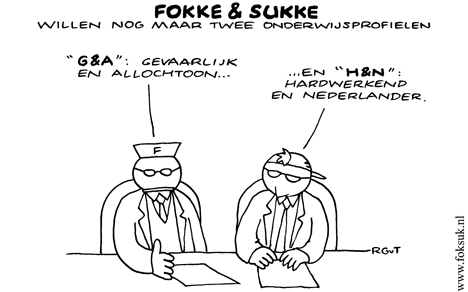
They are effectively proposing to excise culture and original thought from the curriculum. I can't help feeling that the impulse behind it is one of narrow economic utilitarianism, to train able knowledge workers in math, engineering, medical biology and business lingua franca.
It might, at bottom, be a genuine attempt to equip young people with skills they need to survive in a ruthless competitive workplace albeit at the expense of 'luxury skills'. But it might also be a cynical push for a workforce that is smart enough to do knowledge work, but so smart as to look for a way out of the rat race.
Oddly enough, so many members of parliament traditionally have backgrounds as historians, teachers and other professions that require human interaction. Their whole job revolves around it (who ever saw politicians produce anything more than words?). They must have a very dim view of themselves to agree to system where children can no longer train into their own fields..

1 comment:
I was more than usually cynical in this post. I wonder what drove me to it..
Post a Comment