Spring arrived in Vienna this week. Slightly ahead of the Tichy ice salon, which reopens this year on the 16th of March, and very much welcome.
I took the occasion to restart the bike season in earnest. Biking to work on four days, 13km in both directions, I clocked up a good 100km this week. Together with some yoga this means I am getting in some shape again after a winter of sitting down.
The combination of sunshine, exercise and having Terhi over for more than two weeks did wonders for my mood, and not a day too soon.
Saturday, 10 March 2012

Saturday, 18 February 2012
Nederlandse Volkspartij tegen Enge Buren
 Around the time when I was born, some 36 years in 1976, Kees van Kooten and Wim de Bie were active in a satirical 'movement' called the Simplisties Verbond. One of the many sketches featured an interview with the chairman of a new fictional party, 'Dutch People's Party against Scary Neighbours' (YouTube link).
Now flash forward to 2012 and Geert Wilders and his daft hotline for reporting Eastern Europeans who are taking our jobs. The similarities with the fictional party are uncanny, so I want to launch an experiment in memetic engineering (or viral anti-marketing, or whatever you want to call it):
From now on, please refer to the PVV exclusively as 'Nederlandse Volkspartij tegen de Enge Buren'. Refer people to the interview if they do not get the joke. Stimulate others to do the same. Post the link on your Facebook wall.
P.S. I wish I knew of similar material in Austria, because I think it racism goes even deeper here.
Tuesday, 14 February 2012
Happy St. Valentine's Day
I don't particularly like the hubbub around Valentine's Day, probably because the only people who seem to benefit are retailers of cards, candy and chocolate. It is not helped by the fact that the whole tradition seems to go back to a misinterpreted Chaucer poem.
However, this year I got a lovely present from my beautiful and sweet wife Terhi, which I am happy to share with everyone else:
However, this year I got a lovely present from my beautiful and sweet wife Terhi, which I am happy to share with everyone else:
Sunday, 15 January 2012
Rick, in liefde
The title of this post is the epitaph on the stone under which my father's ashes rest (and the ashes of Liesje and Boris). He died on the 15th of January 1987, a quarter century ago today.
I remember some flashes of the day he died, mostly of the morning. Renée told us early on and I recall I cried a little. Out of reflex, as nobody could fully grasp the implications of a loved one's death at seven in the morning. I didn't go to school, I went ice-skating by myself (against the wishes of my aunt). The house quickly filled up with crying people. It must have been like that for days, but it is mostly a blur to me.
I did not attend the cremation, as I was too broken to face bringing my beloved father away. The cremation was two days before my 11th birthday, and I had a hard enough time with life as it was. Everyone tried hard to support me after Rick died, but I was not easy to reach, and would not be for over a decade.
We buried Rick's ashes later in a corner in the cemetery in Papendrecht. Years later, we buried the urns of Liesje, our (and especially his) beloved cat, and Boris, her son, with him. We miss all three of them still. I never visited much, even when I still lived in Papendrecht. Mostly I go when I am in emotional turmoil, as part of a long walk by the river.
Last time I went was on Christmas day, 2011. I went for the first time in forever with others. My brother and Terhi. The timing was in part because the Finns have a tradition to light a candle at the grave of a deceased loved one on Christmas Eve. I wanted her to see it, see him, but it was strange. All I could say was "Dad, this is my wife.", in English because it was anyway more for Terhi's benefit. And we stood there for a while, silently, holding back tears.
25 years on, it is still sometimes too big for words.
Monday, 2 January 2012
Winter break 2011/12
Terhi and I spent Christmas 2011 in the Netherlands with Casper and Renée. It was the first time that Terhi spent a Christmas outside Finland, and we attempted to not overburden her (or any of us) with ritual. Frankly, we all needed the rest.
As usual for an expat, most of the week was spent meeting friends who I don't get to see nearly enough. Annemarie came over for Christmas dinner, and we visited Patrick, Femke, Marije, Susan, Tobias, Kate and Onno. Of course, this was only a fraction of the people I would want to hang out with, but then my work doesn't even allow me to spend time in Finland with my wife.
Even though I can't get to see my friends nearly as often as I want to, it seems I successfully kept abreast of what went on in NL; I watched the New Years' Eve show by Youp van 't Hek on Monday and I there wasn't a topic that I didn't understand. I also thought he did a great job (as usual) pointing out where the Dutch have been practically and morally deficient over 2011.
On New Years' Eve itself, Terhi and I were dancing at Tango Taboe IX. We only went for four days because I had so many people to see, but that made sure we were not exhausted at the end. We also had the first anniversary of our legal marriage on December 30th, for which I borrowed a car (with seat warmers) from one of our fellow dancers and took my wife to dinner at Groenland. The camp was a great succes (as usual) and I really enjoyed the dancing and the people.
Sunday, 18 December 2011
Ambivalent..
I am thoroughly ambivalent about Vienna. On the one hand there are the public transport, the pretty buildings, the nice cakes and the usually helpful people. On the other hand there are a lot of unsafe and stress-inducing places for cyclists, restaurants typically serve unpleasantly heavy food, tourists getting ripped off at every corner and an endless parade of retro-kitsch.
Vienna has been honoured as the city with the best quality of life in the world, and as an expat I am the target audience for such surveys. Maybe I have unusual priorities..
The Christkindlmarkt summarises it neatly. The ones at the Rathaus and Belverdere are noisy, gaudy, kitsch-filled monstrosities frequented by tourists and young people getting drunk.
Today I needed a break from my all-weekend R coding sessions, and I felt like chestnuts. So I wandered to the Karlsplatz market, and it was an altogether more pleasant experience: No mass-produced junk, some places with organic and even vegetarian food, musicians playing, and families having fun. I got half a cup of schilchergluhwein and my chestnuts, and felt much relaxed as I wandered about the place.
I hope I can find more upsides.
Update: I went to TangoLounge in the Galeria Ideal (15th district) and found the vibe surprisingly pleasant. I went to the place twice before on Sunday nights with Terhi and got a headache in both cases, but the crowd and music were different and I quite enjoyed myself this time.
Friday, 25 November 2011
The climate circus - Durban Edition
 It is almost time for this year's edition of the annual climate policy circus. It is commonly known as COP17, as the full title is already more UN speak than most people can handle in a paragraph.
Past editions have gone somewhat as follows:
- Various NGOs, particularly environmental ones, raise expectations starting some two months beforehand.
- After the official opening and welcome, scientists from the IPCC present findings that humanity is causing climate change and that this is bad. A range of scenarios is offered from high emissions to low and with correspondingly high impacts to lower.
- Politicians listen politely, make understanding noises, then bicker. Intense lobbying from interest groups of all colours goes on behind the scenes.
- A week or two later, an 11th hour compromise is reached after two days and nights of unscheduled and acrymonious negotiating. The compromise has many lofty phrases and does not mention the aspects that were left out (some perenially, like non-compliance penalties).
Me, cynical? Never. But did you know that Finland is rising by 30cm - 90cm per century due to isostatic rebound after the last ice age. Just enough to keep pace with the sea level rise projected in these high emissions scenarios..
Update: The BBC is reporting that pretty much all major economies except the EU are trying to scuttle a global climate deal. End of the road, then?
Thursday, 24 November 2011
Kraków project meeting
 My group at IIASA has been involved in the EnerGEO project for two years now, and now that Volker is really busy with IPCC stuff, that has landed on my plate. So off I went with Janusz Cofala and Sabine Fuss to the charming old city of Kraków for a project meeting.
EnerGEO claims to use remote sensing (satellite) data to monitor the environmental impact of energy. It involves air pollution and health effects from air pollution, as well as potentials for solar, wind and biomass and effect of land use change. On the whole it is a very interesting project that suffered from somewhat shaky coordination. This fortunately seems to be improving now. The data seems to be coming together now that we are two years in, and with some luck the integration between work packages will come alive.
It was also fun to see a former colleague from my undergraduate years as the brand new project manager and a student from one of the STS programs I taught in as a junior researcher. Small world..
 We are hosted by the Akademia Górniczo-Hutnicza, a former school of mining and now Poland's second biggest technical university. It has some impressive interbellum statues representing miners and metal workers on the outside of the main building, which itself is suitably pompous and solid the outside and spacious in the inside.
Kraków itself still has a beautiful old city though it smells faintly of coal in the calm winter weather. Though use of lignite in the area has decreased a lot since the dirty communist years, there are apparently still a few places the rely on coal for heating.
Also beautiful and charming are the local tangueras; I was originally going to go a milonga on Tuesday in Masada Cafe, but we arrived late due to de-icing of our little turboprop plane in Vienna. So I left dinner early on Wednesday and went for a dance in Piwnica pod Baranami, a basement café with a small stone floor and a stage in a side room/cavern. The music was bravely neo and non-tango and quite a bit of Polish music, and the energy was great. I hope that organiser will send me some pictures.
I have anyway always had a soft spot for Polish women, and dancing with them (and not just the pretty younger ones) only affirmed that. Due to circumstances at the times, I never followed up any budding romances with Polish girls. I wonder what that would have been like, even if I am very happy that I eventually met and married Terhi.
Kraków was lovely the last time I visited (half a year before I started this blog) and it was lovely again, even though we had no time for sightseeing. I think I like the overall vibe.
Friday, 18 November 2011
Playing tourist
It was really foggy this week, so much that I could sometimes barely see the Reumannplatz. How different from last Sunday, when Terhi, Renée and myself went for a walk from Mödling to Thallern.
The weather was largely clear, with only a haze on the horizon. It was perfect for a walk, and the vineyards were very quaint and picturesque.

The Thallern restaurant was unfortunately booked up and ran out of roasted Saint Martin's goose, but we got a later reservation and did some more more walking around. The food was still OK and the wine was still great but the corduroy shorts and lederhosen on the male staff are just pathetically quaint.
We ended up arriving at the station in between trains, and Terhi and I did a little tango to keep warm. Renée captured it and we may put it on youtube one day..
 The day before, I had taken Terhi and Renée to a performance of Mozart's Requiem in the Karlskirche. And it was not what I expected. It turned out that the concert was one of those events for tourists. In this case, we didn't have musicians in period dress, but we did have the horrible acoustics of the Karlskirche (a piece of Imperial prancing if there ever was one).
I never realised how awful the tourists get treated here, and I wonder how it reflects on the city as a destination. I would be horrible underwhelmed at least, and it somehow reminds me of the first time I was here many years ago.
Afterwards we went out to the newly opened Christmas market at the Rathaus but that was also a bit of a disappointment, with too many kids on their way to being drunk and way too much kitsch.
The weekend was fine and fun, but I get the feeling that tourism in Austria is not what it could be.
Tuesday, 11 October 2011
New mobile phone
The iPhone 4S was released this week, and the feature set is amazing. However, at €600 for a used iPhone 4 on ebay or some €800 or more for a new iPhone 4S, the price is also amazing - or maybe ridiculous.
So when I got a new smartphone this week, I didn't get an Apple phone. No disrespect intended to the late and great Steve Jobs, but I want a smartphone that can do at least five things:

So instead, I went on ebay and got a ZTE Blade for €138, plus €25 for a larger SDHC card. It has a decent screen, I could upgrade it to the latest Android with CyanogenMod 7.1.0, and I can sync all my music via doubleTwist.
Synchronising 16GB takes a while, though: some four hours to copy everything from my Mac to the SDHC card and then another hour for the phone's media manager to go through everything..
So when I got a new smartphone this week, I didn't get an Apple phone. No disrespect intended to the late and great Steve Jobs, but I want a smartphone that can do at least five things:
- Make phone calls
- Send/receive SMS
- Play music, now that my iPod Classic died of hard drive failure
- Get maps when I am in unfamiliar territory
- Check email on the road
So instead, I went on ebay and got a ZTE Blade for €138, plus €25 for a larger SDHC card. It has a decent screen, I could upgrade it to the latest Android with CyanogenMod 7.1.0, and I can sync all my music via doubleTwist.
Synchronising 16GB takes a while, though: some four hours to copy everything from my Mac to the SDHC card and then another hour for the phone's media manager to go through everything..
Saturday, 24 September 2011
Against the IPCC 5th assessment report
 The IPCC is working in full swing on the fifth edition of the climate change assessment report. I think it may be a bad idea to have one.
And that is not (just) because I just spent lots of time on an assessment report that most of our team would now quite happy to put on the midwinter bonfire. And it is despite having spoken briefly with the chairs of working group II and III, who are nice and clever people.
I think AR5 is bad because I think it is counterproductive. IPCC assessment reports have said roughly the same thing since the first one came out between 1990 and 1992. Since then, countless man-hours of really clever people have gone into figuring out what is going on, and despite all the looking under all the stones, the same story stands.
My former colleague Arjan Wardekker did some research that seems to support my position. In one of his studies, he asserts that problems with no conflict on values but disagreement on facts can be resolved by generating scientific consensus. Problems with no conflict on facts but disagreement on values are typically solved be political compromise (i.e. horse trading).
Now the research feeding into AR5 is a good example of the former. Climate change is a good example of the latter. This makes it possible for people who are in climate change denial (i.e. people whose interests are threatened by mitigating and/adapting to climate change) to reframe the debate as a lack of scientific consensus rather than anything that needs political action.
Pretending this is now about consensus of knowledge only allows opponents to call climate change into question, and thereby disguises the political horse trading as a scientifically inspired debate. The new report would only propagate this.
It is my humble opinion, and probably not shared by many of my colleagues, that a series of smaller reports on specific issues where consensus is not ready could inform policy makers better without turning the whole issue into a circus, again.
Qualification: My grievance against AR5 is mostly directed at the working group III part, which is about mitigation. There is a lot of new science coming out on vulnerability and adaptation that will be very important down the road.
Sunday, 4 September 2011
Gesäuse
 On Arnulf's recommendation, I rented a car and took my wife and visiting brother out into the countryside of the Steiermark.
We arrived late in Admont, and because this is a small Austrian village, the proprietor of the guesthouse had already retired. Some confusion later we did manage to settle into our rooms.
In the morning we stumbled on a parade of old-timer cars as we explored the village.

We visited the 11th century Benedictine abbey at Admont, including its world-famous baroque library. The library contains over 1400 medieval manuscripts and over 900 incunabulae.
The abbey is pretty, and obviously wealthy. It has only 30 monks, but owns a lot of land and runs a large number of local businesses, employing over 500 people.
It also has museums of contemporary art (which had a few very nice works) and natural history (including an apparently famous collection of wax fruits).
In the afternoon we went for a walk up to the mountains near Gstatterboden to the Haindlkarhütte. It was a class 1 path (out of 9 classes) and it was hard enough work for three people with a desk job, but the exercise was nice and the views were pretty impressive.


Sunday, 28 August 2011
Tango teacher debut
It had to happen some time.I had given workshop at a Taboe camp, and taught my wife some early steps. But IIASA has interested people and no teachers, so any tango was going to come from me.
At a belly dance workshop on Africa Day in the YSSP programme, I suggested to give a workshop and there was some interest. So I arranged a place and time and sent around an invitation to staff and students. I spent much of the weekend prior on figuring out what to say, in what order and to what music. Fortunately, I was able to build on the instruction I got from Paul and Paras and many other great instructors.
Despite the 36°C on Friday, eight people showed up with equal number of men and women. In an hour and a half, I taught basic pose, axis, walking, turning and musicality. And by the end of it, they were all dancing (with varying degrees of grace). I was very proud and happy, and the participants seemed to enjoy it as well. Special thanks go to Jens who got me back on course when I went a bit too advanced.
I also got a lot more interest from other staff members, who had been away, busy and/or feeling it was too hot for tango. So I will probably do another edition in the autumn.
On the kindness of strangers
I was cycling home from the city centre yesterday in the harsh wind at the end of Saturday afternoon when the battered basket on the side of my bike broke. And so I lost my bag, including phone and wallet. I noticed a couple of blocks later, but cycling back to Karlsplatz and forth didn't yield anything.
Reporting it to the police seemed useless after 17:00 on a Saturday. But my wallet has business cards with my work phone number and email on it, so I went home and checked my work email, hoping that someone honest had taken it. Sure enough, my colleague Shilpa left a message saying that she had been called on my phone by some guy at an Islamic centre in the second district who had found my bag. So I bought some Skype Out credits and gave the man a call from my laptop.
It turns out he had everything in there and was coming to Reumannplatz anyway on Sunday afternoon. So the next morning I sent him another message from Terhi's phone and we met up around two. Mahmed had carefully looked after my bag and was extraordinarily friendly as well. He wouldn't take a reward from me, but promised I was welcome to call him or visit if I needed to practice my German..
Thank you.
Saturday, 20 August 2011
Tango at dusk
In summer, the good people of Crossover Milonga organise a Saturday evening milonga at the lovely Burggarten, right behind the Albertina Museum and just a block and half from the Opera (the walk passes by a nice wine bar too).
 The atmosphere is very friendly and the Palmenhaus and the trees provide a wonderful and romantic background as you dance by the rear facade of the national library. Like in Utrecht, there are always people watching, admiring and enjoying.
 The atmosphere is very friendly and the Palmenhaus and the trees provide a wonderful and romantic background as you dance by the rear facade of the national library. Like in Utrecht, there are always people watching, admiring and enjoying.
Friday, 12 August 2011
LinkedIn using our faces for pseudo-endorsements
 The boys at LinkedIn have decided they need out faces to make sure the advertisements of their partners are well-received. They quietly added Social Advertising to their features:
"LinkedIn may sometimes pair an advertiser's message with social content from LinkedIn's network in order to make the ad more relevant. When LinkedIn members recommend people and services, follow companies, or take other actions, their name/photo may show up in related ads shown to you. Conversely, when you take these actions on LinkedIn, your name/photo may show up in related ads shown to LinkedIn members. By providing social context, we make it easy for our members to learn about products and services that the LinkedIn network is interacting with."
Of course, they never informed us and they turned it on by default. They must assume that we would be happy to have our face put next to an advert. If you have a LinkedIn profile, you can turn this questionable feature off by going to Your Name|Settings|Account|Manage Social Advertising (Your Name and Settings are in the top right of your window when you log in, Account at the bottom left of the Settings page and Manage is in the middle).
Dinner parties
It isn't the easiest part of the expat existence, but our social life in Vienna is getting off the ground little by little. We got invited last Friday to dinner with my colleague Hamed, his wife Maryam and their friend Özge, who studies in Paris. They made lovely Iranian food and we talked and laughed until the metros had dwindled to night schedule.
We all enjoyed the evening, so we made another appointment for last night. I made some Indonesian food and our guests brought beautiful flowers. Again, the atmosphere was excellent and it was a pity that they left past bedtime, but office hours do not move for pleasurable company.
 Regrettably for us, but fortunately for him, Hamed will join MIT as a postdoc in the fall, so get-togethers are numbered. The only upside for us is that it will probably take a while for US authorities to grant a visa and work permit to an Iranian economist.
Tuesday, 2 August 2011
Thallern
 Our colleague Charlie Wilson, like many, is only with us part-time. As he is leaving after tomorrow, Arnulf organised a dinner and wine tasting at the Thallern farm to give him a proper sendoff.
The place was founded in 1141 by Cistercians, and is apparently owned by Heiligenkreuz Abbey. They have gone upmarket in the last year, offering guest accommodations, a posh food and wine store (with their own wines and foods and wines from other Cistercian Abbeys), and a restaurant with a brilliant wine list and fine Austrian traditional foods (including some vegetarian dishes). They are also conveniently located just outside the Guntramsdorf Thallern railway station.
I had my first ever taste of calf lung and hypothalamus and both were quite nice, though I will stick with a vegetarian diet for the foreseeable future. We tried 12 wines and apart from the mosquitos that came out in force after dark, we had a great evening.
Monday, 1 August 2011
Wrongful use of God
It is one of the Ten Commandments, in Exodus 20:7 and similarly phrased in Qur'an 2:224 and 17:36-37: Do not use God's name as a cover for your bad behaviour.
So why is this so often ignored and forgotten? Obviously by people who sanction killing someone else in the name of religion. Be it supposedly Islamic suicide bombers, supposedly Jewish rabbis who legitimise violence against Palestinians, or supposed Christians killing a doctor who performs abortions. I might be missing something, but those people ignore some really important tenets of their faith.
But is goes further than that. A muslim woman who voluntarily dons a full facial veil in Western Europe to show her devotion is maybe not dressing humbly as her faith stipulates, but rather showing off her faith to all who see her. Really visibly sitting in the front row at church three times on Sunday could be, but probably is not always, a sign of a close personal relationship with God.
I would even venture, that bible may not be as in tune with modern life as some adherents would have it. For instance, some of the text of Exodus 34:11-26 is a bit quirky when viewed through a modern lens: I think most of the world does not need to be religiously commanded to not boil their kid in mother's milk..
tangocynic
There's a lot of ideas out there on what tango is and is not. Tangocynic snidely exposes some of these (mis)conceptions.
It has gone viral in the tango community but because I am not on facebook (by choice, do not bother to send me an invitation), I am probably the last to both hear of it and spam others about it.
Nevertheless, enjoy :).
It has gone viral in the tango community but because I am not on facebook (by choice, do not bother to send me an invitation), I am probably the last to both hear of it and spam others about it.
Nevertheless, enjoy :).
Sunday, 31 July 2011
Slovenia
Terhi's friend Klemen gave us an exciting wedding present: a fully hosted weekend in Slovenia. We both thought this is a great gift, because you get an experience rather than stuff, and time with a friend to boot. Also, Klemen is an excellent host.
A colleague picked us up from the train in Maribor and took us to the hotel where Klemen and some of Terhi's other collaborators had been having a meeting. After a swim in the local spa and dinner, we drove to a bed and breakfast between Kranj and Ljubljana. The next morning, our sightseeing began in earnest: Klemen drove us around the country south and west of Ljubljana for two days.
We went down from the Julian Alps to the coastal plain, roughly following the beautifully turquoise Soča river, from Kranjska Gora over the Vršič pass, past the Triglav to Soča to Bovec to Kobarid to Koseč (where we stayed in another bed and breakfast) to Tolmin to Nova Gorica.
We saw an almost endless string of lovely mountains, valleys, gorges and waterfalls, many of which would have been difficult to find as a tourist. At noon on Sunday, we quickly hopped over the border to Gorizia to get some lovely Italian pizza for lunch, before driving back to Ljubljana where we got on the train back Vienna.
A colleague picked us up from the train in Maribor and took us to the hotel where Klemen and some of Terhi's other collaborators had been having a meeting. After a swim in the local spa and dinner, we drove to a bed and breakfast between Kranj and Ljubljana. The next morning, our sightseeing began in earnest: Klemen drove us around the country south and west of Ljubljana for two days.
 |
|  |
 |
|  |
 |
|  |
Monday, 25 July 2011
The Cottage
After running four loads of laundry and getting a good night's rest after the tango camp, we borrowed Renée's Auris hybrid and drove out to visit Terhi's former landlord Stellios in Eindhoven and my friends Dirk and Monique in Houten. In the evening, we packed up, moved our stuff to Casper's place and had dinner all together in the charmingly eclectic Hotel New York.
The next morning we left for Schiphol and flew to Vantaa. From there we went by bus to Lahti and sat at a cafe with Tuukka. Turned out that my iPod had not survived the trip, but we got to see a video one of Tuukka's parachute jumps. After an hours, we proceeded by bus to Joutsa, where Arto and Liisa were waiting to take us to the cottage in Kangasniemi.
Time should have slowed to a crawl at this point, because it doesn't get dark at the cottage in summer, and there is plenty of time to sleep and read.
Of course, there is also lots of woodcutting to do, and mosquitous to avoid. I slightly sprained a muscle in my back from overambitious axe work, got some bruises from heavy logs, and a whole lot of bug bites. We did get lucky with the weather (IMHO) because at 30°C, the lake water is nice and swimmable (especially after sauna) and the Finnish mosquitous are much less active.
We visited Mikkeli, and I got some reading in, but on the whole time went by fairly quickly. On Saturday, we dropped Terhi in Joutsa on the bus to Jyväskylä, and went via Lathi and dinner with Tuukka back to Riihimäki. Next morning, I was already on my way home to dreary Vienna.
Monday, 18 July 2011
Taboe Tango VIII
We skipped the winter camp because we wanted to elope, but Terhi and I were very much coming back for the summer camp.
We spent Saturday at Renée's place and had a lovely dinner with Patrick and Femke. On Sunday we proceeded to Austerlitz and settled into a dorm room with a nice group of people. Thanks to some judiciously placed blankets, we even had some privacy (and weren't bothered when people turned on the light in the middle of the night).
Before the camp, my darling wife was nervous as usual that she wouldn't dance well and that nobody would ask her (all women seem to get this), but it turned out she had nothing to worry about. I was much more confident, but it took me two days for my head to clear itself from everybody (read:work) hassle and start connecting with my followers properly.
The camp itself has grown to 180 people, but this didn't change the atmosphere too much (except that there was no way to dance with everyone or learn everyone's name). Most of the people were staying in a new building which was not quite finished yet and had a terrible (for dancing) concrete floor, as well as a sterile atmosphere. That building will have a proper floor by next camp, but we avoided it as much as we could to save our knees (especially's Terhi's) on this occasion.
We had a private lesson with Michael Lavocah, which was rather useful, especially for my dancing with Terhi, and lots of workshops. As teachers, I particularly liked Corey and Adeline and also Oliver, none of whom I had not met before. I had lovely dances with friends like Simone and Leoni, and with strangers like Allison, an Irish girl. The latter promptly fell in love with a tall Dutch guy and decided she might stay in NL indefinetely; it is always nice when people find each other.
Due to rain, there was no trip to the Henschotermeer for the whole camp this year, so we will have to come back next year. Which is entirely fine with me.
Thursday, 23 June 2011
Energy for all - time for action

Every now and again, the circus comes to town. In this case, it was the Vienna Energy Forum at the Hofburg. The old imperial residence has been tastefully updated with its modern abstract red/orange/blue/black artworks framed by the neo-classical white-and-gold halls. IIASA was a partner in organising this event, though UNIDO was the main organiser.
It started out on Tuesday morning, with the room packed with journalists, camera crews, scientists and people from various NGO, IGO and national political scenes.
Speeches followed by the various officials with the organisers and politicians, including our own director. Of the national politicians, PM Henry Puna of the Cook Islands was particularly eloquent and accessible.
UNIDO head Kandeh Yumkella distilled topic to main points for action:
- Universal access to modern energy services for all in 2030
- 40% improvement in energy efficiency by 2030
- 30% share of modern renewable energy by 2030
 In the process, Yumkella established himself as the brightest star performer of the forum. Save one, the main act of Tuesday morning's circus: former governator Arnold Schwarzenegger.
Schwarzenegger's speech has a personal story for the benefit of his Austrian hosts, and an excellent peptalk with numbers and movie quotes and uplifting examples for the international renewable energy community. One of his main lessons was that almost nobody (outside NW Europe anyway) cares about climate change, or renewable energy, or nature, but many people care about health impacts of coal power, energy security and reliability, how much we pay for energy and where that money goes, and poverty and energy access.
My reference point for Arnold Schwarzenegger is his 1982 film, Conan the Barbarian, and I have to say that the man has matured from rather humble origins into a pretty polished speaker by his current age of 63. After he left, about one third of the conference hall also departed, including most of the press, and we were left to get down to business.
Up next on the programme was the pre-launch of the Global Energy Assessment, a report that I have devoted the better part of the last year to. Unfortunately, Jed Davis' presentation fell utterly flat. Even though I know we have put lots of emphasis in the report on co-benefits and synergies between climate change, energy, health and air pollution, energy security, and energy access, there was barely any it of it in his talk. Even if it had not been scheduled right after Schwarzenegger, the presentation was an anticlimax. I felt compelled to write to Naki and warn him that GEA was in danger of going the way of the Millennium Ecosystem Assessment: an excellent report, that nobody gave much attention to.
Next up was a panel discussion on energy access moderated by the BBC's Zeinab Badawi. She did a good job, especially in handling the recalcitrant director of the OPEC fund for international development. However, I wonder why UNIDO chose to put six people from energy-rich countries, who never experienced energy poverty and may not even have seen it personally, on a panel about solving energy poverty. For instance, the talking points of the Friedrich Kitschelt from the German ministry of economic cooperation and development seemed more like a wishlist of conditions under which E.ON would want to build coal plants in a country. Having someone like Rebecca Grynspan from UNDP could not get it on track.
In the afternoon I reflected with some colleagues on the morning and attended a recording of the BBC World Debate. Again hosted by Zeinab Badawi, it was much more what the morning's panel session should have been: a spirited but good-natured debate on how modern energy could be supplied to the 1.4 billion people without electricity and the 3 billion people who cook with dirty coal and traditional biomass. This debate will air on the BBC around mid-July.
All in all, the official programme of the Vienna Energy Forum was not very interesting. I did some networking and had a few laughs but, in the worlds of our YSSP students remarked: "Now I know why international negotiations never produce much."
Wednesday, 25 May 2011
Grounded by hay fever
Spring is in the air, and with it comes pollen. A test over the winter showed that I am allergic to grasses, rye, birch and alder.
Given the amount of grain farming just south Vienna and the exertion needed to climb up the Wienerberg, that means I can't commute by bike. I tried twice since I came back from my honeymoon, and in both cases I was out with a headache for 24 hours, even with medications.
 Which is really disappointing because the weather is lovely, the landscape is at its nicest and I badly need the exercise because my head is flowing over.
My main problem, as far as I can tell, is the many, many hectares of fields of cereals that are growing between Vienna and Laxenburg, which all look beautifully rustic, but also churn out of boatload of pollen.
Thinking back, I realised that for all its lowlands and agriculture, the Netherlands has very little grasses in bloom. We have lots of cattle grazing, but that grass is mowed for hay before it flowers. I don't recall seeing a lot of grain fields in the Netherlands. We have have roadsides and nature, but that is not so much in terms of surface area, or alternatively it sports very mixed vegetation.
Move to Finland, one might say, not so many grasses there. True, but there they have lots of birch trees. So I remain stuck between the proverbial rock and hard place..
Update: I overlooked that it rains more in NL, thereby keeping the amount of pollen waiting on surfaces a little smaller. On the other hand, I think that the prevailing sea wind is too far to matter, unless I go to Scheveningen. All things considered it I may be physically quite well adapted to my land of origin.
Saturday, 14 May 2011
New life, new perceptions
In the past two years, I have gone from single to seriously taken, then engaged, and now married. I find it changed the way I see things, and most notably, the way other people's emotions have an impact on me.
In films, I used to feel sympathetic when people found a soul mate. For a while I even looked at wedding films with interest. Now I get a 'been there, done that' kind of feeling (and my wedding was invariably better). Not that there were ever more than a handful of romantic comedies that I liked.
Nowadays, I empathise when I see people starting a family, and scenes of the death of a soulmate tear at me in a way they never did before.
I always had some shift in taste, for instance I have rarely listened to angst-driven grunge music the last couple of years, but the phenomenon accelerated in the last two years. Maybe I am growing up or old or both...
Interesting pebbles from the internet
The internet makes really interesting stuff possible, and it also makes it possible that I get alerted to those without having to dig through it. But such pebbles are the foundation stones on which our whole interest in the global web is built.
There's a nice examples of data visualisation and another article on visualising statistics. I find it fascinating because I am now in the business of that myself; MESSAGE spits out oodles of numbers and if there is a point to them, it is not usually obvious. We have a qualified programmer on staff (Peter) who spends most of his time on extracting and visualising our results. These tools are invaluable also for our internal analysis and bug fixing.
Another is a BBC article on the meaning of Mary Shelley's Frankenstein; or, The Modern Prometheus. BBC-interviewed experts gave 10 possible meanings, and readers comments quickly added another 16 that the astute editor at the BBC promptly put in a separate article.
In another brilliant example of crowd-sourcing, the New York Times asked readers to send in their six-word love stories. More dense even than haiku, the page collected a fascinating 144 pages of such stories in three months, and some are truly evocative. NYT promptly started contest for six-word stories on mothers for Mother's day (which I found less entertaining).
And then there are picture collections such as this positive news art page that my darling wife sent me, which should bring smiles to all the Banksy fans at least. On a more serious note, the Hard Rain picture library presents a wide selection of images illustrating social and environmental issues and nature.
Youtube is a microcosm of the wider internet, with videos on anything. Again, I let others inform me about Vi Hart doodling on math or Tara Stiles on down to earth yoga.
Wednesday, 4 May 2011
The Honeymoon IV - Trips
We took three trips from Muscat. The first was with Markku to Nizwa, a small town with an old fortress, a pretty mosque, and a large area of souqs. Unfortunately, the fort was closed by the time we got there, but we had an interesting walk through the centre of Nizwa, which feels much more like Oman before the oil boom. We also visited the cave at Al Hoota, which were quite spectacular and among the nicest I have seen anywhere.
 The second trip started with an early rise to go to the Bandar Al Rowdah marina, where we embarked on a comfortable speedboat to give scuba diving. The marina was actually quite lovely in that I saw a large turtle and a school of fish.
I hadn't been down since False Bay, but the diving centre chose a very calm spot with gorgeous underwater life. Among the sight was a giant moray eel, some scorpionfish, angelfish, moonfish, clownfish, anemones and whole schools of what looked like sardines. One clownfish played chicken with me, which the others told me was because it was attacking its own reflection in my dive mask (I yielded - divers should not harass the wildlife)..
Graham, our instructor from Omantascuba, was to take care of Terhi because she has no diving certification. Unfortunately, he forgot to bring the prescription dive mask, so she saw relatively little. After a while I got her close to the reefs so that she could see the corals at least, and some of the fish were so tame that they floated in close enough for a good look.
When we told them we were on honeymoon, Assad on diveboot wished us a thousand children. He meant it well, but that was a scary thought. On the way home we got a lift into Mattrah from a party organiser carrying large loudspeakers. He was ever so friendly, but I couldn't quite make out everything he tried to say.
Our third trip was into the interior. Markku booked us a night at the Desert Nights Camp, and a rental car to get us there. We took the newly minted motorway down to Qurayyat and on to Sur. That town is entirely underwhelming, as tourist destinations go. Maybe it was because we were out of season. Not much to see, not much to do, and treacherous speed bumps on the road. Those speedbumps became a regular fixture of driving once we went inland, and I several times had to hit the brakes hard to avoid dents on the bottom of the car.
I saw three kinds of desert in Oman: rocky badlands, which consist of steep desolate hills of barren rock, shrub plains, which consist of flat eroded expanses with hardy shrubs every few meters and the occasional gnarly tree, and sandscapes which are miles of undulating mounds of fine sand.
We were picked up at a petrol station and driven into one of the valleys between the dunes that run almost exactly on a north-south axis. Before long, we bumped into view of the camp and signed in while enjoying some fresh juice. Then we were driven up the dune ridge to enjoy the sunset. Except that there was no sunset, because in typical fashion for a Dutchman, it rained that day. We had serious showers as we made our way inland (which thankfully made the locals drive a little more carefully) and by nightfall the sky was still very much overcast.
 So instead we watched the pretty colours and strode down the ridge back to camp. On hearing we were on honeymoon, the camp staff had left a tray of fresh fruit and bottle of (non-alcoholic) fizzy grape juice, so we settled in, cleaned up and enjoyed our present. After that was dinner, accompanied by some local musicians.

In the morning we had a breakfast and a short camel ride around the camp before setting out to the Wadi Bani Khalid. A wadi is like a riverbed, only they fizzle out long before reaching the sea except in the rainy season, when they are prone to flash floods. Like most of Oman, Bani Khalid promised much, but delivered a bit less. We had put on swimwear under our clothes, but despite some climbing we did not find a crystal clear pool among the rocks to dive on the western (tourist) side, and too many local kids and someone washing their car on the eastern side. But it looked pretty, and we saw a cute little lizard.
On the way back through the mountains, we found out just how insanely the locals drive. Let's just say that overtaking at high speeds on narrow mountain roads where it is expressly forbidden to go fast or overtake seems to be a local pastime. I was happy to drive back into the Wave after a total of 750 km of paying close attention.
Unfortunately, that brought our trip to Oman to an end, and after dinner and a nap, we said goodbye and thanks to Markku and drove to the airport. Our flight to Munich got in early, and despite the lack of proper sleep I was strangely rested and composed, even on the train to Vienna.
 |  |
 The second trip started with an early rise to go to the Bandar Al Rowdah marina, where we embarked on a comfortable speedboat to give scuba diving. The marina was actually quite lovely in that I saw a large turtle and a school of fish.
I hadn't been down since False Bay, but the diving centre chose a very calm spot with gorgeous underwater life. Among the sight was a giant moray eel, some scorpionfish, angelfish, moonfish, clownfish, anemones and whole schools of what looked like sardines. One clownfish played chicken with me, which the others told me was because it was attacking its own reflection in my dive mask (I yielded - divers should not harass the wildlife)..
Graham, our instructor from Omantascuba, was to take care of Terhi because she has no diving certification. Unfortunately, he forgot to bring the prescription dive mask, so she saw relatively little. After a while I got her close to the reefs so that she could see the corals at least, and some of the fish were so tame that they floated in close enough for a good look.
When we told them we were on honeymoon, Assad on diveboot wished us a thousand children. He meant it well, but that was a scary thought. On the way home we got a lift into Mattrah from a party organiser carrying large loudspeakers. He was ever so friendly, but I couldn't quite make out everything he tried to say.
Our third trip was into the interior. Markku booked us a night at the Desert Nights Camp, and a rental car to get us there. We took the newly minted motorway down to Qurayyat and on to Sur. That town is entirely underwhelming, as tourist destinations go. Maybe it was because we were out of season. Not much to see, not much to do, and treacherous speed bumps on the road. Those speedbumps became a regular fixture of driving once we went inland, and I several times had to hit the brakes hard to avoid dents on the bottom of the car.
I saw three kinds of desert in Oman: rocky badlands, which consist of steep desolate hills of barren rock, shrub plains, which consist of flat eroded expanses with hardy shrubs every few meters and the occasional gnarly tree, and sandscapes which are miles of undulating mounds of fine sand.
We were picked up at a petrol station and driven into one of the valleys between the dunes that run almost exactly on a north-south axis. Before long, we bumped into view of the camp and signed in while enjoying some fresh juice. Then we were driven up the dune ridge to enjoy the sunset. Except that there was no sunset, because in typical fashion for a Dutchman, it rained that day. We had serious showers as we made our way inland (which thankfully made the locals drive a little more carefully) and by nightfall the sky was still very much overcast.
 |  |
 So instead we watched the pretty colours and strode down the ridge back to camp. On hearing we were on honeymoon, the camp staff had left a tray of fresh fruit and bottle of (non-alcoholic) fizzy grape juice, so we settled in, cleaned up and enjoyed our present. After that was dinner, accompanied by some local musicians.

In the morning we had a breakfast and a short camel ride around the camp before setting out to the Wadi Bani Khalid. A wadi is like a riverbed, only they fizzle out long before reaching the sea except in the rainy season, when they are prone to flash floods. Like most of Oman, Bani Khalid promised much, but delivered a bit less. We had put on swimwear under our clothes, but despite some climbing we did not find a crystal clear pool among the rocks to dive on the western (tourist) side, and too many local kids and someone washing their car on the eastern side. But it looked pretty, and we saw a cute little lizard.
 |  |
Unfortunately, that brought our trip to Oman to an end, and after dinner and a nap, we said goodbye and thanks to Markku and drove to the airport. Our flight to Munich got in early, and despite the lack of proper sleep I was strangely rested and composed, even on the train to Vienna.
Tuesday, 3 May 2011
The Honeymoon III - Muscat
As a tourist destination, Muscat offers more than the United Arab Emirates in that there are still old forts and other historic things to see. Unfortunately, the Muscat forts are generally closed to the public, and the musea close at 13:00 or 14:00 and are closed on weekends. Weekend for the public sector is on thursday and friday (private sector has weekends on friday and saturday).
Because we were on a tourist schedule of sleeping in, we saw relatively little of Muscat. We wandered in Muscat proper and relaxed a bit on the grass in front of Al Alam palace. We explored the Mattrah souq and had excellent fruit juice outside on the corniche. It had an interesting view of the Sultan's new private yacht and two traditional dhows.
A highlight was the Sultan Qaboos Grand Mosque, which has very limited opening hours for kafir, but is well worth a visit. The record-breaking Swarovski chandelier would not work in my living room (it would not even fit in it), but in that space over the world's largest Persian carpet, it works well. The whole complex is tastefully decorated, surrounded by gardens and lots of fragrant jasmin along the outer walls.
We travelled initially by taxi, and once got a ride from a Dutch lady who works at Shell, but after a few days we discovered the shared taxi network. An friendly Omani explained us how it worked and while you spend about twice the time to get anywhere, it also costs about one-tenth, and saves fuel. Like everywhere else I have travelled, the vast majority of the taxi vans were Toyota Hi-Ace of various ages and states of maintenance.
 Dinner was either cooked at home by Terhi and me from ingredient procured at the local Carrefour, or in one of the restaurants. A particularly impressive place was The Chedi, where we went for drinks. A serene complex some kilometers east of the airport, the Chedi features a water garden, two restaurants a bar and a shop. The entrance hall alone is spacious and relaxing. Unlike must of the places, the decor seemed to blend Oman and Arab design elements satisfyingly into modern luxury. We had some very tasty mocktails (mine was a brilliant blend of cranberry juice, lime, ginger and mint).
Mocktails are like cocktails, but contain no alcohol - Omani are Ibadhi muslim , which is less stiff than the reactionary Saudi version of Salafism, but alcohol is only allowed by a special license granted to foreigners only. Businesses that sell alcohol must account for their stock very carefully.
 |  |
 |  |
 |  |
 Dinner was either cooked at home by Terhi and me from ingredient procured at the local Carrefour, or in one of the restaurants. A particularly impressive place was The Chedi, where we went for drinks. A serene complex some kilometers east of the airport, the Chedi features a water garden, two restaurants a bar and a shop. The entrance hall alone is spacious and relaxing. Unlike must of the places, the decor seemed to blend Oman and Arab design elements satisfyingly into modern luxury. We had some very tasty mocktails (mine was a brilliant blend of cranberry juice, lime, ginger and mint).
Mocktails are like cocktails, but contain no alcohol - Omani are Ibadhi muslim , which is less stiff than the reactionary Saudi version of Salafism, but alcohol is only allowed by a special license granted to foreigners only. Businesses that sell alcohol must account for their stock very carefully.
Wednesday, 27 April 2011
The Honeymoon II - Arrival
Muscat is on the North-Eastern end of the Arabian peninsula, where the Gulf of Oman widens out to the Arabian Sea. The climate is hot, at 35-40°C Celsius in early May and, by the coast, rather humid.
Muscat proper is a few square kilometers of royal palace and administration buildings with small residential quarters on the sides. The capital area is a combination of connected village-sized areas between dry hills like Muscat, Mattrah and Al Bustan, the town-sized commercial heart of Ruwi, and a vast low-lying area that stretches for miles between Shati al Qurum and Seeb. One obviously needs a car to get around.
The dominant architecture is that of large, walled, airconditioned footballer mansions in Arabic style, with matching Chelsea tractors parked in front. Omanis have large families (8 kids is not exceptional), and prefer lots of space. As a nation, they have only come into (oil) wealth in the last 40 years, and skills as gardening and living in dense cities are still rather foreign to them. Admittedly, the Omanis do like to go into the wilderness over the weekend on a recreational basis (much like Finns, really), so the large 4x4 cars may actually have a purpose.
We stayed with Markku at The Wave, the luxury garden settlement for expats just north of the airport. It is not walled, but it has only one entry road and few Omani wander in. Few Omani live there, because the 300 m2 villas are too small for them. The area is not finished yet, and construction continues day and night. We had oodles of space in the villa, and between the airconditioning and the pool were little bothered by the heat or the humidity.
Tuesday, 26 April 2011
The Honeymoon I - München
Our first foray into the unknown started with a train ride to Munich, which was thankfully uneventful though a bit slow in the early bits - Lower Austria seems to be a bit on the cheap side when making train tracks.
Munich was an interesting surprise. It started at the train station, where we noticed the Asia*hung* fast food restaurant. It was tastefully decorated in bamboo and cream leather, and the food was quick, fresh, tasty and affordable. Imagine my surprise at finding an actually good fast food place, and in München Hauptbahnhof no less..
We continued for a walk through the centre of town, starting dead straight from the station to the Rathaus where we happened upon a small group of black-clad men surrounded by riot police, surrounding in turn by punks and other alternatively styled people. The black-clad men were silently holding banners proclaiming that the German, Austrian and Swiss people should awaken to something exalted and such. We moved on quickly, but afterwards I wished that somebody would have organised a flash chorus to sing the 4th movement of Beethoven's 9th symphony, 'Ode to Joy'.
Taking a few twists through the quieter streets we happened on a statue that had been converted to a shrine to Michael Jackson. A few dedicated fans covered a statue of a 'tone poet' with pictures of the late king of pop. While I respect their devotion, in all honesty I thought that the result looked a bit pathetic.
Overall, Munich has a very different feel than Vienna. Much more businesslike and less gothic. Functional, but not necessarily a place I want to live.
With that, we returned to the station, took the train to the airport, met up with my new uncle Markku and boarded our comfortable Oman Air flight to Muscat.
Sunday, 24 April 2011
The Wedding
We got up at a reasonable hour and after all the preparations were done (bride's hair), we set out for Laxenburg around noon. We dealt with last-minute issues, but overall the venue was in good shape. Guest started to arrive early, but mostly had a quick peek inside and then waited outside and relaxed in the sunshine while the crew took care of details.
Around the scheduled time of 15:30, we invited people in for coffee, tea, cupcakes (crafted by Manon) and prosecco, and the party got underway properly. Everyone looked splendid and smiling.
At 16:30, the Finnish Reverend Marianna Saartio-Itkonen waited for us at a makeshift altar under a tree in the garden and bright blue heaven. It was her first marriage and she did the blessing with great charm; several people remarked she was the coolest clergyperson ever. A violin and song accompanied the ceremony, though the wind did its best to take away the sheet music. Our attempt to record the blessing and broadcast live on Skype unfortunately ran into technical difficulties.
Around 17:00, we moved inside for the speeches. Arto delivered a very moving speech the brought tears to much of the audience. After that we confessed our elopement to the crowd and gave the floor to Casper, who gave another eloquent and charming speech.
More mingling followed until at 18:00, we moved to the Green Room for dinner. Joshua and I had constructed a menu, and he delivered almost flawlessly; the food was probably the most praised part of the day. It took a bit longer than planned, but nobody seemed to mind much, as there was wine and good company. Terhi and I independently switched tables between courses, so that we could talk more to all the people whom we see too rarely.
Around 20:30, we moved back to the Oval Room where Sidestep had set up their gear. They had studied Volver, by Carlos Gardel, for our opening tango. Some people who were not familiar with the fact that Argentine tango is entirely improvised commented that we rehearsed it well. Others mentioned it was the first time they saw a couple enjoy an opening dance and make it look good. After that, the band played various kinds of music while the dessert buffet was served. It was not until the delicious desserts had subsided somewhat that the crowd to the floor in large numbers.
Terhi and I saw off most of the people and left around 23:30. Casper and Tuukka stayed to take care of the last details and slept at the IIASA guest rooms. I was tired, but I had seen nothing but happy, smiling faces for eight hours and I was very content. And I (now publicly) have a wife!
note: photos forthcoming
Saturday, 23 April 2011
The Pre-Wedding Party
 Terhi, Tuukka, Casper and myself spent much of Good Friday trouncing around Vienna for the official photographs. On the eve of the wedding, I had arranged for some space at the Österreicher in MAK café, so that we could welcome people to Vienna and also give them an early chance to mingle.
As luck would have it, the weather was fine and the everyone moved outdoors to the terrace. Prosecco flowed freely and some people stayed until closing time. The Finns were particularly pleased with the (comparatively low) prices of the wine. For Terhi and myself, there was a first opportunity to meet relatives and friends from the other side, which was interesting. The guests from Vienna were noticeably absent, but most of the people who flew or drove in made it (though some had considerable trouble finding the way).
We made information available on a need-to-know basis, and combined with the foreign surroundings, people seemed somewhat uncertain of what to expect. This also applied to our families who had been poking us with suggestions and questions for months, while we reacted mostly non-committal or by deflecting the question.
Our parents and siblings learned the biggest secret about the wedding on the night before at dinner: Terhi and I quietly eloped and got legally married on 30 December 2010, with only Katja and Saija as witnesses (and those two were not invited to that wedding until the evening before). Everyone was surprised and a little miffed, but Arto was despondent that he had not been present for his daughter's marriage.
Our reasons were several: first, it seemed pointless to involve the Austrian legal system in an already international marriage; second, it was cheaper this way; third, it meant we could fulfil the request for a church bit without cluttering our informally-intended wedding with ceremony; fourth, we wanted to get married ASAP anyway; and fifth, it would mean less hassle and stress for the wedding day. All things considered, I recommend it to any couple.
As host, I didn't get to speak to anyone for very long at the MAK café, but the atmosphere seemed to be building.
Tuesday, 5 April 2011
The doctor is coming
As this is the first season since I myself became a doctor, I can do a bit of advertising.
For warmup, watch these brilliant four-minute shorts that were made for Red Nose Day:
For warmup, watch these brilliant four-minute shorts that were made for Red Nose Day:
| Space | · | Time |
Sunday, 3 April 2011
Xi'an II - AME meeting and sightseeing
The AME meeting itself was a fairly pleasant affair as conferences go. The presentations came in two types: model presentations, where participants described what was noteworthy about their model configuration and results, and overview presentations, where topic leaders presented cross-comparisons of all the participating models on a given topic. All are supposed to lead to journal articles in a special issue.
This being the fourth meeting, and after everyone already submitted abstracts for an article, the presentations got pretty concrete. On the whole, the overview presentations were more interesting than the model presentations, but lots of insightful and interesting comments were made from all sides.
Outside the conference room, we had a Chinese banquet on Tuesday and Thursday, organised by our hosts of the Xi'an University of Science and Technology (XUST). On Wednesday, we had the opportunity to go off on our own for dinner and seven of us went to a famous dumpling restaurant near the Bell Tower in central Xi'an. Afterwards we did some souvenir shopping.
I missed most of Thursday's sessions because I wanted to go for a quick nap, and then slept like a rock for five hours. Unfortunately, that was the last good sleep I had before arriving home on Saturday. After that we joined XUST vice-presidents for another banquet.
I have to say that the Chinese are not very much into vegetarian food, but after a day or two one can sort-of get used to the food on offer. Still, noodles for breakfast is probably not for everyone and after a week, oily vegetables start to become really unpleasant.
Friday morning we left Xi'an proper to go to the Lintong district and see the Terracotta Warriors and Horses. These are a funeral goods for the First Qin Emperor, though much of it was ransacked after he died.

The army is found in three buried pits, and only pit 1 has been excavated significantly. Pit 2 and 3 have huge pompous buildings over them, and soldiers beautifully showcased, but there is little to see in the ground.
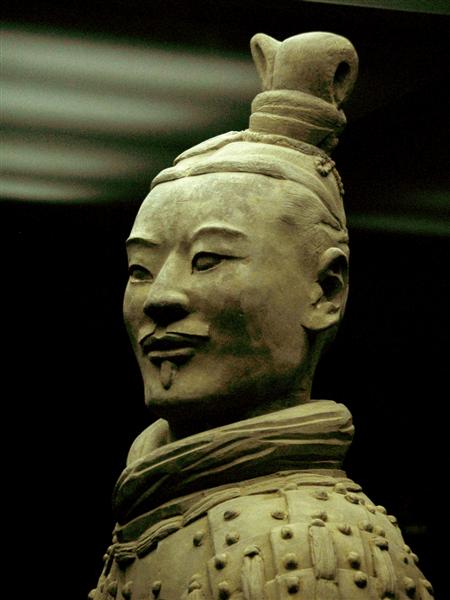 The excavation site has not been opened widely to protect most of the terracotta soldiers from oxidation and further decay. Only about 1080 warriors have been recovered so far and some 5000 remain buried. The actual mausoleum is in a mound 1.5 km away, but that has high concentrations of mercury and has therefore not been opened.
The army was not as impressive as I expected it to be, but that might be due to the way it is presented. However, when examined up close, individual soldiers (and each one looks different) are beautiful pieces of lifelike craftsmanship.
We stayed for two hours at the site, and then returned to the hotel, where we proceeded with a smaller group to have lunch. Chinese professor Chian Kejun, took on the role of most delightful host and walked us to a little restaurant where we had a bowl of noodles in broth for some 3.5 Yuan (about 40 €cent) each.
Afterwards we visited the city walls and the Great Mosque of Xi'an. The mosque was especially nice in that it was the first quiet place I had been to in a week.
The flight home that followed was not extremely eventful. We flew to Beijing together with organiser Susan Sweeney and Chiang Kejun, who promptly took us to the first class lounge and got us to our hotels in Beijing.
Our hotel was the Crowne Plaza and that had all the details done just right. I would have really liked to sleep late and have breakfast there, but we had to get up around 5:30 to catch our flight to Vienna. Again, an uneventful flight with little or no sleep and a meal going wrong. I watched True Grit , Tangled and Morning Glory, none of which was particularly good, though I may have simply been too tired to enjoy them properly. I slept for 15 hours after I arrived home, which was a new personal record..
This being the fourth meeting, and after everyone already submitted abstracts for an article, the presentations got pretty concrete. On the whole, the overview presentations were more interesting than the model presentations, but lots of insightful and interesting comments were made from all sides.
Outside the conference room, we had a Chinese banquet on Tuesday and Thursday, organised by our hosts of the Xi'an University of Science and Technology (XUST). On Wednesday, we had the opportunity to go off on our own for dinner and seven of us went to a famous dumpling restaurant near the Bell Tower in central Xi'an. Afterwards we did some souvenir shopping.
I missed most of Thursday's sessions because I wanted to go for a quick nap, and then slept like a rock for five hours. Unfortunately, that was the last good sleep I had before arriving home on Saturday. After that we joined XUST vice-presidents for another banquet.
I have to say that the Chinese are not very much into vegetarian food, but after a day or two one can sort-of get used to the food on offer. Still, noodles for breakfast is probably not for everyone and after a week, oily vegetables start to become really unpleasant.
Friday morning we left Xi'an proper to go to the Lintong district and see the Terracotta Warriors and Horses. These are a funeral goods for the First Qin Emperor, though much of it was ransacked after he died.
 The excavation site has not been opened widely to protect most of the terracotta soldiers from oxidation and further decay. Only about 1080 warriors have been recovered so far and some 5000 remain buried. The actual mausoleum is in a mound 1.5 km away, but that has high concentrations of mercury and has therefore not been opened.
The army was not as impressive as I expected it to be, but that might be due to the way it is presented. However, when examined up close, individual soldiers (and each one looks different) are beautiful pieces of lifelike craftsmanship.
We stayed for two hours at the site, and then returned to the hotel, where we proceeded with a smaller group to have lunch. Chinese professor Chian Kejun, took on the role of most delightful host and walked us to a little restaurant where we had a bowl of noodles in broth for some 3.5 Yuan (about 40 €cent) each.
Afterwards we visited the city walls and the Great Mosque of Xi'an. The mosque was especially nice in that it was the first quiet place I had been to in a week.
 |  |
Our hotel was the Crowne Plaza and that had all the details done just right. I would have really liked to sleep late and have breakfast there, but we had to get up around 5:30 to catch our flight to Vienna. Again, an uneventful flight with little or no sleep and a meal going wrong. I watched True Grit , Tangled and Morning Glory, none of which was particularly good, though I may have simply been too tired to enjoy them properly. I slept for 15 hours after I arrived home, which was a new personal record..
Friday, 1 April 2011
Nuclear power
In the aftermath of Tohoku earthquake and the resulting tsunami, some 12000 people were killed, hundreds of thousands of people displaced and the seaside left a ravaged wasteland. Rolling blackouts still affect Tokyo and the north-east, and many industrial plants have come to a halt either due to lack of power or being unable to ship raw materials in and products out.
Yet, media focus is almost exclusively on the Fukushima nuclear plant. There is barely any radiation outside 1 km of the plant and, except for the 50 or so engineers who remained on-site, nobody has had more radiation exposure than would result from an x-ray. Radiation levels are less than 1/1000th of those in Chernobyl. Nevertheless, some countries advised their nationals to flee, and my Japanese colleagues are tired of having to explain the foreign friends that what is actually going on is rather little.
Of course, TEPCO plant managers have made mistakes, for instance by not flooding the reactor buildings before the batteries of the cooling system ran out. Presumably they thought they could contain the situation and save the plant. Instead, they got up to their arms in mess and had to flood the plant anyway with sea water.
There is a backlash building against nuclear power, and I see why. Bottom line is that core breaches, accidents that are supposed to happen once in a million years, have now occurred three times in forty years. While this may be bad luck, it suggests our risk analysis is obviously flawed: it only takes into account the risks we know. And there seems to be an endless supply of things we did not think of.
Still, nuclear power has claimed relatively few lives over the years, when compared to deaths in coal mining and from air pollution. I am not saying it is good, but it might even be the lesser of evils. In that sense I have always differed in opinion from most my friends in the environmental sciences movement - I am not necessarily anti-nuclear.
The benefit is nuclear plants are simple: low volumes of fuel that do not produce a lot of CO2. The problems with nuclear are well known: risk of accidents and contamination, waste, limited supply of fissile material, and weapons proliferation. Annoyingly, tradeoffs are involved between waste and resources on the one hand, and proliferation on the other. Most current light water reactors generate lots of fissile waste and are not very efficient (this is linked) but do not pose a significant weapons risk. Breeder reactors can use up much more fissile material, leaving much less waste, but yield a lot of bomb material if stopped halfway.
I am not very worried about proliferation. We had five official nuclear powers during the cold war (UN security council permanent members, Israel was the unofficial sixth power). Since then, seven more countries got them, though four gave them up (Belarus, Kazakstan, Ukraine, South Africa) and three are now considered nuclear powers (India, Pakistan, North Korea). Several others have the know-how to make a bomb on the shelf (Netherlands is among those, it even has a uranium enrichment plant).
And all this proliferation hasn't made nuclear war any more likely.
I believe in the doctrine of Mutual Assured Destruction: anyone stupid enough to throw a nuclear bomb is going to find him/herself on the receiving end of a retaliatory strike, making it just not worth it (the acronym, MAD, is an apt one). Even petty dictators (perhaps particularly petty dictators) are concerned with their own survival. For all I care, every government in the world can have ten bombs.
I worry a bit about the nutcase revolutionary who wants one single bomb, but one nutcase cannot get the infrastructure together to refine fissile material (unless you are a Bond villain). And because forensic techniques can trace the source of a bomb's fissile material, no petty dictator would be mad enough to give one to terrorists.
I am worried about nuclear waste. The documentary Into Eternity, about the Finnish Onkalo permanent waste storage site neatly presents the problems inherent in keeping people out for all eternity.
I also worry about accidents, but not as much as some. Nuclear plants should be built with every redundant passive safety mechanism we can think of, because just one Chernobyl accident was too many. On the other hand, Chernobyl was caused by people disregarding the safety manual, and TEPCO didn't follow theirs either. Human error and not following instructions is the major risk in nuclear power. And the damage caused by coal mining, oil spills, deforestation and acid rain covers much larger areas and more people than Chernobyl ever did (even if the total amount of energy involved is also lots higher).
As such, I think that if we are going to do nuclear power, it should be done with breeder reactors, with strict controls on fuel cycle timing. I trust my government with so much, I will trust them with nuclear material as well. That is not to say we should build nuclear plants nilly-willy, by careless and dodgy contractors in the Congo or other places run by corrupt fools. But we don't do that anyway.
Summa summarum, nuclear is still a bad way of producing power, like coal, like unconventional oil (AKA steam-cleaning tar from sand and hydrocracking it) and like shale gas. But it may well be preferable to runaway climate change.
At the AME meeting, there was some extra attention to nuclear, mostly because a few models show a large share of nuclear and it is interesting to see what else could fill the gap. There was a also a presentation segment on how energy services are affected by the quake and tsunami in Japan.
I cannot follow everything at Fukushima because at night here, the Great Firewall of China blocks most of the BBC World website except the front page. The articles are accessible by day, so I presume the Chinese government are vetting the articles individually. Regardless, I hope that with the reactors cooling down entirely, the frenzy dies down a bit. At least in China, the media seem to have moved on already to obsessively covering Libya already.
Meanwhile, I hope that someone will keep cleaning up and rebuilding the lives survivors of the Tohoku tsunami, even if most of the world moves on to newer media frenzies.
Subscribe to:
Posts (Atom)