Saturday, 24 September 2011

Against the IPCC 5th assessment report

The IPCC is working in full swing on the fifth edition of the climate change assessment report. I think it may be a bad idea to have one.

And that is not (just) because I just spent lots of time on an assessment report that most of our team would now quite happy to put on the midwinter bonfire. And it is despite having spoken briefly with the chairs of working group II and III, who are nice and clever people.

I think AR5 is bad because I think it is counterproductive. IPCC assessment reports have said roughly the same thing since the first one came out between 1990 and 1992. Since then, countless man-hours of really clever people have gone into figuring out what is going on, and despite all the looking under all the stones, the same story stands.

My former colleague Arjan Wardekker did some research that seems to support my position. In one of his studies, he asserts that problems with no conflict on values but disagreement on facts can be resolved by generating scientific consensus. Problems with no conflict on facts but disagreement on values are typically solved be political compromise (i.e. horse trading).

Now the research feeding into AR5 is a good example of the former. Climate change is a good example of the latter. This makes it possible for people who are in climate change denial (i.e. people whose interests are threatened by mitigating and/adapting to climate change) to reframe the debate as a lack of scientific consensus rather than anything that needs political action.

Pretending this is now about consensus of knowledge only allows opponents to call climate change into question, and thereby disguises the political horse trading as a scientifically inspired debate. The new report would only propagate this.

It is my humble opinion, and probably not shared by many of my colleagues, that a series of smaller reports on specific issues where consensus is not ready could inform policy makers better without turning the whole issue into a circus, again.

Qualification: My grievance against AR5 is mostly directed at the working group III part, which is about mitigation. There is a lot of new science coming out on vulnerability and adaptation that will be very important down the road.

Sunday, 4 September 2011

Gesäuse

On Arnulf's recommendation, I rented a car and took my wife and visiting brother out into the countryside of the Steiermark.

We arrived late in Admont, and because this is a small Austrian village, the proprietor of the guesthouse had already retired. Some confusion later we did manage to settle into our rooms.

In the morning we stumbled on a parade of old-timer cars as we explored the village.

We visited the 11th century Benedictine abbey at Admont, including its world-famous baroque library. The library contains over 1400 medieval manuscripts and over 900 incunabulae.

The abbey is pretty, and obviously wealthy. It has only 30 monks, but owns a lot of land and runs a large number of local businesses, employing over 500 people.

It also has museums of contemporary art (which had a few very nice works) and natural history (including an apparently famous collection of wax fruits).

In the afternoon we went for a walk up to the mountains near Gstatterboden to the Haindlkarhütte. It was a class 1 path (out of 9 classes) and it was hard enough work for three people with a desk job, but the exercise was nice and the views were pretty impressive.

Sunday, 28 August 2011

Tango teacher debut

It had to happen some time.I had given workshop at a Taboe camp, and taught my wife some early steps. But IIASA has interested people and no teachers, so any tango was going to come from me.

At a belly dance workshop on Africa Day in the YSSP programme, I suggested to give a workshop and there was some interest. So I arranged a place and time and sent around an invitation to staff and students. I spent much of the weekend prior on figuring out what to say, in what order and to what music. Fortunately, I was able to build on the instruction I got from Paul and Paras and many other great instructors.

Despite the 36°C on Friday, eight people showed up with equal number of men and women. In an hour and a half, I taught basic pose, axis, walking, turning and musicality. And by the end of it, they were all dancing (with varying degrees of grace). I was very proud and happy, and the participants seemed to enjoy it as well. Special thanks go to Jens who got me back on course when I went a bit too advanced.

I also got a lot more interest from other staff members, who had been away, busy and/or feeling it was too hot for tango. So I will probably do another edition in the autumn.

On the kindness of strangers

I was cycling home from the city centre yesterday in the harsh wind at the end of Saturday afternoon when the battered basket on the side of my bike broke. And so I lost my bag, including phone and wallet. I noticed a couple of blocks later, but cycling back to Karlsplatz and forth didn't yield anything.

Reporting it to the police seemed useless after 17:00 on a Saturday. But my wallet has business cards with my work phone number and email on it, so I went home and checked my work email, hoping that someone honest had taken it. Sure enough, my colleague Shilpa left a message saying that she had been called on my phone by some guy at an Islamic centre in the second district who had found my bag. So I bought some Skype Out credits and gave the man a call from my laptop.

It turns out he had everything in there and was coming to Reumannplatz anyway on Sunday afternoon. So the next morning I sent him another message from Terhi's phone and we met up around two. Mahmed had carefully looked after my bag and was extraordinarily friendly as well. He wouldn't take a reward from me, but promised I was welcome to call him or visit if I needed to practice my German..

Thank you.

Saturday, 20 August 2011

Tango at dusk

In summer, the good people of Crossover Milonga organise a Saturday evening milonga at the lovely Burggarten, right behind the Albertina Museum and just a block and half from the Opera (the walk passes by a nice wine bar too).

The atmosphere is very friendly and the Palmenhaus and the trees provide a wonderful and romantic background as you dance by the rear facade of the national library. Like in Utrecht, there are always people watching, admiring and enjoying.

Friday, 12 August 2011

LinkedIn using our faces for pseudo-endorsements

The boys at LinkedIn have decided they need out faces to make sure the advertisements of their partners are well-received. They quietly added Social Advertising to their features:
"LinkedIn may sometimes pair an advertiser's message with social content from LinkedIn's network in order to make the ad more relevant. When LinkedIn members recommend people and services, follow companies, or take other actions, their name/photo may show up in related ads shown to you. Conversely, when you take these actions on LinkedIn, your name/photo may show up in related ads shown to LinkedIn members. By providing social context, we make it easy for our members to learn about products and services that the LinkedIn network is interacting with."
Of course, they never informed us and they turned it on by default. They must assume that we would be happy to have our face put next to an advert. If you have a LinkedIn profile, you can turn this questionable feature off by going to Your Name|Settings|Account|Manage Social Advertising (Your Name and Settings are in the top right of your window when you log in, Account at the bottom left of the Settings page and Manage is in the middle).

Dinner parties

It isn't the easiest part of the expat existence, but our social life in Vienna is getting off the ground little by little. We got invited last Friday to dinner with my colleague Hamed, his wife Maryam and their friend Özge, who studies in Paris. They made lovely Iranian food and we talked and laughed until the metros had dwindled to night schedule.

We all enjoyed the evening, so we made another appointment for last night. I made some Indonesian food and our guests brought beautiful flowers. Again, the atmosphere was excellent and it was a pity that they left past bedtime, but office hours do not move for pleasurable company.

Regrettably for us, but fortunately for him, Hamed will join MIT as a postdoc in the fall, so get-togethers are numbered. The only upside for us is that it will probably take a while for US authorities to grant a visa and work permit to an Iranian economist.

Tuesday, 2 August 2011

Thallern

Our colleague Charlie Wilson, like many, is only with us part-time. As he is leaving after tomorrow, Arnulf organised a dinner and wine tasting at the Thallern farm to give him a proper sendoff.

The place was founded in 1141 by Cistercians, and is apparently owned by Heiligenkreuz Abbey. They have gone upmarket in the last year, offering guest accommodations, a posh food and wine store (with their own wines and foods and wines from other Cistercian Abbeys), and a restaurant with a brilliant wine list and fine Austrian traditional foods (including some vegetarian dishes). They are also conveniently located just outside the Guntramsdorf Thallern railway station.

I had my first ever taste of calf lung and hypothalamus and both were quite nice, though I will stick with a vegetarian diet for the foreseeable future. We tried 12 wines and apart from the mosquitos that came out in force after dark, we had a great evening.

Monday, 1 August 2011

Wrongful use of God

It is one of the Ten Commandments, in Exodus 20:7 and similarly phrased in Qur'an 2:224 and 17:36-37: Do not use God's name as a cover for your bad behaviour.

So why is this so often ignored and forgotten? Obviously by people who sanction killing someone else in the name of religion. Be it supposedly Islamic suicide bombers, supposedly Jewish rabbis who legitimise violence against Palestinians, or supposed Christians killing a doctor who performs abortions. I might be missing something, but those people ignore some really important tenets of their faith.

But is goes further than that. A muslim woman who voluntarily dons a full facial veil in Western Europe to show her devotion is maybe not dressing humbly as her faith stipulates, but rather showing off her faith to all who see her. Really visibly sitting in the front row at church three times on Sunday could be, but probably is not always, a sign of a close personal relationship with God.

I would even venture, that bible may not be as in tune with modern life as some adherents would have it. For instance, some of the text of Exodus 34:11-26 is a bit quirky when viewed through a modern lens: I think most of the world does not need to be religiously commanded to not boil their kid in mother's milk..

tangocynic

There's a lot of ideas out there on what tango is and is not. Tangocynic snidely exposes some of these (mis)conceptions.

It has gone viral in the tango community but because I am not on facebook (by choice, do not bother to send me an invitation), I am probably the last to both hear of it and spam others about it.

Nevertheless, enjoy :).

Sunday, 31 July 2011

Slovenia

Terhi's friend Klemen gave us an exciting wedding present: a fully hosted weekend in Slovenia. We both thought this is a great gift, because you get an experience rather than stuff, and time with a friend to boot. Also, Klemen is an excellent host.

A colleague picked us up from the train in Maribor and took us to the hotel where Klemen and some of Terhi's other collaborators had been having a meeting. After a swim in the local spa and dinner, we drove to a bed and breakfast between Kranj and Ljubljana. The next morning, our sightseeing began in earnest: Klemen drove us around the country south and west of Ljubljana for two days.

We went down from the Julian Alps to the coastal plain, roughly following the beautifully turquoise Soča river, from Kranjska Gora over the Vršič pass, past the Triglav to Soča to Bovec to Kobarid to Koseč (where we stayed in another bed and breakfast) to Tolmin to Nova Gorica.

We saw an almost endless string of lovely mountains, valleys, gorges and waterfalls, many of which would have been difficult to find as a tourist. At noon on Sunday, we quickly hopped over the border to Gorizia to get some lovely Italian pizza for lunch, before driving back to Ljubljana where we got on the train back Vienna.


Monday, 25 July 2011

The Cottage

After running four loads of laundry and getting a good night's rest after the tango camp, we borrowed Renée's Auris hybrid and drove out to visit Terhi's former landlord Stellios in Eindhoven and my friends Dirk and Monique in Houten. In the evening, we packed up, moved our stuff to Casper's place and had dinner all together in the charmingly eclectic Hotel New York.

The next morning we left for Schiphol and flew to Vantaa. From there we went by bus to Lahti and sat at a cafe with Tuukka. Turned out that my iPod had not survived the trip, but we got to see a video one of Tuukka's parachute jumps. After an hours, we proceeded by bus to Joutsa, where Arto and Liisa were waiting to take us to the cottage in Kangasniemi.

Time should have slowed to a crawl at this point, because it doesn't get dark at the cottage in summer, and there is plenty of time to sleep and read.

Of course, there is also lots of woodcutting to do, and mosquitous to avoid. I slightly sprained a muscle in my back from overambitious axe work, got some bruises from heavy logs, and a whole lot of bug bites. We did get lucky with the weather (IMHO) because at 30°C, the lake water is nice and swimmable (especially after sauna) and the Finnish mosquitous are much less active.

We visited Mikkeli, and I got some reading in, but on the whole time went by fairly quickly. On Saturday, we dropped Terhi in Joutsa on the bus to Jyväskylä, and went via Lathi and dinner with Tuukka back to Riihimäki. Next morning, I was already on my way home to dreary Vienna.

Monday, 18 July 2011

Taboe Tango VIII

We skipped the winter camp because we wanted to elope, but Terhi and I were very much coming back for the summer camp.

We spent Saturday at Renée's place and had a lovely dinner with Patrick and Femke. On Sunday we proceeded to Austerlitz and settled into a dorm room with a nice group of people. Thanks to some judiciously placed blankets, we even had some privacy (and weren't bothered when people turned on the light in the middle of the night).

Before the camp, my darling wife was nervous as usual that she wouldn't dance well and that nobody would ask her (all women seem to get this), but it turned out she had nothing to worry about. I was much more confident, but it took me two days for my head to clear itself from everybody (read:work) hassle and start connecting with my followers properly.

The camp itself has grown to 180 people, but this didn't change the atmosphere too much (except that there was no way to dance with everyone or learn everyone's name). Most of the people were staying in a new building which was not quite finished yet and had a terrible (for dancing) concrete floor, as well as a sterile atmosphere. That building will have a proper floor by next camp, but we avoided it as much as we could to save our knees (especially's Terhi's) on this occasion.

We had a private lesson with Michael Lavocah, which was rather useful, especially for my dancing with Terhi, and lots of workshops. As teachers, I particularly liked Corey and Adeline and also Oliver, none of whom I had not met before. I had lovely dances with friends like Simone and Leoni, and with strangers like Allison, an Irish girl. The latter promptly fell in love with a tall Dutch guy and decided she might stay in NL indefinetely; it is always nice when people find each other.

Due to rain, there was no trip to the Henschotermeer for the whole camp this year, so we will have to come back next year. Which is entirely fine with me.

Thursday, 23 June 2011

Energy for all - time for action


Every now and again, the circus comes to town. In this case, it was the Vienna Energy Forum at the Hofburg. The old imperial residence has been tastefully updated with its modern abstract red/orange/blue/black artworks framed by the neo-classical white-and-gold halls. IIASA was a partner in organising this event, though UNIDO was the main organiser.

It started out on Tuesday morning, with the room packed with journalists, camera crews, scientists and people from various NGO, IGO and national political scenes.

Speeches followed by the various officials with the organisers and politicians, including our own director. Of the national politicians, PM Henry Puna of the Cook Islands was particularly eloquent and accessible.

UNIDO head Kandeh Yumkella distilled topic to main points for action:
  • Universal access to modern energy services for all in 2030
  • 40% improvement in energy efficiency by 2030
  • 30% share of modern renewable energy by 2030
In the process, Yumkella established himself as the brightest star performer of the forum. Save one, the main act of Tuesday morning's circus: former governator Arnold Schwarzenegger.

Schwarzenegger's speech has a personal story for the benefit of his Austrian hosts, and an excellent peptalk with numbers and movie quotes and uplifting examples for the international renewable energy community. One of his main lessons was that almost nobody (outside NW Europe anyway) cares about climate change, or renewable energy, or nature, but many people care about health impacts of coal power, energy security and reliability, how much we pay for energy and where that money goes, and poverty and energy access.

My reference point for Arnold Schwarzenegger is his 1982 film, Conan the Barbarian, and I have to say that the man has matured from rather humble origins into a pretty polished speaker by his current age of 63. After he left, about one third of the conference hall also departed, including most of the press, and we were left to get down to business.

Up next on the programme was the pre-launch of the Global Energy Assessment, a report that I have devoted the better part of the last year to. Unfortunately, Jed Davis' presentation fell utterly flat. Even though I know we have put lots of emphasis in the report on co-benefits and synergies between climate change, energy, health and air pollution, energy security, and energy access, there was barely any it of it in his talk. Even if it had not been scheduled right after Schwarzenegger, the presentation was an anticlimax. I felt compelled to write to Naki and warn him that GEA was in danger of going the way of the Millennium Ecosystem Assessment: an excellent report, that nobody gave much attention to.

Next up was a panel discussion on energy access moderated by the BBC's Zeinab Badawi. She did a good job, especially in handling the recalcitrant director of the OPEC fund for international development. However, I wonder why UNIDO chose to put six people from energy-rich countries, who never experienced energy poverty and may not even have seen it personally, on a panel about solving energy poverty. For instance, the talking points of the Friedrich Kitschelt from the German ministry of economic cooperation and development seemed more like a wishlist of conditions under which E.ON would want to build coal plants in a country. Having someone like Rebecca Grynspan from UNDP could not get it on track.

In the afternoon I reflected with some colleagues on the morning and attended a recording of the BBC World Debate. Again hosted by Zeinab Badawi, it was much more what the morning's panel session should have been: a spirited but good-natured debate on how modern energy could be supplied to the 1.4 billion people without electricity and the 3 billion people who cook with dirty coal and traditional biomass. This debate will air on the BBC around mid-July.

All in all, the official programme of the Vienna Energy Forum was not very interesting. I did some networking and had a few laughs but, in the worlds of our YSSP students remarked: "Now I know why international negotiations never produce much."

Wednesday, 25 May 2011

Grounded by hay fever

Spring is in the air, and with it comes pollen. A test over the winter showed that I am allergic to grasses, rye, birch and alder.

Given the amount of grain farming just south Vienna and the exertion needed to climb up the Wienerberg, that means I can't commute by bike. I tried twice since I came back from my honeymoon, and in both cases I was out with a headache for 24 hours, even with medications.

Which is really disappointing because the weather is lovely, the landscape is at its nicest and I badly need the exercise because my head is flowing over.

My main problem, as far as I can tell, is the many, many hectares of fields of cereals that are growing between Vienna and Laxenburg, which all look beautifully rustic, but also churn out of boatload of pollen.

Thinking back, I realised that for all its lowlands and agriculture, the Netherlands has very little grasses in bloom. We have lots of cattle grazing, but that grass is mowed for hay before it flowers. I don't recall seeing a lot of grain fields in the Netherlands. We have have roadsides and nature, but that is not so much in terms of surface area, or alternatively it sports very mixed vegetation.

Move to Finland, one might say, not so many grasses there. True, but there they have lots of birch trees. So I remain stuck between the proverbial rock and hard place..

Update: I overlooked that it rains more in NL, thereby keeping the amount of pollen waiting on surfaces a little smaller. On the other hand, I think that the prevailing sea wind is too far to matter, unless I go to Scheveningen. All things considered it I may be physically quite well adapted to my land of origin.

Saturday, 14 May 2011

New life, new perceptions

In the past two years, I have gone from single to seriously taken, then engaged, and now married. I find it changed the way I see things, and most notably, the way other people's emotions have an impact on me.

In films, I used to feel sympathetic when people found a soul mate. For a while I even looked at wedding films with interest. Now I get a 'been there, done that' kind of feeling (and my wedding was invariably better). Not that there were ever more than a handful of romantic comedies that I liked.

Nowadays, I empathise when I see people starting a family, and scenes of the death of a soulmate tear at me in a way they never did before.

I always had some shift in taste, for instance I have rarely listened to angst-driven grunge music the last couple of years, but the phenomenon accelerated in the last two years. Maybe I am growing up or old or both...

Interesting pebbles from the internet

The internet makes really interesting stuff possible, and it also makes it possible that I get alerted to those without having to dig through it. But such pebbles are the foundation stones on which our whole interest in the global web is built.

There's a nice examples of data visualisation and another article on visualising statistics. I find it fascinating because I am now in the business of that myself; MESSAGE spits out oodles of numbers and if there is a point to them, it is not usually obvious. We have a qualified programmer on staff (Peter) who spends most of his time on extracting and visualising our results. These tools are invaluable also for our internal analysis and bug fixing.

Another is a BBC article on the meaning of Mary Shelley's Frankenstein; or, The Modern Prometheus. BBC-interviewed experts gave 10 possible meanings, and readers comments quickly added another 16 that the astute editor at the BBC promptly put in a separate article.

In another brilliant example of crowd-sourcing, the New York Times asked readers to send in their six-word love stories. More dense even than haiku, the page collected a fascinating 144 pages of such stories in three months, and some are truly evocative. NYT promptly started contest for six-word stories on mothers for Mother's day (which I found less entertaining).

And then there are picture collections such as this positive news art page that my darling wife sent me, which should bring smiles to all the Banksy fans at least. On a more serious note, the Hard Rain picture library presents a wide selection of images illustrating social and environmental issues and nature.

Youtube is a microcosm of the wider internet, with videos on anything. Again, I let others inform me about Vi Hart doodling on math or Tara Stiles on down to earth yoga.

Wednesday, 4 May 2011

The Honeymoon IV - Trips

We took three trips from Muscat. The first was with Markku to Nizwa, a small town with an old fortress, a pretty mosque, and a large area of souqs. Unfortunately, the fort was closed by the time we got there, but we had an interesting walk through the centre of Nizwa, which feels much more like Oman before the oil boom. We also visited the cave at Al Hoota, which were quite spectacular and among the nicest I have seen anywhere.

The second trip started with an early rise to go to the Bandar Al Rowdah marina, where we embarked on a comfortable speedboat to give scuba diving. The marina was actually quite lovely in that I saw a large turtle and a school of fish.

I hadn't been down since False Bay, but the diving centre chose a very calm spot with gorgeous underwater life. Among the sight was a giant moray eel, some scorpionfish, angelfish, moonfish, clownfish, anemones and whole schools of what looked like sardines. One clownfish played chicken with me, which the others told me was because it was attacking its own reflection in my dive mask (I yielded - divers should not harass the wildlife)..

Graham, our instructor from Omantascuba, was to take care of Terhi because she has no diving certification. Unfortunately, he forgot to bring the prescription dive mask, so she saw relatively little. After a while I got her close to the reefs so that she could see the corals at least, and some of the fish were so tame that they floated in close enough for a good look.

When we told them we were on honeymoon, Assad on diveboot wished us a thousand children. He meant it well, but that was a scary thought. On the way home we got a lift into Mattrah from a party organiser carrying large loudspeakers. He was ever so friendly, but I couldn't quite make out everything he tried to say.

Our third trip was into the interior. Markku booked us a night at the Desert Nights Camp, and a rental car to get us there. We took the newly minted motorway down to Qurayyat and on to Sur. That town is entirely underwhelming, as tourist destinations go. Maybe it was because we were out of season. Not much to see, not much to do, and treacherous speed bumps on the road. Those speedbumps became a regular fixture of driving once we went inland, and I several times had to hit the brakes hard to avoid dents on the bottom of the car.

I saw three kinds of desert in Oman: rocky badlands, which consist of steep desolate hills of barren rock, shrub plains, which consist of flat eroded expanses with hardy shrubs every few meters and the occasional gnarly tree, and sandscapes which are miles of undulating mounds of fine sand.

We were picked up at a petrol station and driven into one of the valleys between the dunes that run almost exactly on a north-south axis. Before long, we bumped into view of the camp and signed in while enjoying some fresh juice. Then we were driven up the dune ridge to enjoy the sunset. Except that there was no sunset, because in typical fashion for a Dutchman, it rained that day. We had serious showers as we made our way inland (which thankfully made the locals drive a little more carefully) and by nightfall the sky was still very much overcast.

So instead we watched the pretty colours and strode down the ridge back to camp. On hearing we were on honeymoon, the camp staff had left a tray of fresh fruit and bottle of (non-alcoholic) fizzy grape juice, so we settled in, cleaned up and enjoyed our present. After that was dinner, accompanied by some local musicians.


In the morning we had a breakfast and a short camel ride around the camp before setting out to the Wadi Bani Khalid. A wadi is like a riverbed, only they fizzle out long before reaching the sea except in the rainy season, when they are prone to flash floods. Like most of Oman, Bani Khalid promised much, but delivered a bit less. We had put on swimwear under our clothes, but despite some climbing we did not find a crystal clear pool among the rocks to dive on the western (tourist) side, and too many local kids and someone washing their car on the eastern side. But it looked pretty, and we saw a cute little lizard.

On the way back through the mountains, we found out just how insanely the locals drive. Let's just say that overtaking at high speeds on narrow mountain roads where it is expressly forbidden to go fast or overtake seems to be a local pastime. I was happy to drive back into the Wave after a total of 750 km of paying close attention.

Unfortunately, that brought our trip to Oman to an end, and after dinner and a nap, we said goodbye and thanks to Markku and drove to the airport. Our flight to Munich got in early, and despite the lack of proper sleep I was strangely rested and composed, even on the train to Vienna.

Tuesday, 3 May 2011

The Honeymoon III - Muscat

As a tourist destination, Muscat offers more than the United Arab Emirates in that there are still old forts and other historic things to see. Unfortunately, the Muscat forts are generally closed to the public, and the musea close at 13:00 or 14:00 and are closed on weekends. Weekend for the public sector is on thursday and friday (private sector has weekends on friday and saturday).

Because we were on a tourist schedule of sleeping in, we saw relatively little of Muscat. We wandered in Muscat proper and relaxed a bit on the grass in front of Al Alam palace. We explored the Mattrah souq and had excellent fruit juice outside on the corniche. It had an interesting view of the Sultan's new private yacht and two traditional dhows.

A highlight was the Sultan Qaboos Grand Mosque, which has very limited opening hours for kafir, but is well worth a visit. The record-breaking Swarovski chandelier would not work in my living room (it would not even fit in it), but in that space over the world's largest Persian carpet, it works well. The whole complex is tastefully decorated, surrounded by gardens and lots of fragrant jasmin along the outer walls.

We travelled initially by taxi, and once got a ride from a Dutch lady who works at Shell, but after a few days we discovered the shared taxi network. An friendly Omani explained us how it worked and while you spend about twice the time to get anywhere, it also costs about one-tenth, and saves fuel. Like everywhere else I have travelled, the vast majority of the taxi vans were Toyota Hi-Ace of various ages and states of maintenance.

Dinner was either cooked at home by Terhi and me from ingredient procured at the local Carrefour, or in one of the restaurants. A particularly impressive place was The Chedi, where we went for drinks. A serene complex some kilometers east of the airport, the Chedi features a water garden, two restaurants a bar and a shop. The entrance hall alone is spacious and relaxing. Unlike must of the places, the decor seemed to blend Oman and Arab design elements satisfyingly into modern luxury. We had some very tasty mocktails (mine was a brilliant blend of cranberry juice, lime, ginger and mint).

Mocktails are like cocktails, but contain no alcohol - Omani are Ibadhi muslim , which is less stiff than the reactionary Saudi version of Salafism, but alcohol is only allowed by a special license granted to foreigners only. Businesses that sell alcohol must account for their stock very carefully.

Wednesday, 27 April 2011

The Honeymoon II - Arrival

Muscat is on the North-Eastern end of the Arabian peninsula, where the Gulf of Oman widens out to the Arabian Sea. The climate is hot, at 35-40°C Celsius in early May and, by the coast, rather humid.

Muscat proper is a few square kilometers of royal palace and administration buildings with small residential quarters on the sides. The capital area is a combination of connected village-sized areas between dry hills like Muscat, Mattrah and Al Bustan, the town-sized commercial heart of Ruwi, and a vast low-lying area that stretches for miles between Shati al Qurum and Seeb. One obviously needs a car to get around.

The dominant architecture is that of large, walled, airconditioned footballer mansions in Arabic style, with matching Chelsea tractors parked in front. Omanis have large families (8 kids is not exceptional), and prefer lots of space. As a nation, they have only come into (oil) wealth in the last 40 years, and skills as gardening and living in dense cities are still rather foreign to them. Admittedly, the Omanis do like to go into the wilderness over the weekend on a recreational basis (much like Finns, really), so the large 4x4 cars may actually have a purpose.

We stayed with Markku at The Wave, the luxury garden settlement for expats just north of the airport. It is not walled, but it has only one entry road and few Omani wander in. Few Omani live there, because the 300 m2 villas are too small for them. The area is not finished yet, and construction continues day and night. We had oodles of space in the villa, and between the airconditioning and the pool were little bothered by the heat or the humidity.

Tuesday, 26 April 2011

The Honeymoon I - München

Our first foray into the unknown started with a train ride to Munich, which was thankfully uneventful though a bit slow in the early bits - Lower Austria seems to be a bit on the cheap side when making train tracks.

Munich was an interesting surprise. It started at the train station, where we noticed the Asia*hung* fast food restaurant. It was tastefully decorated in bamboo and cream leather, and the food was quick, fresh, tasty and affordable. Imagine my surprise at finding an actually good fast food place, and in München Hauptbahnhof no less..

We continued for a walk through the centre of town, starting dead straight from the station to the Rathaus where we happened upon a small group of black-clad men surrounded by riot police, surrounding in turn by punks and other alternatively styled people. The black-clad men were silently holding banners proclaiming that the German, Austrian and Swiss people should awaken to something exalted and such. We moved on quickly, but afterwards I wished that somebody would have organised a flash chorus to sing the 4th movement of Beethoven's 9th symphony, 'Ode to Joy'.

Taking a few twists through the quieter streets we happened on a statue that had been converted to a shrine to Michael Jackson. A few dedicated fans covered a statue of a 'tone poet' with pictures of the late king of pop. While I respect their devotion, in all honesty I thought that the result looked a bit pathetic.

Overall, Munich has a very different feel than Vienna. Much more businesslike and less gothic. Functional, but not necessarily a place I want to live.

With that, we returned to the station, took the train to the airport, met up with my new uncle Markku and boarded our comfortable Oman Air flight to Muscat.

Sunday, 24 April 2011

The Wedding

We got up at a reasonable hour and after all the preparations were done (bride's hair), we set out for Laxenburg around noon. We dealt with last-minute issues, but overall the venue was in good shape. Guest started to arrive early, but mostly had a quick peek inside and then waited outside and relaxed in the sunshine while the crew took care of details.

Around the scheduled time of 15:30, we invited people in for coffee, tea, cupcakes (crafted by Manon) and prosecco, and the party got underway properly. Everyone looked splendid and smiling.

At 16:30, the Finnish Reverend Marianna Saartio-Itkonen waited for us at a makeshift altar under a tree in the garden and bright blue heaven. It was her first marriage and she did the blessing with great charm; several people remarked she was the coolest clergyperson ever. A violin and song accompanied the ceremony, though the wind did its best to take away the sheet music. Our attempt to record the blessing and broadcast live on Skype unfortunately ran into technical difficulties.

Around 17:00, we moved inside for the speeches. Arto delivered a very moving speech the brought tears to much of the audience. After that we confessed our elopement to the crowd and gave the floor to Casper, who gave another eloquent and charming speech.

More mingling followed until at 18:00, we moved to the Green Room for dinner. Joshua and I had constructed a menu, and he delivered almost flawlessly; the food was probably the most praised part of the day. It took a bit longer than planned, but nobody seemed to mind much, as there was wine and good company. Terhi and I independently switched tables between courses, so that we could talk more to all the people whom we see too rarely.

Around 20:30, we moved back to the Oval Room where Sidestep had set up their gear. They had studied Volver, by Carlos Gardel, for our opening tango. Some people who were not familiar with the fact that Argentine tango is entirely improvised commented that we rehearsed it well. Others mentioned it was the first time they saw a couple enjoy an opening dance and make it look good. After that, the band played various kinds of music while the dessert buffet was served. It was not until the delicious desserts had subsided somewhat that the crowd to the floor in large numbers.

Terhi and I saw off most of the people and left around 23:30. Casper and Tuukka stayed to take care of the last details and slept at the IIASA guest rooms. I was tired, but I had seen nothing but happy, smiling faces for eight hours and I was very content. And I (now publicly) have a wife!

note: photos forthcoming

Saturday, 23 April 2011

The Pre-Wedding Party

Terhi, Tuukka, Casper and myself spent much of Good Friday trouncing around Vienna for the official photographs. On the eve of the wedding, I had arranged for some space at the Österreicher in MAK café, so that we could welcome people to Vienna and also give them an early chance to mingle.

As luck would have it, the weather was fine and the everyone moved outdoors to the terrace. Prosecco flowed freely and some people stayed until closing time. The Finns were particularly pleased with the (comparatively low) prices of the wine. For Terhi and myself, there was a first opportunity to meet relatives and friends from the other side, which was interesting. The guests from Vienna were noticeably absent, but most of the people who flew or drove in made it (though some had considerable trouble finding the way).

We made information available on a need-to-know basis, and combined with the foreign surroundings, people seemed somewhat uncertain of what to expect. This also applied to our families who had been poking us with suggestions and questions for months, while we reacted mostly non-committal or by deflecting the question.

Our parents and siblings learned the biggest secret about the wedding on the night before at dinner: Terhi and I quietly eloped and got legally married on 30 December 2010, with only Katja and Saija as witnesses (and those two were not invited to that wedding until the evening before). Everyone was surprised and a little miffed, but Arto was despondent that he had not been present for his daughter's marriage.

Our reasons were several: first, it seemed pointless to involve the Austrian legal system in an already international marriage; second, it was cheaper this way; third, it meant we could fulfil the request for a church bit without cluttering our informally-intended wedding with ceremony; fourth, we wanted to get married ASAP anyway; and fifth, it would mean less hassle and stress for the wedding day. All things considered, I recommend it to any couple.

As host, I didn't get to speak to anyone for very long at the MAK café, but the atmosphere seemed to be building.

Tuesday, 5 April 2011

The doctor is coming

As this is the first season since I myself became a doctor, I can do a bit of advertising.

For warmup, watch these brilliant four-minute shorts that were made for Red Nose Day:


Space · Time

Sunday, 3 April 2011

Xi'an II - AME meeting and sightseeing

The AME meeting itself was a fairly pleasant affair as conferences go. The presentations came in two types: model presentations, where participants described what was noteworthy about their model configuration and results, and overview presentations, where topic leaders presented cross-comparisons of all the participating models on a given topic. All are supposed to lead to journal articles in a special issue.

This being the fourth meeting, and after everyone already submitted abstracts for an article, the presentations got pretty concrete. On the whole, the overview presentations were more interesting than the model presentations, but lots of insightful and interesting comments were made from all sides.

Outside the conference room, we had a Chinese banquet on Tuesday and Thursday, organised by our hosts of the Xi'an University of Science and Technology (XUST). On Wednesday, we had the opportunity to go off on our own for dinner and seven of us went to a famous dumpling restaurant near the Bell Tower in central Xi'an. Afterwards we did some souvenir shopping.

I missed most of Thursday's sessions because I wanted to go for a quick nap, and then slept like a rock for five hours. Unfortunately, that was the last good sleep I had before arriving home on Saturday. After that we joined XUST vice-presidents for another banquet.

I have to say that the Chinese are not very much into vegetarian food, but after a day or two one can sort-of get used to the food on offer. Still, noodles for breakfast is probably not for everyone and after a week, oily vegetables start to become really unpleasant.

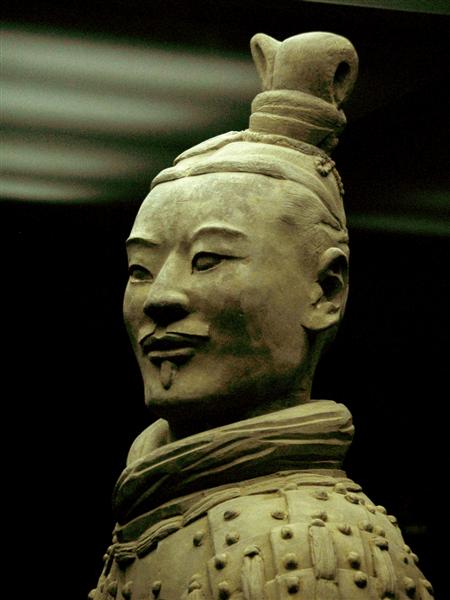
Friday morning we left Xi'an proper to go to the Lintong district and see the Terracotta Warriors and Horses. These are a funeral goods for the First Qin Emperor, though much of it was ransacked after he died.


The army is found in three buried pits, and only pit 1 has been excavated significantly. Pit 2 and 3 have huge pompous buildings over them, and soldiers beautifully showcased, but there is little to see in the ground.

The excavation site has not been opened widely to protect most of the terracotta soldiers from oxidation and further decay. Only about 1080 warriors have been recovered so far and some 5000 remain buried. The actual mausoleum is in a mound 1.5 km away, but that has high concentrations of mercury and has therefore not been opened.

The army was not as impressive as I expected it to be, but that might be due to the way it is presented. However, when examined up close, individual soldiers (and each one looks different) are beautiful pieces of lifelike craftsmanship.

We stayed for two hours at the site, and then returned to the hotel, where we proceeded with a smaller group to have lunch. Chinese professor Chian Kejun, took on the role of most delightful host and walked us to a little restaurant where we had a bowl of noodles in broth for some 3.5 Yuan (about 40 €cent) each.

Afterwards we visited the city walls and the Great Mosque of Xi'an. The mosque was especially nice in that it was the first quiet place I had been to in a week.

 
The flight home that followed was not extremely eventful. We flew to Beijing together with organiser Susan Sweeney and Chiang Kejun, who promptly took us to the first class lounge and got us to our hotels in Beijing.

Our hotel was the Crowne Plaza and that had all the details done just right. I would have really liked to sleep late and have breakfast there, but we had to get up around 5:30 to catch our flight to Vienna. Again, an uneventful flight with little or no sleep and a meal going wrong. I watched True Grit , Tangled and Morning Glory, none of which was particularly good, though I may have simply been too tired to enjoy them properly. I slept for 15 hours after I arrived home, which was a new personal record..

Friday, 1 April 2011

Nuclear power

In the aftermath of Tohoku earthquake and the resulting tsunami, some 12000 people were killed, hundreds of thousands of people displaced and the seaside left a ravaged wasteland. Rolling blackouts still affect Tokyo and the north-east, and many industrial plants have come to a halt either due to lack of power or being unable to ship raw materials in and products out.

Yet, media focus is almost exclusively on the Fukushima nuclear plant. There is barely any radiation outside 1 km of the plant and, except for the 50 or so engineers who remained on-site, nobody has had more radiation exposure than would result from an x-ray. Radiation levels are less than 1/1000th of those in Chernobyl. Nevertheless, some countries advised their nationals to flee, and my Japanese colleagues are tired of having to explain the foreign friends that what is actually going on is rather little.

Of course, TEPCO plant managers have made mistakes, for instance by not flooding the reactor buildings before the batteries of the cooling system ran out. Presumably they thought they could contain the situation and save the plant. Instead, they got up to their arms in mess and had to flood the plant anyway with sea water.

There is a backlash building against nuclear power, and I see why. Bottom line is that core breaches, accidents that are supposed to happen once in a million years, have now occurred three times in forty years. While this may be bad luck, it suggests our risk analysis is obviously flawed: it only takes into account the risks we know. And there seems to be an endless supply of things we did not think of.

Still, nuclear power has claimed relatively few lives over the years, when compared to deaths in coal mining and from air pollution. I am not saying it is good, but it might even be the lesser of evils. In that sense I have always differed in opinion from most my friends in the environmental sciences movement - I am not necessarily anti-nuclear.

The benefit is nuclear plants are simple: low volumes of fuel that do not produce a lot of CO2. The problems with nuclear are well known: risk of accidents and contamination, waste, limited supply of fissile material, and weapons proliferation. Annoyingly, tradeoffs are involved between waste and resources on the one hand, and proliferation on the other. Most current light water reactors generate lots of fissile waste and are not very efficient (this is linked) but do not pose a significant weapons risk. Breeder reactors can use up much more fissile material, leaving much less waste, but yield a lot of bomb material if stopped halfway.

I am not very worried about proliferation. We had five official nuclear powers during the cold war (UN security council permanent members, Israel was the unofficial sixth power). Since then, seven more countries got them, though four gave them up (Belarus, Kazakstan, Ukraine, South Africa) and three are now considered nuclear powers (India, Pakistan, North Korea). Several others have the know-how to make a bomb on the shelf (Netherlands is among those, it even has a uranium enrichment plant).

And all this proliferation hasn't made nuclear war any more likely.

I believe in the doctrine of Mutual Assured Destruction: anyone stupid enough to throw a nuclear bomb is going to find him/herself on the receiving end of a retaliatory strike, making it just not worth it (the acronym, MAD, is an apt one). Even petty dictators (perhaps particularly petty dictators) are concerned with their own survival. For all I care, every government in the world can have ten bombs.

I worry a bit about the nutcase revolutionary who wants one single bomb, but one nutcase cannot get the infrastructure together to refine fissile material (unless you are a Bond villain). And because forensic techniques can trace the source of a bomb's fissile material, no petty dictator would be mad enough to give one to terrorists.

I am worried about nuclear waste. The documentary Into Eternity, about the Finnish Onkalo permanent waste storage site neatly presents the problems inherent in keeping people out for all eternity.

I also worry about accidents, but not as much as some. Nuclear plants should be built with every redundant passive safety mechanism we can think of, because just one Chernobyl accident was too many. On the other hand, Chernobyl was caused by people disregarding the safety manual, and TEPCO didn't follow theirs either. Human error and not following instructions is the major risk in nuclear power. And the damage caused by coal mining, oil spills, deforestation and acid rain covers much larger areas and more people than Chernobyl ever did (even if the total amount of energy involved is also lots higher).

As such, I think that if we are going to do nuclear power, it should be done with breeder reactors, with strict controls on fuel cycle timing. I trust my government with so much, I will trust them with nuclear material as well. That is not to say we should build nuclear plants nilly-willy, by careless and dodgy contractors in the Congo or other places run by corrupt fools. But we don't do that anyway.

Summa summarum, nuclear is still a bad way of producing power, like coal, like unconventional oil (AKA steam-cleaning tar from sand and hydrocracking it) and like shale gas. But it may well be preferable to runaway climate change.

At the AME meeting, there was some extra attention to nuclear, mostly because a few models show a large share of nuclear and it is interesting to see what else could fill the gap. There was a also a presentation segment on how energy services are affected by the quake and tsunami in Japan.

I cannot follow everything at Fukushima because at night here, the Great Firewall of China blocks most of the BBC World website except the front page. The articles are accessible by day, so I presume the Chinese government are vetting the articles individually. Regardless, I hope that with the reactors cooling down entirely, the frenzy dies down a bit. At least in China, the media seem to have moved on already to obsessively covering Libya already.

Meanwhile, I hope that someone will keep cleaning up and rebuilding the lives survivors of the Tohoku tsunami, even if most of the world moves on to newer media frenzies.

Tuesday, 29 March 2011

Xi'an I - Asia Modeling Exercise meeting

Going to China for the fourth AME meeting (my second) was a fun-filled 20 hour trip. It started easily enough, taking the usual train to Vienna airport and meeting up with Volker and his family at the departure hall.

The nine-hour flight to Beijing was OK. I saw the ballet-horror film Black Swan, which was excellent. I love Darren Aronofsky's dark fairytales. After my laptop battery ran out I saw the latest in the Chronicles of Narnia; Voyage of the Dawn Treader, which is pretty forgettable on the screen in the back of an airplane seat. Also, the Christian morality tale gets more and more incessant as the series progresses, and that starts to irk. As usual, my dinner went wrong and I didn't get any sleep, but we arrived in Beijing at 4:50 AM local time in good order.

After clearing the efficient passport queue and taking the train to the main domestic terminal, we had to wait for a while until the departure area opened at 6:15. Then we had an adventurous but not very satisfying Chinese fast food breakfast.

The most notable aspect of our five-hour stay at Beijing Capital airport was the dislocation I felt. Sitting by the windows next to the charging station, and looking mostly at a laptop screen, you could be at any major airport in the world. Only advertisements coming from the TV screen in Chinese reminded me that I was a continent away from home (and possibly the neo-pompous building with suitable red flags across the field).

By 10:30, we were on the plane to Xi'an. This flight foreshadowed some aspects on China in general, in that it was packed with people, the food was not quite what I was looking for and I didn't understand what people were saying. But I was sitting next to a very friendly Chinese young businessman who kindly answered all my questions.

Looking from the plane flying West, I got my first shock: until an hour outside Beijing all I saw was desert. I had not realised quite how parched the area is. I saw some hills with shrubs, but mostly barren beige wasteland dotted with villages. Suddenly, the three enormous canals that are being created to move water from South to North are starting to make sense. On the other hand, I expected to spot China's huge tree planting program but there was no tree in sight.

Coming into Xi'an I noticed glinting on the rooftops of the small houses below. At lower altitude, I recognised the shape of solar water heaters, which are almost ubiquitous here and where China has the majority share of the world's installed capacity. This in contrast to solar photovoltaic cells, which have a much smaller (both also growing) market. Some news reports seem to confuse the two.

On the ground in Xi'an we found a taxi and had two more shocks: the first is the air quality. I half expected this to be disastrous in Beijing, but there we didn't get out of the terminal building. In Xi'an it hit full force: the haze outside was easily visible and my lungs were quietly protesting. But at least the taxi driver offered us a cigarette as well.

On getting closer to the city, the sheer scale of China's urbanisation became apparent. Xi'an is not a great city, merely a provincial capital with a couple of million inhabitants (!), but on the outskirts we saw five rows of ten high-rise flats under construction, each over 20 floors. And these 50 towers were only the beginning. It went on literarily for kilometres.

None of this bothered our taxi driver, who seemed blissfully unaware of basic traffic rules such as not overtaking on the right and staying in your own lane when the road has a continuous centre stripe and/or a bus coming from the other direction. He also seemed to deliberately narrowly by people crossing the busy street.

The Jinshi International Hotel was, at first sight, a case study in opulence. The hotel doesn't even start until the fifth floor, and the rooms are built around the space above the inner courtyard with huge artworks on the wall. Marble, brass and wood everywhere and a small army of staff to care of you.

On closer inspection, you notice the poor noise insulation (especially at night, next to a major road), the dark grey mould in the bathroom, the chipped stone and panels around fittings, and the fact that the staff mean very well but do not entirely understand even your deliberately slow and pronounced English.

It is, in many ways, what I dislike about cliché nouveau riche: grand but not polished, expensive but not refined. For me, really great design is in the details and the care with which items and services are finished.

Thursday, 10 March 2011

Casual misogyny - in pop music

I can get very angry about the latest reports of mass rape in the Congo, acid thrown at school girls in Afghanistan, or female genital mutilation in Northern Africa.

But lets stay a little closer to home. Pop music is not known for carrying a lot of messages. But if you listen carefully you can sometimes pick up disturbing lyrics. A famous example is 'Better the Devil you know' by Kylie Minogue in her saccharine SAW years, which was neatly deconstructed by Nick Cave in his lecture, 'The Secret Life of the Love Song'.

A more surprising example is Mungo Jerry's 1970 hit 'In the Summer Time', an otherwise cheerful song by any standard. It was released just two years after the Ford sewing machinists strike of 1968, when women first got equal pay in Britain (as brilliantly depicted in the film, Made in Dagenham). And some of the lyrics go as follows:
You got women, you got women on your mind
Have a drink, have a drive
Go out and see what you can find

If her daddy's rich, take her out for a meal
If her daddy's poor, just do what you feel
Speed along the lane
Do a ton, or a ton and twenty-five
When the sun goes down, you can make it
Make it good in a lay-by
Excuse me? Get drunk first? How to treat girls depends on how wealthy their father is? And is poor, you can do what you feel? You can explain this in many ways, but quite few seem less-than-feminist-approved.

Of course, both examples pale in comparison to hip-hop music, which has the dubious distinction of having the only misogyny subtopic article on Wikipedia.

Monday, 28 February 2011

The Wedding Plan

After careful consideration, Terhi and I settled on having our wedding in the Grünne Haus (formerly Palais Dietrichstein) in Laxenburg (just south of Vienna) on Saturday, 23rd of april 2011. We planned it over the Easter weekend so that people will have a little more time to deal with travel.

We intend to have a reasonably sized wedding, but no too many people. Also, we understand that travelling all the way to Austria might not be for everyone, given limited time and money.

Preparation are almost complete, with venue, clothes and band and such arranged. At the latest count, we have 71 confirmed guests (including 2 little children), which should be enough for a good party yet not put a significant dent in our poorly developed pension plans.

The only snag on the road is the current wave of protests in the Arab world. We are planning to go to Oman for our honeymoon and over the weekend, protests erupted there as well. Fortunately for us, the Sultan Qaboos is said to be fairly popular and relatively liberal, so there is not as much chance of an Egyptian- or Libyan-style mess.

Mac software

Macs are considered expensive toys, but I find mine to be totally worth the money I paid for it. It is shiny and sturdy and easy to use and it has a screen that doesn't distort from side angles, so that I can watch films on it with my love.

You can get all sorts of useful software for your Mac, and some of it is quite affordable (as in free). Fortunately, Mac OS X 10.6 (Snow Leopard) only costs 10 euros, so that is a no-brainer if you have a Mac with an Intel processor.

For web browsing, Apple's Safari is generally OK, but Firefox tends to be better at rendering non-standard webpages. A good compromise is Camino, which uses the internals of Firefox, but with a user interface written specifically for the Mac. I am using a 2.1 preview version that is pretty stable already. In any case, get the latest Flash player, as that bug-ridden plugin is the biggest source of application crashes you wil find on your Mac.

Beyond that, MS Office 2011 works fine for word processing, calculations and presentations, and also works very well with the Windows counterpart. If that is beyond your means or preferences, NeoOffice, a Mac-specific derivative of OpenOffice.org, works very smoothly and opens most .doc, .ppt and .xls files. You also get to use a few icons made by yours truly and, if you make a serious donation, support and bug fixing second to none. NeoOffice does not have a ribbon interface like Office 2011, but some of us consider that an upside.

For organising media, either use the ubiquitous iTunes or get the free Songbird. For viewing media, you can either expand the capabilities of the built-in Quicktime using Perian, XiphQT and WMV components, or you can use VLC, which will decode almost anything. Transcoding can be done with VLC or Handbrake.

For managing archives, I either use the built-in functions, StuffIt Expander or Ez7z. I use Sequel Pro to manage MYSQL databases.

I haven't used any free DTP or high-feature photo editing software on my Mac, as I had a license to use Adobe software until the end of the summer. I have used NeoOffice for text layout (which works better than Word for complicated documents) and GIMP for images, but the latter has a user interface that is almost as arcane as Photoshop's.

For games, you can get rebuilt classics like Oolite and Freespace, and the Apple app store contains lots of games that are cheap enough to try and fun enough to waste a few rainy hours on. You can also get some decent well-known games on Steam and (soonish) its open equivalent, Desura.

Of course, the majority of flagship games run only on MS Windows. For that, you have Wine, which lets you run Windows software on Mac or Linux without the need for actual Windows. The easiest implementation for Mac is Wineskin, which makes the whole setup process far easier than installing Windows will ever be. Games like The Elder Scrolls IV: Oblivion and Dragon Age: Origins run with a minimum of effort, others require some digging, like Mass Effect. Of course, you can also buy Crossover, which is like making a donation to Wine development (never mind the silly website).

And if that doesn't work, you can always virtualise and install Windows properly (I deeply recommend Windows 7 if you do, it is just a lot less painful). This used to require expensive and finicky software, but now you can VirtualBox from Oracle for free and it works pretty nicely.

Wednesday, 16 February 2011

Cost of Apples

I love subvertisements (thanks, Terhi!).


Quite funny, and point made. I agree that Apple is pricy. Not even so much for laptops, where they offer excellent build quality, but on phones they make ridiculous profits:

This is why I haven't bought an iPhone. And it isn't because the suppliers are overpaid or cuddled. Excluding distribution, marketing development, royalties and software, an iPhone costs less than $180 to make, but it sells for $600 or up to $200 and an onerous 2-year contract at inflated price (at least in Europe, carrier routinely charge iPhone users €10 per month more than users of other phones for the same connectivity).
Can anyone recommend me a nicely working smartphone with a pleasant user interface at a reasonable price?

Tuesday, 15 February 2011

Rats in government

Combating corruption is one thing, and I am sure some of our politicians are sniffing around in the grey area between humans and parasites. The UK prime minister goes one step further and even has specimens of Rattus rattus living around the house. To combat this plague, a cat was introduced to 10 Downing Street.


What is most interesting is the British press. They must be quite used to even the weirdest of peoples talking to them and having opinions on subjects they know precious little about..

Sunday, 13 February 2011

Demise of the scientific method?

An article by Jonah Lehrer on the fallibility of scientist and their methods generated a bit of a stir recently, among the comments a rebuttal by by PZ Meyers.

I have to agree with Meyers' misgivings about the tone of the Lehrer's article, but that doesn't take away the many reasons why science is not producing the rock solid laws that the public expect of it. Furthermore, while scientist themselves mostly get properly trained in Popper and Kuhn and uncertainty and all as undergrads, the careful scepticism in taught early on has usually been neglected and atrophied by the time they reach the work treadmill.

So how does the work I do stack up? I currently work on energy planning, which is supposed to yield good ideas for the future of the energy system.

We use a model for that, called MESSAGE, which is loaded with data and plausible assumptions about old, current and near-future energy technologies and scenario assumptions (population, economic changes, etc.). The model then comes up with an overall least-cost energy system between now and 2100.

Important here is that linear programming models, like MESSAGE, are not predictive in any sense. In fact, our definition of calibrating is making sure that the model is bound up to the current year by real-world data, not by setting some ab-initio equations that then cause the model to produce output equal to the real world up to present day. This is not a gold standard for modelling.

As such the main use for them is to organise thinking. It can compare chains of energy technologies, from well to wheel or from mine to power plant in a systemic way and under plausible constraints. It is a large scale way of doing the comparison of cost of driving that I did for my Ph.D.

This is necessary because if you compare cost and emissions of driving on petrol and driving on electricity and driving on ethanol, you can do the math and make graphs that make sense. Once you add hundreds of other chains and scenario assumptions, this is no longer feasible. The added value of MESSAGE is to structure thinking about these options, not the mixes of future energy systems it spits out.

Many mainstream economic models (e.g. GTAP) that I see are computable general equilibrium or partial equilibrium models. These rely on a set of historically derived transaction values and of elasticities between two quantities: how much does one respond if the other moves.

These models can at least reproduce the current situation. Unfortunately, the elasticities are only valid for a limited range of responses close to current values. In other words, if anything goes weird in the real world, the models still predict business as usual. Like in finance some time ago.

More generally, having a model that can replicate the current situation out of historical data is no guarantee in any way shape or form that it will predict the future. The modeller may have built in feedbacks and mechanism that reproduced the current situation, but this does not mean those are the feedbacks and mechanisms that apply for any future situation, nor even that the ones in the model were the same ones that in real life drove the current situation.

It will never be that way, and shame on people who suggest otherwise. Even meteorologists who work from basic atmospheric chemistry and physics get it right most of the time, for about the next three days, after decades of refinement.

Update: According to an intriguing new study, all previous medical trial data on painkillers can go out the window as well.