My darling saw fit to visit me again this weekend. We had some plans to go into town and visit some artists' studios, but ended up lounging about my apartment, spending time in each other's arms.
We seem to turn each other into giddy teenagers, save for the insecurity and emotional ineptitude. I literally have yet to find anything about her that I do not like (other than that she lives too far away).
I am also very impressed that she is taking up tango, making fast progress. She even has the raw courage to go with me to the Taboe winter camp. I will reciprocate by going with her to Finland in (late) spring. And there's a vacancy for a lecturer on sustainable energy and climate change mitigation at her university..
Addendum: If anyone knows of a decent, affordable hotel in Paris for the end of January, please let me know. Same goes for restaurants.
Monday, 23 November 2009

Monday, 16 November 2009
Waiting
I am waiting for a lot of things that I have sent out to get back to me:
2 articles are with journal editors, presumably under review
1 article and a thesis intro are with my promotors
7 job applications are somewhere on the minds and/or desks of prospective employers
Not to mention that Terhi isn't coming until friday..
So while I mull over job applications 8 and 9, as well as the results chapter of the thesis, I am feeling like my attention span is being stretched thin. Of course, last time I was looking for a job, it took only 72 applications to find something semi-permanent...
Sunday, 15 November 2009
Rosa, the Ashton Brothers and the Nederlands Blazers Ensemble
I had a fairly quiet weekend, mostly occupied by sleep and drinking tea and finishing chores around the apartment. The november gloom and rain tend to drive me indoors. On sunday, Renée, Casper and Annemarie came up Utrecht for a an evening of entertainment.
We had dinner at Rosa's Kitchen. This small restaurant is the only one in my district, but it has a decent reputation. For myself, I was a little disappointed by the overabundance of cheese: every vegetarian option had Parmesan cheese except the deserts. The others were quite happy with their choices, especially my mother with her Red Snapper dish. The service was pretty good and friendly, and managed to avoid nearly all of the 100 things restaurant staffers should never do.
After dinner we set out to Vredenburg Leidsche Rijn (the big red box) to see the Ashton Brothers & Nederlands Blazers Ensemble take on Shakespeare's Midsummer Night's Dream. It was not your average Shakespeare rendition: They spoke Puck's opening and closing monologues, but the rest was more of a collection of musical sketches inspired by Midsummer Night's Dream than a play.
There was music, slapstick, acrobatics and theatre, and all of it really well done. The musicians were not quite so used to doing comedic theatre but they they took to it with gusto and smiles. The music bounced from Mendelssohn to twenties jazz to German schlager (briefly, thankfully). The show may not have pleased all the critics, but I've read Midsummer Night's Dream, seen the film and seen the play performed normally. A derivative work was all the more refreshing.
Tuesday, 10 November 2009
Has GDP outlived its usefulness?
Gross Domestic Product measures economic transactions. It is also used as a proxy indicator for how industrious we are. It has long been used as a measure of added value, the result of someone successfully making a product and selling it for more than the cost of the parts, or of someone performing a tangible service. And we all want GDP growth because it means we as a society have more money to pursue whatever private or public goals we have.
GDP has long been criticised as being the wrong indicator. Critics say it does not include the side effects of these economic actions, or that we should focus instead on utility. The former king of Bhutan introduced the Gross National Happiness to account for this.
However, critics have failed to impress economists or policymakers and GDP has stood for decades as the prime measure of how well a country is doing in the race among nations.
Lately, I wonder if GDP still measures what it used to. Two developments seem to have changed the nature of what GDP actually measures:
The first is the digital age. It is now possible to make something once (i.e. music) and sell it with the tiniest amount of added effort. This was already somewhat true for industries like pharmaceuticals and music but the internet has accelerated this. As a result, more economic transactions barely require any more investment or work force.
The second is the financial services ballooning into a much larger part of the economy. Finance is now a significant part of GDP in some important economies, such as Britain, United States and even The Netherlands. But the value created is ephemeral, based purely on perception and therefore prone to disappearing with a gloomy outlook or reappearing if the mood changes in the City or on Wall Street.
Therefore, while GDP still measures economic transactions, it no longer seems useful as a proxy indicator even for created economic value, much less mental or physical activity, or employment. Hence, I expect an increasing mismatch between the official definition of a recession (2 quarters of consecutive shrinking GDP) and the experience of the people living in these economies.
Monday, 9 November 2009
Irgendwann fällt jede Mauer
For those who do not read German, the quote means "Eventually every wall falls" and it was once spray-painted on a section of the Berlin Wall. It is twenty years ago today that, after the simmering summer of 1989, we sat glued to the TV set with live images from the newly defunct Wall.
I grew up with explanations of a death zone with mines and automated machine guns and guard towers. To me, Eastern Europe was like a giant concentration camp where people were squeezed rather than butchered. I know my parents visited Bulgaria for vacation, and we had house guests from Yugoslavia at some point, but it was otherwise a section of the globe that was closed and scary. This was back in the Cold War, when a devastating global war not the remote and academic possibility it is now.
Yet we saw this monolithic institution crumble before our eyes. People cheering on top of the concrete, taking hammers to it. Border guards, known for shooting on sight, just standing to the sides looking bemused at their obsolesce. Journalists trying to convey the symbolism and the political repercussions.
Like the Berliners themselves, we all went to sleep thinking it was a dream and we would wake up again in a world divided. But we didn't and we woke up in a new world instead..
Sunday, 8 November 2009
Terhi
Ludwig Wittgenstein famously said: "Of which one cannot speak, one must remain silent." In this case, I wonder where to start.
The story started at the ESSA conference. At the reception, I met a Finnish lady and she asked to interview me about communication and collaboration between scientists. We had the interview and I ran into her again several times over the conference. We chatted a bit and while I thought she was fairly charming, I promptly filed it under observations that would never see any followup. At the time I was a rather taken with a Russian lady I had met in London the weekend before, and thought that Terhi had a boyfriend anyway.
But the week after I returned, she ventured an email to thank me for the interview. This quickly snowballed into long pages of text exchanged on a daily basis, and Skype calls between Guildford and Utrecht. We obviously meshed extremely well on-line, but whether we would match well in person became a scary open question.
Terhi was due to go to Brussels for a meeting on thursday, November 5th, and suggested she would come and visit afterwards. In the four weeks remaining before our big date, we both spent a lot of effort preparing for each other. Then on tuesday, I found out the Belgian train staff would be on strike on thursday.
 Rather than let her spend another night away from me, we decided that her project should rent a car so that I could pick up her and two project partners and bring them to NL. It was cheaper than hotels and we would not have to postpone our meeting. I ended up driving to Brussels in a well-equipped but ugly Lancia and returning with my lady via Delft to Utrecht.
To make a long story short and keep it private: I spent the weekend in bliss. Everything went well, and my new girlfriend even had the guts to go to a tango party with me. The only downside was that I had to put her on a train back to the UK on sunday. Our parents are now informed, so we are officially off the singles list.
The story started at the ESSA conference. At the reception, I met a Finnish lady and she asked to interview me about communication and collaboration between scientists. We had the interview and I ran into her again several times over the conference. We chatted a bit and while I thought she was fairly charming, I promptly filed it under observations that would never see any followup. At the time I was a rather taken with a Russian lady I had met in London the weekend before, and thought that Terhi had a boyfriend anyway.
But the week after I returned, she ventured an email to thank me for the interview. This quickly snowballed into long pages of text exchanged on a daily basis, and Skype calls between Guildford and Utrecht. We obviously meshed extremely well on-line, but whether we would match well in person became a scary open question.
Terhi was due to go to Brussels for a meeting on thursday, November 5th, and suggested she would come and visit afterwards. In the four weeks remaining before our big date, we both spent a lot of effort preparing for each other. Then on tuesday, I found out the Belgian train staff would be on strike on thursday.
Rather than let her spend another night away from me, we decided that her project should rent a car so that I could pick up her and two project partners and bring them to NL. It was cheaper than hotels and we would not have to postpone our meeting. I ended up driving to Brussels in a well-equipped but ugly Lancia and returning with my lady via Delft to Utrecht.To make a long story short and keep it private: I spent the weekend in bliss. Everything went well, and my new girlfriend even had the guts to go to a tango party with me. The only downside was that I had to put her on a train back to the UK on sunday. Our parents are now informed, so we are officially off the singles list.
Tuesday, 27 October 2009
Young Energy Specialists and Development Cooperation
YES-DC is a small NGO of people in my field. It has been going on for 15 years. I used to go quite often to YES-DC events, but most of their events are on tuesday- and wednesday evenings, and I tend to fill these with tango and kempo nowadays. Fortunately, the board decided to celebrate this lustrum on friday with a dinner and drinks session for all of the current and former members.
It was nice to see some of the people who have been sending me lots of e-mail through the years. A surprisingly large number of them work in commercial enterprises rather than the government or research institutes one might expect. I also got two suggestions for job openings.
It was nice to see some of the people who have been sending me lots of e-mail through the years. A surprisingly large number of them work in commercial enterprises rather than the government or research institutes one might expect. I also got two suggestions for job openings.
Monday, 19 October 2009
Out and about
Nelleke had her birthday this weekend, and she took us all for a refreshing walk into the woods south of Amersfoort. We started at her place with some tea and sumptuous chocolate cake, and then we walked down to Den Treek and back. We enjoyed pretty autumn colours, lots of sunshine and some nice conversations. We got very lucky with the weather, and only had a five minute spell of light rain, which was compensated by a rainbow.
I always notice the difference in my lungs when I get back from the woods into the city, and notice how dirty the air in Utrecht actually is. This is apparently shared by many people, as researchers from the VU in Amsterdam found significant health benefits from living close to green spaces. The effect is most significant for depression and anxiety and strongest in children. Which lands me the first compelling reason to ever move to suburbia.
Unfortunately, the bees that help reproduce all the pretty flowers (and important food crops) are under threat. Colony Collapse Disorder has now been linked to modern neonicotine pesticides (derivatives of the addictive agent in tobacco). Details are available at the university website, but the summary is that bees suffer even more from second-hand tobacco than humans. There's also a petition to urge our agriculture politicians to tighten standards and properly implements the ones that already exist.
Monday, 12 October 2009
Parkheuvel **
I am merrily dozing off in the train on the way home from the annual shareholder meeting of my mother's store. My brother and myself are minority shareholders, and therefore a meeting must be convened to approve the annual report. For us, it is a perfect excuse to go for dinner at a very nice restaurant once per year, on the company's payroll.
This year, we took an alternative approach and discussed the report over lunch at the restaurant Parkheuvel. The establishment has two stars from the Michelin Guide, which gave us particularly high expectations.
And those expectations were met. We gave the chef quite free reign (vegetarian for me, no fish for my brother, anything else goes). I had a lovely starter made of salsify and potatoes, a main course of green asparagus and mushrooms, and crème brulée and rum ice cream for desert. Casper and Renée had a sublime deer for main course (it is autumn after all). The wine arrangement was equally brilliant. Unfortunately we all had things to do in the afternoon, so we limited ourselves to half glasses.
Combined with very agreeable service, we had two increasingly cheerful hours.
Friday, 9 October 2009
Heat
Not much of that in my appartement over the last two weeks, because the district heating system for the whole building was drained to perform maintenance. It wasn't so bad this week, but last week my home felt pretty cold.
They changed my valves to thermostat ones, and also made two of them so that I can replace the radiators without having to disconnect the heating to half the building. I also replaced the radiator I use most with a more efficient one.
And now this Friday the whole thing went live. And only a few drops from the replaced radiator, so I trust the young man who installed it can fix it quickly.
Friday, 2 October 2009
And now for something completely different...
It is awards season. We had the Emmys already, and now the annual Ig Nobel Prizes are upon us. Awarded ahead of the Nobel Prizes, these awards honour scientists doing the ludicrous and the useless.
Less farcical, and also very enjoyable, is the new on-line lecture series Justice with Michael Sandel from Harvard University. It is a course designed to make people think about justice, and not so much to promote a specific philosophy of justice. Somewhat geared towards the US context, Sandel starts out discussing Utilitarianism and Libertarianism, involving his student audience by presenting them with tricky series of ethical dilemma's. Later on the 12-hour series, Locke, Kant, Rawls and Aristotle join the fray.
Less farcical, and also very enjoyable, is the new on-line lecture series Justice with Michael Sandel from Harvard University. It is a course designed to make people think about justice, and not so much to promote a specific philosophy of justice. Somewhat geared towards the US context, Sandel starts out discussing Utilitarianism and Libertarianism, involving his student audience by presenting them with tricky series of ethical dilemma's. Later on the 12-hour series, Locke, Kant, Rawls and Aristotle join the fray.
Tuesday, 29 September 2009
The New Cool Cat
 I installed Mac OS X 10.6 Snow Leopard today. I haven't noticed a lot of difference yet. There's lots of small practical new features but it is mostly the OS I know and like working on. Speed also seems pretty similar. More information can be found in a very detailed review at Ars Technica.
The update took more time than I expected, but it freed up some 8 GB (!) on my hard drive. Nearly everything was working fine out of the box, and the only painful part was getting my personal wiki server back up to work. This may sound trivial, but that server holds my personal recipe book and other vital texts.
I made things harder on myself by forgetting to copy down a piece of the configuration guide I had written in my wiki after the update to OS X 10.5. After installing the latest MySQL database (5.1.39) and Mediawiki (1.15.1) servers, and importing an SQL backup of the Wiki tables, I fortunately got the whole thing up and running again.
Update: The wiki required some additional cleaning in the database. I have also noticed that menus and some of the other user interface elements are much snappier on Snow Leopard than they were on Leopard.
Sunday, 27 September 2009
Flashback: VOICES conference
This was my first ever travel report, about the 1997 VOICES conference in Istanbul. It is in Dutch and is sort of my first blog post. I wanted to put this on the blog under 1997, but Blogspot doesn't allow backdating before 2000..
De reis voerde per nachttrein naar Budapest, alwaar we een gesprek hebben gehad met een aantal studenten die zich in Hongarije met de vergroening van de universiteiten houden. De tweede dag hebben we besteed aan het bekijken en bewandelen van wat in mijn ogen de mooiste stad van Europa moet zijn. Mooie gebouwen waar je maar kijkt. Picknicken op een heuvel uitkijkend op de stad terwijl iest verderop een tweetal straatmuzikanten zit te oefenen. Maar aan alles komt een eind en dus gingen we verder per nachttrein naar Belgrado.
Een enorme verandering van omgeving want waar Budapest zich duidelijk als een razende aan het ontwikkelen is, is Beograd onder het juk van de VN sancties in 1993 stil gevallen. De stad heeft ontzettend last van luchtverontreiniging, vooral in het centrum. Gelukkig was er ruimte om de stank te ontvluchten. Op een eilandje in de Donau was er (voor wie durfde) mogelijkheid om te zwemmen en in een poging tot sport zijn we door een Servisch voetbalteampje met 8-1 ingemaakt. Terug naar de serieuze kant gingen we de volgende dag, toen we een lezing gaven over het LHUMP en ISEA (International Students for Environmental Action). De beloofde menigtes aan toeschouwers bleven uit, maar de mensen die er waren zijn in ieder geval genoeg ge
Weer een totaal andere stad, of liever gezegd een gebrek daaraan. Na de aardbeving in 1963 (of zo) is Skopje opgebouwd met enorm veel tussenruimte. Het is zo los gebouwd dat het de indruk geeft van een uitgebreid dorp. In werkelijkheid wonen er meer mensen dan in de regio Utrecht. Dit was duidelijk te merken in het drukke nachtleven. Het tweede opvallende aan Skopje was de milieubeweging. De BEM, een paraplu-organisatie van milieugroepen, is net een derde politieke partij en heeft een aantal zeer succesvolle acties gehad tegen zware industri%le installaties. Helaas zijn zij niet bezig met het opgroenen van universiteiten, maar daar kan verandering in komen. Na een enkel dagje moesten we helaas weer verder, ditmaal per bus naar Sofia.
Het eerste een vreemdeling moet weten van Bulgarije is dat het net begint op te klimmen uit een enorme economische crisis die voorkwam uit het wanbeheer van de ex-communisten. Het tweede is dat je nooit geld moet wisselen op straat. De Bulgaren zijn heel vriendelijk, maar ze kijken heel voorzichtig naar de toekomst. De vervallen hoogovens die we passeerden zijn een duidelijk symbol van de malaise waar het land in verkeert. Voor een westerling is het echter goed toeven. Het gemiddelde maandsalaris is ongeveer fl 100,-. Een drie-gangenmenu in een restaurant kost 5,60 pp., inclusief wijn en dergelijke. Omdat het milieu in essentie iets is waar mensen zich pas druk over maken als ze hun eerste levensbehoeften geregeld hebben, hadden we geen hoge verwachtingen van de milieubeweging in Sofia. Het bleek dat hard getrokken wordt aan het natuurbehoud, maar dat ook hier het hoger onderwijs nog niet echt wordt aangepakt. Ene afspraak met studenten om hierover te praten liep helaas mis. Sofia heeft in ieder geval het voordeel dat het tegen een beboste berg aan ligt, met prachtige watervallen en een fenomenaal uitzicht. Met pijn in ons hart verlieten we dan ook Sofia om samen met de Zweedse delegatie en de Yugoslavische delegatie, die we al in Belgrado hadden ontmoet, door te reizen naar Istanbul.
Na een goede nachtrust, die slechts onderbroken werd doordat we bij de Turkse grens allemaal ons bed en de trein uitmoesten om een sticker en een stempel te halen, kwamen we aan op het station bij de Bosporus waar we werden opgewacht door de VOICES organisatie. Per bus werden we naar het appartementencomplex gebracht waar we hebben geslapen. Na opfrissen en inschrijven en relaxen begon de conferentie met een receptie. We waren hier een beetje sceptisch over omdat het tenslotte een studenten milieu conferentie en groot was onze verbazing toen er obers langskwamen met toastjes met kaviaar en andere liflafjes. Na de onvermijdelijke speeches begaf het gezelschap zich of naar bed of naar beneden naar de Bosporus om nog wat te gaan drinken.
Onmiddellijk na aanvang begonnen een aantal mensen te mopperen over de keuze van Siemens als hoofdsponsor, daar in verschillende landen boycotcampagnes lopen tegen dit bedrijf. Zij maken namelijk kernreactor. Dit was voor onze Turkse gastheren en vrouwen kennelijk geen probleem en reden genoeg voor en klein brandje tussen onze reisleider, Camiel, en mw. prof. Kosacof.
Ondertussen was het kennismakingsproces in volle gang. 100 afgevaardigden uit alle delen van de wereld, van Japan tot Argentinie, van Bhutan tot Zambia, van Canada tot Australie begonnen met ongekend enthousiasme aan het maken van een milieu-handvest voor studenten. Het begon met een korte ceremonie ter herdenking van de vorig jaar overleden professor Kriton Curi. Deze man heeft in zijn eentje de milieukunde en milieubeweging aan de Bogazici universiteit opgezet en was de stuwende kracht achter het VOICES congres.
De methode die gekozen was voor het vormgeven van het charter heet Syntegrity. Dit is een model waarbij veel meer dan bij andere beleidsprocessen iedere deelnemer zijn stem kan laten horen. Het systeem is onwikkeld voor grote bedrijven, waar de besluitvormende groep uit ongeveer 30 personen bestaat. Dit betekende dat we 3 parallelle Syntegrities hadden lopen. In drie dagen tijd zijn met brainstormsessies en discussierondes een lijst met uitspraken geformuleerd en bij elke uitspraak een aantal actiepunten. Na de sessies overdag was er het avondprogramma waar onder andere een cruise over de Bosporus en een galadiner in waren opgenomen.
Op zaterdag was het tijd voor wat tourisme. We bezochten de Sultan Ahmet moskee, de Haghia Sofia, het Topkapi paleis en de overdekte bazaar, een waar labyrinth met winkeltjes. Bij terugkomst was eindelijk het handvest afgemaakt en was het tijd om alweer van de eerste mensen afscheid te nemen. Op zondag zijn we naar het aziatische deel van de stad gegaan om ook daar nog wat rond te kijken. Omdat het openbaar vervoer ook in Istanbul nog wat te wensen overliet moest ik hierna, zonder afscheid te nemen van al mijn nieuwe vrienden en vriendinnen, snel naar het station om de Balkan Express te nemen. Na een slopende treinreis van 50 1/2 uur was ik dan eindelijk waar ik niet wilde zijn, thuis.
De hele reis was een belevenis op zich met veel nieuwe culturen en mensen. De conferentie zelf was alsof ik thuiskwam. Zes dagen lang heb ik gewerkt met mensen waarvan ik het gevoel had dat ik ze al jaren kende. De campus van de universiteit was een paradijs, met een paar gebouwen die uitstaken tussen de vijgebomen en de palmen. Ook het uitzicht op de Bosporus en de stad vanaf het pad tussen de slaapplaats en de conferentiezaal is een aanblik die ik nooit zal vergeten. Alles bij elkaar waren het waarschijnlijk de twee beste weken van mijn leven tot nu toe en ik denk er aan terug met een beetje een leeg gevoel, dat het meeste lijkt op liefdesverdriet.
Maar ach, in april zie ik iedereen weer op de volgende conferentie.
"O brave new world,Van 9 tot en met 13 september zou in Istanbul de VOICES conferentie worden gehouden. Vision Of an International Charter on the Environment by Students. Hierbij mocht een Nederlandse inbreng natuurlijk niet ontbreken. De 11 personen van het Landelijk Hogeschool en Universitair Milieuplatform vertrokken op maandag 1 september vanuit Utrecht naar de Balkan, terwijl de rest van studerend Nederland alvast aan de collegebanken ging wennen.
That hath such people in it!"
- Miranda, in William Shakespeare's The Tempest
De reis voerde per nachttrein naar Budapest, alwaar we een gesprek hebben gehad met een aantal studenten die zich in Hongarije met de vergroening van de universiteiten houden. De tweede dag hebben we besteed aan het bekijken en bewandelen van wat in mijn ogen de mooiste stad van Europa moet zijn. Mooie gebouwen waar je maar kijkt. Picknicken op een heuvel uitkijkend op de stad terwijl iest verderop een tweetal straatmuzikanten zit te oefenen. Maar aan alles komt een eind en dus gingen we verder per nachttrein naar Belgrado.
Een enorme verandering van omgeving want waar Budapest zich duidelijk als een razende aan het ontwikkelen is, is Beograd onder het juk van de VN sancties in 1993 stil gevallen. De stad heeft ontzettend last van luchtverontreiniging, vooral in het centrum. Gelukkig was er ruimte om de stank te ontvluchten. Op een eilandje in de Donau was er (voor wie durfde) mogelijkheid om te zwemmen en in een poging tot sport zijn we door een Servisch voetbalteampje met 8-1 ingemaakt. Terug naar de serieuze kant gingen we de volgende dag, toen we een lezing gaven over het LHUMP en ISEA (International Students for Environmental Action). De beloofde menigtes aan toeschouwers bleven uit, maar de mensen die er waren zijn in ieder geval genoeg ge
Weer een totaal andere stad, of liever gezegd een gebrek daaraan. Na de aardbeving in 1963 (of zo) is Skopje opgebouwd met enorm veel tussenruimte. Het is zo los gebouwd dat het de indruk geeft van een uitgebreid dorp. In werkelijkheid wonen er meer mensen dan in de regio Utrecht. Dit was duidelijk te merken in het drukke nachtleven. Het tweede opvallende aan Skopje was de milieubeweging. De BEM, een paraplu-organisatie van milieugroepen, is net een derde politieke partij en heeft een aantal zeer succesvolle acties gehad tegen zware industri%le installaties. Helaas zijn zij niet bezig met het opgroenen van universiteiten, maar daar kan verandering in komen. Na een enkel dagje moesten we helaas weer verder, ditmaal per bus naar Sofia.
Het eerste een vreemdeling moet weten van Bulgarije is dat het net begint op te klimmen uit een enorme economische crisis die voorkwam uit het wanbeheer van de ex-communisten. Het tweede is dat je nooit geld moet wisselen op straat. De Bulgaren zijn heel vriendelijk, maar ze kijken heel voorzichtig naar de toekomst. De vervallen hoogovens die we passeerden zijn een duidelijk symbol van de malaise waar het land in verkeert. Voor een westerling is het echter goed toeven. Het gemiddelde maandsalaris is ongeveer fl 100,-. Een drie-gangenmenu in een restaurant kost 5,60 pp., inclusief wijn en dergelijke. Omdat het milieu in essentie iets is waar mensen zich pas druk over maken als ze hun eerste levensbehoeften geregeld hebben, hadden we geen hoge verwachtingen van de milieubeweging in Sofia. Het bleek dat hard getrokken wordt aan het natuurbehoud, maar dat ook hier het hoger onderwijs nog niet echt wordt aangepakt. Ene afspraak met studenten om hierover te praten liep helaas mis. Sofia heeft in ieder geval het voordeel dat het tegen een beboste berg aan ligt, met prachtige watervallen en een fenomenaal uitzicht. Met pijn in ons hart verlieten we dan ook Sofia om samen met de Zweedse delegatie en de Yugoslavische delegatie, die we al in Belgrado hadden ontmoet, door te reizen naar Istanbul.
Na een goede nachtrust, die slechts onderbroken werd doordat we bij de Turkse grens allemaal ons bed en de trein uitmoesten om een sticker en een stempel te halen, kwamen we aan op het station bij de Bosporus waar we werden opgewacht door de VOICES organisatie. Per bus werden we naar het appartementencomplex gebracht waar we hebben geslapen. Na opfrissen en inschrijven en relaxen begon de conferentie met een receptie. We waren hier een beetje sceptisch over omdat het tenslotte een studenten milieu conferentie en groot was onze verbazing toen er obers langskwamen met toastjes met kaviaar en andere liflafjes. Na de onvermijdelijke speeches begaf het gezelschap zich of naar bed of naar beneden naar de Bosporus om nog wat te gaan drinken.
Onmiddellijk na aanvang begonnen een aantal mensen te mopperen over de keuze van Siemens als hoofdsponsor, daar in verschillende landen boycotcampagnes lopen tegen dit bedrijf. Zij maken namelijk kernreactor. Dit was voor onze Turkse gastheren en vrouwen kennelijk geen probleem en reden genoeg voor en klein brandje tussen onze reisleider, Camiel, en mw. prof. Kosacof.
Ondertussen was het kennismakingsproces in volle gang. 100 afgevaardigden uit alle delen van de wereld, van Japan tot Argentinie, van Bhutan tot Zambia, van Canada tot Australie begonnen met ongekend enthousiasme aan het maken van een milieu-handvest voor studenten. Het begon met een korte ceremonie ter herdenking van de vorig jaar overleden professor Kriton Curi. Deze man heeft in zijn eentje de milieukunde en milieubeweging aan de Bogazici universiteit opgezet en was de stuwende kracht achter het VOICES congres.
De methode die gekozen was voor het vormgeven van het charter heet Syntegrity. Dit is een model waarbij veel meer dan bij andere beleidsprocessen iedere deelnemer zijn stem kan laten horen. Het systeem is onwikkeld voor grote bedrijven, waar de besluitvormende groep uit ongeveer 30 personen bestaat. Dit betekende dat we 3 parallelle Syntegrities hadden lopen. In drie dagen tijd zijn met brainstormsessies en discussierondes een lijst met uitspraken geformuleerd en bij elke uitspraak een aantal actiepunten. Na de sessies overdag was er het avondprogramma waar onder andere een cruise over de Bosporus en een galadiner in waren opgenomen.
Op zaterdag was het tijd voor wat tourisme. We bezochten de Sultan Ahmet moskee, de Haghia Sofia, het Topkapi paleis en de overdekte bazaar, een waar labyrinth met winkeltjes. Bij terugkomst was eindelijk het handvest afgemaakt en was het tijd om alweer van de eerste mensen afscheid te nemen. Op zondag zijn we naar het aziatische deel van de stad gegaan om ook daar nog wat rond te kijken. Omdat het openbaar vervoer ook in Istanbul nog wat te wensen overliet moest ik hierna, zonder afscheid te nemen van al mijn nieuwe vrienden en vriendinnen, snel naar het station om de Balkan Express te nemen. Na een slopende treinreis van 50 1/2 uur was ik dan eindelijk waar ik niet wilde zijn, thuis.
De hele reis was een belevenis op zich met veel nieuwe culturen en mensen. De conferentie zelf was alsof ik thuiskwam. Zes dagen lang heb ik gewerkt met mensen waarvan ik het gevoel had dat ik ze al jaren kende. De campus van de universiteit was een paradijs, met een paar gebouwen die uitstaken tussen de vijgebomen en de palmen. Ook het uitzicht op de Bosporus en de stad vanaf het pad tussen de slaapplaats en de conferentiezaal is een aanblik die ik nooit zal vergeten. Alles bij elkaar waren het waarschijnlijk de twee beste weken van mijn leven tot nu toe en ik denk er aan terug met een beetje een leeg gevoel, dat het meeste lijkt op liefdesverdriet.
Maar ach, in april zie ik iedereen weer op de volgende conferentie.
La Seduzione
Last May, I met two tango dancers who were preparing and practising for a performance. I didn't know the details, but I couldn't make the first show. Then I danced with Jolanda on Friday and she told there were two more performances this weekend.
So I decided to have a look, with no preconceptions about what I was going to see or hear. Turns out, the chamber choir Nescio were staging a collage opera, with music by Monteverdi, Händel, Offenbach, Mozart and Beethoven, but also by Carlos Gardel, Elton John and Billy Joel.
The plot is that a group of gypsy women come a monastery to bury a child. After the ceremony is a festive evening where one of the girls and a young monk fall in love. After some romance, the abbot intervenes and convinces the young monk to return his life to God. The girl, now wearing her wedding dress, is stunned and commits suicide, and the other gypsy women leave in mourning.
On the whole, it was an enjoyable performance, though one of the musicians seems to have mistuned his or her instrument.
The tango was obviously between the gypsy girl and the young monk. I have seen Almar and Jolanda dance more smoothly, but it was a nice performance nonetheless. It started quite eye-catchingly with him taking off his cowl and tunic, after she dropped her black mourner's dress to reveal a little red, bare-backed dress with tiny bells on the skirt. Both costume changes drew applause.
The bigger surprise was that one of my professors was one of the monks in the choir. As a middle-aged, slightly balding academic, he completely looked the part. And it always makes someone pleasantly more human to see them away from work, doing what they enjoy.
5 years of 1000 dragons
Qian Long means a thousand dragons, which is the number of martial artists that Michel and Rolf want to train and send out into the world. So far in the last five years, they've trained some 100 people to any degree of skill (though a good many stopped for various reasons) and soon Sempai Kevin will be their first student to take his black belt exam.
But most of all they've built an enthusiastic and diverse community with people from all walks of life; from truck driver to academic and from fashion designer to psychiatrist. This was really evident in the party.
Particular praise goes to Chi Shang, Ward, Michael and Myrthe who made a short film about Qian Long which was amazingly well done and showed excellent production value, especially considering the limited resources they had. The Shaolin Scroll and Mortal Kempo V segments were especially brilliant. I hope I will get this one on DVD so I can lend it to friends together with the Taboe camp film.
 Much praise also to René and Eveline who did the lion dance, with Imre playing the monk. They haven't had a long time to practice the lion but the show was very well done. It was narrated by Arne who also summed up our thoughts about Claudio, Rolf and Michel in a very good speech.
The salsa workshop was originally to be led by Sifu Eric and his wife Renate, but one of the Chu'an Fa member runs a salsa school and took over. The workshop was fun, mostly thanks to the lady who danced with me. I think I stepped on her toes only twice, and fortunately martial arts people are not scared of bumping into someone.
On the downside, I truly dislike the way salsa (like most dances) is commonly taught, by a male teacher using cheesy half Dutch and half English in a very effeminate tone of voice. Argentine tango is usually taught in style, and also with more insight and less rote learning.
Dancing was nice, though the DJ did not really take our e-mailed suggestions into account. But when I wasn't dancing it was so nice to see these people whom I normally see working hard in black uniforms to be themselves and go wild. Funny to me was also the difference between giving a tango lady a hug (you feel mostly bones and soft tissue) and giving one to a kempo man (muscle everywhere).
Saturday, 26 September 2009
Bursts of activity
I started my week on Monday with kempo training. Then I submitted a job application, looked into the FP7 research proposal and wrote some of the introduction to my thesis.
All quite useful, expect that this kept me away from kempo training on Wednesday. I really dislike to bail on training, because my trainers are putting in personal effort to teach me and I feel I should at least practice hard. So I do a few moments of doing stances and kicks and punches throughout the day. But there's still a lot to learn even for my 4th Kyu.
But on Tuesday, I got drafted into a neo-tango course. I hadn't really planned on it, but Jipke was looking for a partner and I had promised to try out. When I got there, she and I clicked pretty well. The rest of the participants are mostly friends who will almost guarantee a good atmosphere (Rik & Kim, Jeroen & Simone, Michiel & Simone). So am staying on, which means I have a new single mother in my life (but no romance this time).
On Thursday came the final edition of Las Nueve for this year. The weather was lovely, the crowd was friendly and I was in good form. I got a chance to dance and talk with some ladies I used to dance with very often but hadn't done in a while. I should do so more often. Jipke's ex-boyfriend (and potential alternative dance partner) was very disappointed with the news, and his voice sounded as if I was stealing his girlfriend. He will survive.
Friday had the camp reunion edition of Taboe Tango. Roberto made a documentary about this summer's camp and how Paras and Paul created that community. This documentary premiered before the milonga and we all agreed he captured both P&P and the atmosphere at the camp very well. I got a copy of the DVD, so anyone who is curious can borrow it and have a look. The milonga itself was nice. I got asked so often that I didn't manage to dance with everyone, but most of them were very lovely. So thanks to the DJ and everyone I danced and talked with.
Things I heard at the Taboe milonga (I shall be discrete as to what and whom it concerned) also reminded me of Roger Ebert's review of The Tango Lesson, where he wrote "Most dances are for people who are falling in love. The tango is a dance for those who have survived it, and are still a little angry about having their hearts so mishandled."
Tango should quiet down a bit now that Las Nueve stopped and I hope to get up to full martial arts speed next week. We'll start well with Qian Long's 5th birthday party tonight. Congratulations to Michel and Rolf and everyone else who made this amazing milestone happen!
Wednesday, 23 September 2009
Looking for a European Commission job
Sometimes, just the recruitment process makes you want to work somewhere: I had some trouble getting in touch with the head of unit for a vacancy in DG RTD. The phone numbers on the vacancy were messed up and when I finally did get the right number, nobody answered and I didn't get connected to the switchboard.
So I called their personnel department, looking for someone in staff recruitment. I ended up with a lady who did not know the vacancy, not was she responsible for recruitment in that unit. But she very graciously offered to walk to the unit, look around and then call me back right away. That far exceeds the courtesy I am accustomed to when it comes to recruitment.
While the administrative errors are a little bit disconcerting, I have found the Commission to be consistently cordial and helpful in almost all my dealings with them.
Tuesday, 22 September 2009
London II and Belgium
The rest of the weekend was only about visiting friends. I started the Saturday in London, then met up with Lorraine. We walked around Hyde Park and Kensington Gardens for a bit, then had a nice meal at the Giraffe on Kensington High Street and rounded off with a short visit to the Victoria and Albert museum. By that time we were both exhausted (neither of us had slept much in the previous night), and I set off to visit my cousin.
Jeroen married the lovely Claire last spring in South Africa. I was not able to attend the wedding, but my mother and brother represented me. I had only met Claire briefly in Durban, and hadn't seen Jeroen in well over a year. We went out for some nice Thai food and spoke of many things. Next morning we had a slow breakfast and parted with promises to meet more often. Then it was off to St. Pancras to take the train to Leuven.
In Leuven I met up with Marleen and Sebastien. I met both of them this summer at the Taboe Camp. We had a lousy dinner in an Italian restaurant (which Marleen assures me is uncommon for Leuven), but did not let it ruin our mood and continued instead to a milonga in Humbeek. By that time, I was pretty tired and not in the mood for new people getting close, so tango was a bit tricky. I did enjoy watching and talking to a teaching couple from Antwerpen. I stayed over with Marleen and Sebastien in her house just outside Leuven and took the train home on Monday morning.
Once there I had time for a quick nap before kempo training thrust me back into my normal routine.
Guildford III - Presenting ...
I've been wandering in and out of sessions for a bit. Most of the simulations deals with the spreading of ideas, norms or innovation through spatial and/or social networks and are pretty interesting, if not entirely relevant for my department.
Agent-based modelling still seems to be a cottage industry for the most part. For the most part, they are exercises that shine a new light on (or undermine) common assumptions about social phenomena. Only a few real-life case studies have been done, and these required a lot of preparation to get the data (ABM is not a silver bullet). An impressive example of this was the study Agent-based policy assessment in Indonesia: Poverty, energy and forests by Alex Smajgl and Geoff Carlin of CSIRO.
My own presentation started badly because I had copied the wrong file. After got the right one, I got into it pretty well and made a reasonable presentation. I tried to explain the significant details of my model and managed reasonably well in just under 20 minutes. Questions were on the possibility of expanding the social feedback and on why I used simple heuristics instead of price elasticities or come other compensatory system (I know, too much jargon in that sentence).
Potentially nice was the meeting I had later with Wander and Jean-Daniel about setting up an FP7 project to further explore adoption of alternative fuels and cars in social networks. I would play a significant role in that, and I am very happy that they are enthusiastic about the subject and also honoured that they want me to be part of such a project. Unfortunately, the project would not start until late next year even if it is approved.
I was also reminded what really sparks my scientific interest: how to make decisions based on uncertain data. And I really like sustainable transport as a case study in that.
I enjoyed the contact with Ph.D. student and post-docs. Wherever I meet those, I enjoy their quick and open minds, and find that you can have an interesting conversation on nearly any subject with many of them.
The conference dinner in Guildford was a traditionally English one (roast beef, baked apples, replacing the roast beef for me). If was allright, but didn't even get close to the DIME conference dinner in Bordeaux (especially the wine).
Agent-based modelling still seems to be a cottage industry for the most part. For the most part, they are exercises that shine a new light on (or undermine) common assumptions about social phenomena. Only a few real-life case studies have been done, and these required a lot of preparation to get the data (ABM is not a silver bullet). An impressive example of this was the study Agent-based policy assessment in Indonesia: Poverty, energy and forests by Alex Smajgl and Geoff Carlin of CSIRO.
My own presentation started badly because I had copied the wrong file. After got the right one, I got into it pretty well and made a reasonable presentation. I tried to explain the significant details of my model and managed reasonably well in just under 20 minutes. Questions were on the possibility of expanding the social feedback and on why I used simple heuristics instead of price elasticities or come other compensatory system (I know, too much jargon in that sentence).
Potentially nice was the meeting I had later with Wander and Jean-Daniel about setting up an FP7 project to further explore adoption of alternative fuels and cars in social networks. I would play a significant role in that, and I am very happy that they are enthusiastic about the subject and also honoured that they want me to be part of such a project. Unfortunately, the project would not start until late next year even if it is approved.
I was also reminded what really sparks my scientific interest: how to make decisions based on uncertain data. And I really like sustainable transport as a case study in that.
I enjoyed the contact with Ph.D. student and post-docs. Wherever I meet those, I enjoy their quick and open minds, and find that you can have an interesting conversation on nearly any subject with many of them.
Emile Chappin, Isamu Okada (?) and Takao Terano  | myself and Terhi Nokkala  |
 Chao Yang and Lu Wang |  Nigel Gilbert |
The conference dinner in Guildford was a traditionally English one (roast beef, baked apples, replacing the roast beef for me). If was allright, but didn't even get close to the DIME conference dinner in Bordeaux (especially the wine).
Wednesday, 16 September 2009
Guildford II - Many observations
I have spent quite a bit of the last few days just observing my surroundings.
First of all, the UK really has a strong culture of fear, particularly on swine flue. I have a few examples:
On the upside, some things here are really efficient: I reported a broken switch in my room and two repairmen knocked on my door just an hour and a half later. I think UU facility management will have the join the caterers when they come and have a look here. Regrettably, IT support is just as mixed as it is in Utrecht.
Also inefficient is the cost structure of the British rail system. A few years ago it was derided for being unsafe and more punctual when it came to strikes then when it came to running trains. Nowadays it is just really expensive: a one-way ticket to Leeds from London costs £80-£110 unless you book two weeks in advance.
At the conference, I have noticed that a research field that stretches across disciplinary boundaries brings lots of communication troubles. In general, people making social simulations do so from their own background, be it practical or theoretical, from economics, or sociology or computer science or political science. This is true in any field of science, but it is especially obvious here because the field are mixed.
This connects to something I like about modelling: it forces you not only to think about the way you want to formalise a phenomenon, but also to examine what part your own perception of the world you are inserting. It is a very reflective undertaking.
Interestingly, a lot of social simulation is busy with systems in which cooperation and altruism emergy out of systems where this is not expected and explicitly not built in (such as Prisoner's Dilemma games). The ethical and philosophical implications fascinate me.
Another thing I noticed is that two contributions I have seen deal with terrorism, and both are from US-based researchers.
Finally, I went to see the Cathedral of the Holy Spirit. Completed in 1961, it is quite modern. surprisingly, it was used in the classic 1976 horror film, The Omen. The ceilings are high but grimy concrete and the brick facade is better from a distance. But the hillside and the view are nice, and the resident clergy invited me to attend mass in a most disarmingly cordial fashion.
Tomorrow I will have my presentation (fingers crossed) and the conference dinner.
First of all, the UK really has a strong culture of fear, particularly on swine flue. I have a few examples:
- Gel dispensers on the walls of university buildings labelled Sanitise your hands
- A sticker on the door of the lavatory that says Now wash your hands, which I always thought was something you teach to kids before they reach 5 years old).
- No jars of water at the River Tango milonga, because "someone might put drugs in them".
- Warnings about suspicious items in the train to Guildford
On the upside, some things here are really efficient: I reported a broken switch in my room and two repairmen knocked on my door just an hour and a half later. I think UU facility management will have the join the caterers when they come and have a look here. Regrettably, IT support is just as mixed as it is in Utrecht.
Also inefficient is the cost structure of the British rail system. A few years ago it was derided for being unsafe and more punctual when it came to strikes then when it came to running trains. Nowadays it is just really expensive: a one-way ticket to Leeds from London costs £80-£110 unless you book two weeks in advance.
At the conference, I have noticed that a research field that stretches across disciplinary boundaries brings lots of communication troubles. In general, people making social simulations do so from their own background, be it practical or theoretical, from economics, or sociology or computer science or political science. This is true in any field of science, but it is especially obvious here because the field are mixed.
This connects to something I like about modelling: it forces you not only to think about the way you want to formalise a phenomenon, but also to examine what part your own perception of the world you are inserting. It is a very reflective undertaking.
Interestingly, a lot of social simulation is busy with systems in which cooperation and altruism emergy out of systems where this is not expected and explicitly not built in (such as Prisoner's Dilemma games). The ethical and philosophical implications fascinate me.
Another thing I noticed is that two contributions I have seen deal with terrorism, and both are from US-based researchers.
Finally, I went to see the Cathedral of the Holy Spirit. Completed in 1961, it is quite modern. surprisingly, it was used in the classic 1976 horror film, The Omen. The ceilings are high but grimy concrete and the brick facade is better from a distance. But the hillside and the view are nice, and the resident clergy invited me to attend mass in a most disarmingly cordial fashion.
Tomorrow I will have my presentation (fingers crossed) and the conference dinner.
Monday, 14 September 2009
Guildford I
Guildford is under an hour from London Waterloo by train. Getting to the university was easy, because the campus is next to the very tall tower of the Cathedral of Surrey.
UniS has a residential campus, so after registering I dropped off my stuff in a student room. It is quite small. I think I know what kind of accommodation my brother had when he lived in Manchester (though mine are probably better kept). During the opening of the conference I learned that UniS was actually site of the first Led Zeppelin concert effort. Holy ground therefore, to some people. The food at the Hillside restaurant is not only locally grown and organic when they can get it, but also very tasty. I have half a mind of sending the caterers in the Educatorium over to have a look.
To prove again that this is a small world, the third person I ran into was Emile Chappin, brother of Maryse, a former colleague at the Innovation Science department. I met some other new people, but after very little sleep over the weekend, I retired early and watched The Tango Lesson before I went to sleep.
UniS has a residential campus, so after registering I dropped off my stuff in a student room. It is quite small. I think I know what kind of accommodation my brother had when he lived in Manchester (though mine are probably better kept). During the opening of the conference I learned that UniS was actually site of the first Led Zeppelin concert effort. Holy ground therefore, to some people. The food at the Hillside restaurant is not only locally grown and organic when they can get it, but also very tasty. I have half a mind of sending the caterers in the Educatorium over to have a look.

To prove again that this is a small world, the third person I ran into was Emile Chappin, brother of Maryse, a former colleague at the Innovation Science department. I met some other new people, but after very little sleep over the weekend, I retired early and watched The Tango Lesson before I went to sleep.
Sunday, 13 September 2009
London I - festivals
Off to London then. I travelled by train and that went reasonably. I found out in Rotterdam that the 10:26 train I had planned to take to Brussels was a Thalys. So I took the next IC (which is only 7 minutes slower), and had 15 minutes to get from my train to the Eurostar. As my ticket and the train manager said that boarding closes 30 minutes before departing, I was a little apprehensive.
In the event, the ladies at the desk let me through and flew through customs so that it took my a mere five minutes from getting off one train to getting on the next.
Once in London, two tube lines were inoperable because of events and maintenance, but a bus got me to Tom's place in Hackney. Tom was pretty busy all weekend, so didn't join me for any events. He did hook me up with a young Chinese tanguera. I am really grateful to Tom for putting me up when it was so inconvenient, and it was nice to catch up with him a little.
After settling in, I ventured to London Bridge to take in the Thames Festival. I wandered along the South Bank and settled down at the Tate for music and a fire show. That took some time so I wandered into the museum and some of the current collections.
Once the fire show started, I wandered back down. I ended up talking and walking down the Thames' bank with a Russian and a Ukranian young lady, both in the banking industry.
Coincidentally, London was host to the River Tango festival as well. So around 21:00, I took a bus to Holborn and the Bloomsbury Ballroom. The main party of the festival quickly got in full swing, and the floor was positively packed with 550 tango dancers. The evening's DJ was Michael Lavocah, whom I know pretty well from the Taboe camp. There were several fine sets by Sexteto Canyengue and a lovely multi-faceted dance performance by Sebastián Arce and Mariana Montes.
I stayed until 1:30 and then got a bus back to Stoke Newington. Sitting on London buses, I saw the wisdom in having the next generation of Routemasters be hybrid buses. They spend quite a bit of time idling and waiting in traffic. They also transport every kind of person, and quite a few stereotypically drunk Londoners at night.
Thursday, 10 September 2009
Credit crunch aftershock
One year on from the near-collapse of our financial system, BBC World News has a series of segments on the aftermath of the credit crunch, called Aftershock.
The segments itself are worth watching, if a little depressing because you get the sense that not much has been done in fixing the systemic causes of the crash. Even Alan Greenspan, who for years helped dismantle regulatory safeguards and reassured people the system was still safe, now says another crash will happen.
Much more brilliant is the Aftershock promo video they made, with the following spliced in:
- People in suits (presumably bankers and stockbrokers) rioting
- Riot police pelted with coins and briefcases with papers
- "Free The Free Market" sprayed on a wall and carried on signs
- "Deregulate Or Die" and "Bring Back Our Bonuses" carried on signs
- A dozen bankers assaulting a police van
- A woman in a suit throwing a molotov-cocktail made from a champagne bottle
- A riot police officer looking incredulously at the hatred and mayhem
Tuesday, 8 September 2009
New Adventure
No, I haven't found a new job yet. But now that data stomping for the fourth article is done, I can finally get seriously down to finding one. And today I for the first time, I had a sense of looking for an interesting new adventure, and started to enjoy it.
So far I have been looking mostly at the European Commission, but I also intend to look at environmental NGOs, higher education (to teach) and possibly even research (but not at the faculty of Science at Utrecht University).
Other than that, I spent some time with old friends this weekend and that felt exactly right. I need to spend more time with so many of them. In some cases I am hesitant to call or write because I feel I have neglected them quite grievously.
I am also really pleased that our kempo teachers, Michel and Rolf, are taking time to work with us one on one. I have some work to do before I get my 4th kyū, but it is interesting work.
Today Rolf told me I do lots of spurious movements with my shoulders and my head. Funnily enough, my tango teacher Paras said the same thing two weeks ago; I have 'noise' movements in my upper body.
That same noise hasn't stopped tango ladies (especially beginners, who maybe don't know any better) from heaping compliments on me, to the point where I feel a bit embarassed because I know that I make a lot of mistakes. More interesting work to do here as well.
Friday, 4 September 2009
Lego Arcade

In a moment of procrastination and random surfing, I stumbled on a brilliant video segment called Lego Arcade.
I have tons of Lego (all stored in my mother's attic) and played with it forever. This bit of stop-motion retro animation is another fine example of its versatility.
The clip features animated version of a couple of classic arcade videogames, with original 80s synthetic soundtracks: Frogger, Pacman, Space Invaders, Arkanoid, Tron Lightcycle and Asteroids.
Tuesday, 1 September 2009
Tasks and capacity
In the last few months I have repeatedly hit the following situation: two or three research articles on my desk to be rewritten or expanded, a backlog of administrative tasks, and a social life in need of attention. I have discovered this is more than I can handle.
In such a situation, my mind tries to keep all of the information it needs to finish each of these tasks at the ready. The result is that without external focus, a train of thought can run for about 30 seconds before being interrupted by some other issue popping up and taking over. The end result is that I get effectively paralysed, paying attention to every task at once and therefore to none.
The only solution is to get my mind off things, make an annotated list of tasks, and then start with the smallest ones. Once the task list shrinks to a more manageable size, my mind unfreezes and I can leave the list alone and be somewhat creative.
The downside is that in the process of regaining focus, I have to drop some of the things I kept trying to remember. This means that a substantial share of the knowledge I had in the forefront of my mind sinks away, or is forgotten altogether. The end result is that I have to spend a lot of time retracing my thoughts when I get to the second or following big task (I will remember enough to dive into the first one).
So I lose time twice: first in freezing up, then in retracing my thoughts. It also tends to happen when I have to get a lot of things done. It never happens before a deadline, because that forces me to focus on one thing (though everything else will still fall by the wayside).
I have lost weeks to this trap in this year alone. Fortunately, one article is now with a journal editor, while another should be sent off in two weeks (unless a co-author specifically objects). This should leave me with some mental working space, which I will desperately need for job applications...
Monday, 31 August 2009
Biofuels 'news'
I am getting increasingly annoyed with largely insignificant studies ricocheting around the blogosphere and fringe news sites.
Today's offering is the fact that malformed watermelons can be used to make ethanol. I saw this posted on Dailytech and in a weekly GAVE news mail.
Pasting this all over the web is an utter waste of time, considering that the density of malformed watermelons per hectare of farming is pretty small, and that we have long known how to make alcohol from fruits with lots of sugar in them.
So here is my request to (amateur) journalists: if you find nothing noteworthy to report about, either just keep quiet or expand your horizon into something that matters.
Köln
I was invited to Anja's birthday party in Cologne this weekend, and decided to take her up on the invitation.
It was also a good time to catch up with Veronica, whom I hadn't seen in many months. So we sat down in a tiny square in the centre of town and caught up on vacations, work and love life (hers is happy and uneventful, mine is mostly uneventful). After two hours, she had to go prepare for a pub choir performance in the local street festival. I went on to the Amsterdamerstrasse.
 Turns out that Anja lives in a very nice apartment with high ceilings which is eminently suitable for parties. I helped prepare a little, but most of it was already done when I got there. The party itself started with a Nichiren Buddhist ceremony. There was much chanting of "Nam Myōhō Renge Kyō". I stepped out because I prefer meditating in silence and chanting tends to distract rather than focus me. Also, I am of the opinion that faith can bring people together but is best consummated in private.
During the ceremony, more people stepped out and more guests arrived (it was a pretty open undertaking). Eventually we got the festivities underway with music and food and drink and I got to dance with Astrid (who was also the DJ for the evening) and Anja. Actually, I should say I got to perform with the two ladies, because I was still the only tango leader present at the time and it was mostly us dancing with some ten people looking on in admiration (fortunately). In her wisdom, Astrid switched between disco, salsa and tango music so nobody could feel left out.
We later had a tango workshop from Sophie, who did a pretty good job explaining the basics and was also a pleasant dancer. The party lasted into the wee hours and I also got to observe some good tango when Wolfgang arrived. Anja astounded everyone with her limitless energy, taking on salsa and tango with hardly a break in between. In the end, three men and three women stayed on to sleep, though all the men left early in the morning. Except that I had dropped my keys and had to come back to get them (and breakfast) and took a later train.
The most striking thing about the party were two of Anja's friends. Both were lovely ladies, did contact improvisation with Anja, and were very nice to talk to. But they couldn't have been more different on the dancing floor. Sara was tall and thin and all over the place with her long legs (she told me she had wanted to move to NL from her native Geneva because she wouldn't stick out there), almost floating. Suzanna was shorter and stockier and (for lack of a scientific term) quite grounded. The same variation seemed to be present in the men, and it was a testament to the great atmosphere that everyone mixed so easily.
And after I got home, I slept for the next 13 out of the next 16 hours..
Sunday, 23 August 2009
Birds
News out recently: birds are clever, and it works for them.


As I am not a bird, being a smartass hasn't helped much in the mating game. However, I am struck by increasing numbers of friends who ask why in heaven I don't have a girlfriend - I am open to suggestions on the matter because I don't have an answer beyond bad choices and bad timing. I am reminded of Erasmus, who must have written the following on a very lonely night:
- Like in Aesop's fable, rooks use tools and problem solving intelligence.
- For Satin Bower birds, intelligence is also a key asset in the mating game.


As I am not a bird, being a smartass hasn't helped much in the mating game. However, I am struck by increasing numbers of friends who ask why in heaven I don't have a girlfriend - I am open to suggestions on the matter because I don't have an answer beyond bad choices and bad timing. I am reminded of Erasmus, who must have written the following on a very lonely night:
"This type of man who is devoted to the study of wisdom is always most unlucky in everything, and particularly when it comes to procreating children; I imagine this is because Nature wants to ensure that the evils of wisdom shall not spread further throughout mankind."With due apologies to all my highly educated friends who are having yet more children :).
Sunday, 16 August 2009
Bostheater: The Tempest
Every summer, a play is performed at the open air theatre in the Amsterdamse Bos (which is not really a forest but more of a large suburban park). My brother, mother and aunt have gone there four times now, taking other people along, and really enjoyed the atmosphere and the plays.
As usual, we started out with a picnic, and this year we also celebrated Casper's 31st birthday.
This year's play was Shakespeare's The Tempest. The play is pretty short, so they saw fit to extending it with elements of a musical. As far as I know, it was the first time they did musical, and it worked reasonably well. Here's some of the official photos:
 (photo credits: Serge Ligtenberg)
We especially liked the performances of Bart Rijnink (Ariel, an airy spirit), Annemaaike Bakker (Miranda, Trinculo), Sieger Sloot (Prospero) and Hendrik Aerts (Caliban).
Sloot was in school with my brother and myself long ago, so it was interesting to see him do his thing.
The Tempest was preceded by a 20 minute impression of the play by a group of teenagers. Oddly enough, they were only three boys and a boatload of girls. Some of them showed talent, and may yet end up in the main play someday.
As usual, we started out with a picnic, and this year we also celebrated Casper's 31st birthday.
This year's play was Shakespeare's The Tempest. The play is pretty short, so they saw fit to extending it with elements of a musical. As far as I know, it was the first time they did musical, and it worked reasonably well. Here's some of the official photos:
 Caliban and Prospero talk, while Miranda sleeps. |
 (photo credits: Serge Ligtenberg)
Ariel up to its tricks.
We especially liked the performances of Bart Rijnink (Ariel, an airy spirit), Annemaaike Bakker (Miranda, Trinculo), Sieger Sloot (Prospero) and Hendrik Aerts (Caliban).
Sloot was in school with my brother and myself long ago, so it was interesting to see him do his thing.
The Tempest was preceded by a 20 minute impression of the play by a group of teenagers. Oddly enough, they were only three boys and a boatload of girls. Some of them showed talent, and may yet end up in the main play someday.
Thursday, 13 August 2009
News editors
The BBC rotated their regional editors recently. Both the Europe and North America have written a final story about their experiences.
Mark Mardell wrote an essay on the EU, eolquently stating how it succeeded to the point of making itself seems irrelevant. Justin Webb writes about how he finally came to like the US (I sympathise with what he encountered, but I personally cannot find the country redeeming as he does).
The funniest thing about these two stories is that they reflect their subject material so much.
Tuesday, 11 August 2009
Microsoft Office 2008 Mac
When I bought my MacBook this winter, I upgraded to Office 2008. And yesterday, I wiped it out and reinstalled Office 2004. I feel Microsoft have insulted mac users by putting such a clumsy product on the market.
For instance, every time you change the formatting of a cell in Excel, the whole spreadsheet will be recalculated. Even though (by definition) formatting should not influence the calculation. If I customise the toolbar to include Paste Special, the toolbar does Paste from Scrapbook instead. It messes up graphs, and there is no way to turn off the warning that saving a document in Office 2004 format (which most of the whole world still uses) causes loss of formatting. And that is just in Excel, which I have long considered the best of the Office applications.
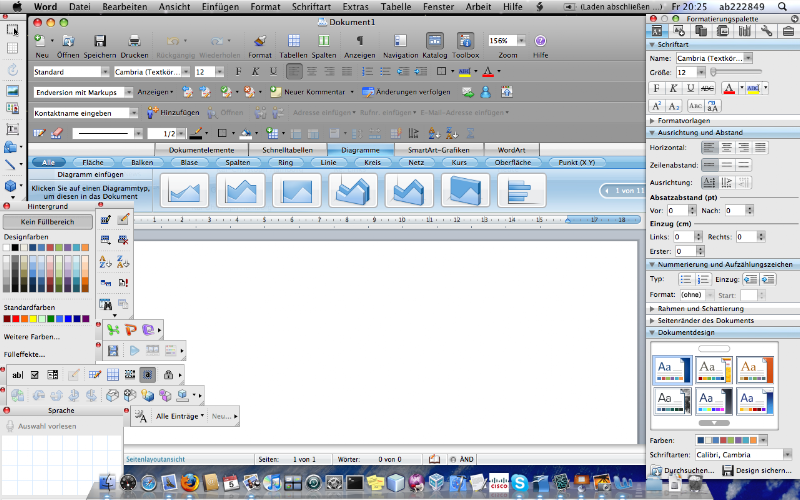
The office 2008 user interface is horribly clumsy, having been constructed in four different paradigms (menu, toolbox, ribbon, and traditional toolbars) with every function accessible from at least three of these. The result looks something like this (on someone else's Mac):
I accept this to some degree in free software, but from a commercial product from people who have been doing this for 20 years, I expect sanity, cleanliness, and for functions to work. Even worse is that Office 2004 is actually faster to calculate spreadsheets, even though it runs recompiled PowerPC code.
I would prefer to switch to NeoOffice entirely. However, small differences in the spreadsheet syntax and some fidelity issues in importing Word documents compel me to keep Microsoft Office around.
For instance, every time you change the formatting of a cell in Excel, the whole spreadsheet will be recalculated. Even though (by definition) formatting should not influence the calculation. If I customise the toolbar to include Paste Special, the toolbar does Paste from Scrapbook instead. It messes up graphs, and there is no way to turn off the warning that saving a document in Office 2004 format (which most of the whole world still uses) causes loss of formatting. And that is just in Excel, which I have long considered the best of the Office applications.
The office 2008 user interface is horribly clumsy, having been constructed in four different paradigms (menu, toolbox, ribbon, and traditional toolbars) with every function accessible from at least three of these. The result looks something like this (on someone else's Mac):
I accept this to some degree in free software, but from a commercial product from people who have been doing this for 20 years, I expect sanity, cleanliness, and for functions to work. Even worse is that Office 2004 is actually faster to calculate spreadsheets, even though it runs recompiled PowerPC code.
I would prefer to switch to NeoOffice entirely. However, small differences in the spreadsheet syntax and some fidelity issues in importing Word documents compel me to keep Microsoft Office around.
Monday, 27 July 2009
Office phone interruption
As I am now no longer employed at he university and sometimes work from home, they moved me across the hall to a smaller office together with Jenssie Wu. I am now in UN905.
Of course, my phone has not yet moved with me. So if you need to get my attention by day, e-mail is probably the fastest solution unless you want to go through the secretariat.
My apologies for the inconvenience.
Update: My office phone number has been restored to +31 30 253 7646
Of course, my phone has not yet moved with me. So if you need to get my attention by day, e-mail is probably the fastest solution unless you want to go through the secretariat.
My apologies for the inconvenience.
Update: My office phone number has been restored to +31 30 253 7646
Sunday, 26 July 2009
Hybrid cars
Hybrid cars have been very hot in recent years (they are now the top selling models in Japan), but not all are created equal. The communication specialists at Honda have made a very nice explanation of how hybrids work. The legend for page 2 is as follows: Honda (Civic, upcoming Fit/Jazz) uses the parallel system, Toyota (Prius) uses the combined system, and Chevrolet (upcoming Volt) uses the series system.
Now the hybrid systems have been simulated to achieve some 15%-20% reduction in fuel consumption on their own. Toyota claims more for the Prius, but much of this is due to better aerodynamics (that geeky look actually has a purpose).
The upcoming 3rd generation Prius will actually be bigger heavier than the existing one, though apparently also have lower fuel consumption. I would have preferred that Toyota put all of their gains towards fuel economy, but they must want to win over Jeremy Clarkson as well.
Personally, I would like to see the Honda Fit Hybrid to be introduced in NL (where it is called Jazz). That car is sufficiently small for me to consider buying in lieu of an Aygo/C1/107. I don't care for large cars in general, so any future employer with a leasing contract has a fat chance of peer pressuring me into something bigger than a MiTo.
Update: Bill Reinert, a US manager at Toyota had some remarks about the powertrain strategies of their competitors. While I doubt his diplomatic talent, I agree with his technical assessment.
Renée turned 60
My mother has reached the hallowed age of 60 on Wednesday. So, there was an excellent party on Saturday from five in the afternoon until around midnight, with some 40 friends attending.
My friend Manon (website under construction) did an excellent job with the seven-course walking dinner, and Henk chose excellent wines to go with them. Both did much to enhance the atmosphere, as did the lovely weather.
Her big gift for this year was a bronze statue that she chose for her garden. My brother and myself did not join that one, as we gave her a helicopter flight over Victoria Falls (just the helicopter flight, mind you, she was already on a trip to Africa).
The best comment Renée heard was that someone said sixty was no longer a scary age to him because she demonstrated such vigour and capacity for enjoying life at her age...
Saturday, 25 July 2009
Sunset on the Great War
The BBC reported the passing in the last week of Harry Patch, born 1898 and the last veteran of the trenches on the western front, and Henry Allingham, born 1896 and also the oldest man in the world at 113. There are now only three veterans of the Great War left alive.
I was not even remotely conceived during this conflict, but Goodbye to All That and Im Westen nichts Neues made a deep impression on me. It is from memoirs of this conflict that I lost the view that war may be glorious. I strongly recommend Erich Maria Remarque's book to anyone who retains a romantic view of armed conflict, much as I recommend Solzhenitsyn's book to anyone with residual sympathy for the communist era in Eastern Europe. Im Westen nichts Neues in particular described the soldiers' alienation so powerfully that I would feel physical nausea and vertigo after reading two or three chapters in one sitting.
John McCrae wrote a most famous poem on WWI:
I adopted a Commonwealth custom for November 11th, Armistice Day, and July 4th, rememberance day in NL. On these days, I read the fourth verse from For the Fallen:
Soon there will be no living memories of the Great War left to temper neoconservatives and other idiots. And it will be our task to remember them, lest follies of history are foolishly repeated. Though the aforementioned idiots make sure there are enough of such memories to go around in each generation, I still hope we will never again see wanton slaughter on that scale.
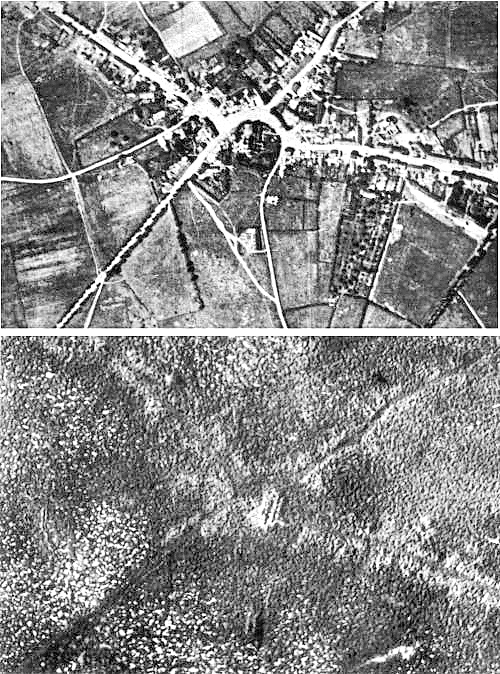
Update: to make the point visusally, here are 'before' and 'after' aerial photographs of the Belgian village of Passendale, in 1917. Artillery bombardment obliterated it almost entirely.
I was not even remotely conceived during this conflict, but Goodbye to All That and Im Westen nichts Neues made a deep impression on me. It is from memoirs of this conflict that I lost the view that war may be glorious. I strongly recommend Erich Maria Remarque's book to anyone who retains a romantic view of armed conflict, much as I recommend Solzhenitsyn's book to anyone with residual sympathy for the communist era in Eastern Europe. Im Westen nichts Neues in particular described the soldiers' alienation so powerfully that I would feel physical nausea and vertigo after reading two or three chapters in one sitting.
John McCrae wrote a most famous poem on WWI:
In Flanders Fields the poppies blowAnd Wilfred Owen once wrote regarding Horatius:
Between the crosses, row on row,
That mark our place; and in the sky
The larks, still bravely singing, fly
Scarce heard amid the guns below.
We are the Dead.
Short days ago
We lived, felt dawn, saw sunset glow,
Loved, and were loved, and now we lie
In Flanders fields.
Take up our quarrel with the foe:
To you from failing hands we throw
The torch, be yours to hold it high.
If ye break faith with us who die
We shall not sleep, though poppies grow
In Flanders fields."
My friend, you would not tell with such high zestBoth poets died in the line of duty in France in 1918.
To children ardent for some desperate glory
The old Lie: Dulce et decorum est
Pro patria mori.
I adopted a Commonwealth custom for November 11th, Armistice Day, and July 4th, rememberance day in NL. On these days, I read the fourth verse from For the Fallen:
They shall grow not old, as we that are left grow old;And though my father was never involved in any war (he was much opposed to it, as far as I remember), I often also find my thoughts drifting to him and other people I knew who died young when I read these lines. I can rarely repeat these particular lines without tears.
Age shall not weary them, nor the years condemn.
At the going down of the sun and in the morning
We will remember them.
Soon there will be no living memories of the Great War left to temper neoconservatives and other idiots. And it will be our task to remember them, lest follies of history are foolishly repeated. Though the aforementioned idiots make sure there are enough of such memories to go around in each generation, I still hope we will never again see wanton slaughter on that scale.
Update: to make the point visusally, here are 'before' and 'after' aerial photographs of the Belgian village of Passendale, in 1917. Artillery bombardment obliterated it almost entirely.
Friday, 24 July 2009
Summer Kempo
Summer is a slow time for kempo practice, if only because we train less frequently, and I tend to skip when it is raining. However, the training session on Wednesdays at 19:30 in the Wilhelminapark are free and open to everyone. So please feel invited if you want to try it, or to have a picknick in the park and watch us sweat for two hours.
For couch potatoes, there is the video registration of Sensei Michel's kata with a naginata for the 2009 Dutch traditional kempo championship. It earned him a silver medal, and rightly so. NB: if this or any of the related videos look easy, that is because the participants did well enough to make them look easy.
For couch potatoes, there is the video registration of Sensei Michel's kata with a naginata for the 2009 Dutch traditional kempo championship. It earned him a silver medal, and rightly so. NB: if this or any of the related videos look easy, that is because the participants did well enough to make them look easy.
Tuesday, 21 July 2009
De Parade
Another annual event, De Parade is great fun, if only for sitting around and watching people. But I also took a ride in the swing carousel and went to three performances:
- Altitude - a short play about funeral preparations in a dysfunctional family
- Mr Hands - a dance performance with excellent live music
- Niets is echt moeilijk - a very funny absurdist theatre show
Monday, 20 July 2009
We Came in Peace For All Mankind
It is now 40 years ago that Neil Armstrong and Edwin Aldrin landed on the Moon in the Sea of Tranquility.
Their voyage stands out as one of the most intrepid even undertaken by humans, and an example of both our best and worst drives as a species. On the one hand, their voyage required massive organisation, technical development and raw bravery. On the other hand, it was a product of paranoid Cold War rivalry. I prefer to remember it by the plague left on the Eagle lunar module's ladder:
Their voyage stands out as one of the most intrepid even undertaken by humans, and an example of both our best and worst drives as a species. On the one hand, their voyage required massive organisation, technical development and raw bravery. On the other hand, it was a product of paranoid Cold War rivalry. I prefer to remember it by the plague left on the Eagle lunar module's ladder:
Here Men From Planet Earth
First Set Foot Upon the Moon.
July 1969 A.D.
We Came in Peace For All Mankind.
Thursday, 16 July 2009
Scientific tidbits
Science is constantly providing us with new food for thought. Some highlights from the last few weeks:
- Sperm cells were made in the lab, with no male sexual organs involved. Which means that men are now finally obsolete. Fortunately, we can still do heavy lifting and tell women they look pretty.
- Cats exploit humans by a special soliciting purr, which is different from the normal 'I am content' purr. I listened to the little film and I recognise the high note in the purr, but I never realised it worked on a subconscious level.
- Bad bosses are bad for your heart. Those who rate their seniors as least competent have a 25% (short term) to 64% (long term) higher risk of a serious heart problem.
Monday, 13 July 2009
Tango Taboe camp IV
As ususal, I came early and helped build up the decorations. Many familiar faces trickled in, the atmosphere built pretty quickly. It was pretty hot, temperature wise at least, so we spent one morning at the Henschotermeer. People came up to the group to ask where we were from, because we were quite visibly having fun.
Taboe camp has a deserved reputation for being touchy-feely, though some people seem to think this means there is a lot of hanky-panky going on as well. There isn't, and most of the people attending are (married) couples. For myself, I realised I had no clue as to what I wanted from any of the lovely single women.
So instead, I just danced. I learned few new techniques but I did get a lot of practice and new insights on existing stuff. And unlike the other times, the emotional withdrawal shock of leaving my 80-strong family and return my single appartment was pretty mild.
Special thanks to my roommates and my camp peer group: Simone, Anja, Esther, Rik, Bart, Michael, Jeroen and Dirk Jan.
P.S. I know this blog entry arrived a little late. Busy, busy, and not in the mood for writing stories.
Friday, 26 June 2009
Art, or so they say...
The university botanical gardens are hosting an exhibition by artist Paul McCarthy, called Air Pressure. It is a gift from the municipality of Utrecht for the 370th anniversary of the university.
 The exhibit consists of giant inflatable objects. The university website waxes lyrically about the beautiful imagery and colour contrasts with the botanical gardens. An extraordinary exhibition for the whole family..
I am not convinced. Maybe they are writing about a different exhibition. When I look out the window of my office, I see Santa Claus with a Buttplug (the same figure as in Rotterdam), a stand-alone buttplug, two pigs (one without a head), and a massive turd, all poking through the treeline..
Maybe I am too Dutch to appreciate the artistic value of the shock effect. I like the pigs, but not the others. In any case, I think they clash with the gardens, are not very child-friendly and I wish they'd stop ruining my view.
The exhibition will go on until mid-September, but the students do not have to endure this. The Uithof had an elated atmosphere today, as the remaining students finished their exams. Soon, the summer quiet will descend (and the staff can all get to work without interruption).
The exhibit consists of giant inflatable objects. The university website waxes lyrically about the beautiful imagery and colour contrasts with the botanical gardens. An extraordinary exhibition for the whole family..I am not convinced. Maybe they are writing about a different exhibition. When I look out the window of my office, I see Santa Claus with a Buttplug (the same figure as in Rotterdam), a stand-alone buttplug, two pigs (one without a head), and a massive turd, all poking through the treeline..

Maybe I am too Dutch to appreciate the artistic value of the shock effect. I like the pigs, but not the others. In any case, I think they clash with the gardens, are not very child-friendly and I wish they'd stop ruining my view.
The exhibition will go on until mid-September, but the students do not have to endure this. The Uithof had an elated atmosphere today, as the remaining students finished their exams. Soon, the summer quiet will descend (and the staff can all get to work without interruption).
The King is dead
Michael Jackson, the King of Pop, has died at age 50. I'd say he is the second one, the first being Elvis Presley in 1977. The title may be vacant for a little while. I think it is probably for the best, as I doubt that he enjoyed life a lot in recent years, and I also doubt that it was going to get much better, even with a 50-concert comeback plan.
He was undoubtedly a genius composer and his early albums are legendary, particularly Thriller and Bad. He broke racial barriers (most of which we no longer remember) by his stardom, and helped launch MTV with his epic music videos. He had an unrivalled feeling for catchy rythms and it is almost impossible to sit still when hearing some of his songs.
However, he seems to have become more and more introvert after the Dangerous album. That didn't help his music, which got more and more self-absorbed and saccharine. His eccentricities and plastic surgery earned him the nickname Wacko Jacko. He alledgedly had an unhealthy interest in boys, and later some parents developed an unhealthy interest in letting their child stay over for the night and then sue Jackson. The last news before his death was the he would return to the stage in London. Presumably to raise money, as some of his property had been seized by creditors. I hope he rests in peace.
My own memories of him stretch back to the Thriller era. I remember Beat It when it first came out. I associate it with summer, two videogames (Bruce Lee and Match Point) and the visit of my South-African cousin, Winston.
I wonder if we will see Jackson impersonators like we do Elvis impersonators. And then to see which Jackson-look they will adopt (from little black boy to pale middle white guy with a funny nose). In the more immediate aftermath, the news brought parts of the internet to a standstill.
Sunday, 21 June 2009
The Stig and the demonstrations
It was revealed today (while I was out dancing) that Michael Schumacher is The Stig. However, he was shown as a guest star on the credits, so maybe it was all an elaborate hoax. Or was it?
(My apologies if the preceding paragraph doesn't make any sense to you. If that is the case, you are either a woman, or have been living under a rock for some years now...)
Of course, the BBC had much more important news this week, keeping us informed about Iran. They did such a good job at it that Supreme Leader Ali Khamenei singled out the British and their media for 'meddling' in Iranian affairs.
If by this he means that the BBC is supplying the people of Iran with information other than what his state-controlled media are feeding, BBC managers must have been grinning wide - until their correspondent in Tehran became persona non grata. It reminds me of a quote by Finley Peter Dunne about the purpose of journalism: "To comfort the afflicted and afflict the comfortable."
Of course, it is quite possible that Ahmadinejad won the election. But he didn't win it fair and square, because his regime seems to have committed pre-emptive electoral fraud. For this alone, they deserve the protests and a good dressing-down. The situation also reminds me that Khamenei was never considered a religious authority like his predecessor. He was a politician, competent manager and mid-level cleric until he was made supreme leader of Iran and got the title of ayatollah ex officio.
Sunday, 14 June 2009
Banksy

His identity is know only to a select view. But his works are very intriguing. Banksy started out as a graffiti artist but now makes all sort of artworks.
After exhibitions all over the world, he has returned to his native Bristol and (in secret) prepared an exhibition in the Bristol City Museum and Art Gallery. The Banksy Versus Bristol Museum exhibition is free and is drawing large crowds.
I understand why, after watching a slide show of the works on display. They are very accessible and just a tad subversive. In regret that I will not be near Bristol before August 31.
Tuesday, 9 June 2009
More cheerfully said than done
Consider the following scenario:
You are three weeks before the end of your contract and your boss tells you the last bit of work you are going to do (already agreed upon, and to be done without pay) should be expanded. However, it is impossible to arrange extra funding for you.
Two weeks later, you inform him that you have been accepted to speak at a conference about the work you have done for him, and he tells you that there is no money to pay for the trip.
Next week you hear that your boss has been able to free up money from the department reserves to extend the contracts of two of your colleagues.
The day after that he informs you that you should do yet another unpaid study. And the fifth study he wants you to do is more filler than academically groundbreaking, a least-resistance exercise to attain his minimum of 5 articles in the dissertation. Never mind that 4 is quite enough by university standards and two of the completed articles should have been in two parts, but you were told to be keep them in singles to save time.
Wouldn't you feel appreciated?
This is how my management interactions with my boss in the past month can be summarised. Now, I have heard that people who still get angry at you and pay attention in general are the ones who care, and you can tell if people have given up on you when they stop interacting. If they do still care, my management has a pretty contradictory way of showing it.
Regardless of whether my information is accurate and complete or whether it was intended this way, the message I hear is that André does not want to invest in me, but does want to keep me on a string until he has sucked up all of my unemployment benefits for his research goals. My promotor (also head of the department) shows little sign of an opinion in the matter.
In addition, I am quite sure that the UWV (who pay my unemployment benefits) want me to get a new job, not stay working with the university. In fact, they made rules against it after universities kept pulling this trick to get free labour.
So I feel squeezed, unappreciated and greatly annoyed. I need to repeat breathing exercises before I can get myself to sleep. I feel like my Ph.D. thesis is hostage to people whose interests are now almost completely out of step with mine.
There are probably all sorts of reasons why things came out as they did, but trust is an emotional and irrational quality, and mine is pretty much spent. Something has to give, and my tenured professors created far more wiggle room for themselves than I have. I sincerely hope I do not have get external mediation in this mess, but I am one bad meeting away from not talking to my supervisor anymore without representation.
Update: We sorted it out. The deal is that we will aim for five articles, but if I get a new job in the mean time, they will look at the four articles for my promotion. Other than that we had some frank and open talks, and markedly improved the tone of communication. I'm pretty happy with this outcome.
Sunday, 7 June 2009
European Parliament elections
The European elections are the second-biggest exercise in democracy in the world (the national election in India are the biggest). For me, it was fun to vote because the voting machines has been recalled due to hacking concerns. Instead, we voted the old-school way: with a ballot and red pencil. I had never done that before. It was also going to be interesting to watch the results because the economic and political landscape in Europe changed a lot from five years ago.
In NL, the most startling results was the size of the PVV. Though in my opinion, Wilders and his friends have probably reached the top end of what vague populist yelling can net in terms of voters. More telling were the traditional parties' responses: CDA and PvdA trying to woo PVV voters without alienating their other voters, VVD trying to woo PVV voters by co-opting his positions, SP telling Wilders off at every opportunity, and D66 and Groenlinks simply subscribing to a different ideology.
Strangely, only Femke Halsema seemed to have a way of dealing with Wilders' intransigence in debates. Most parties were merely able to confuse the already distant activities of the European Parliament. In the event, D66 and GroenLinks positioned themselves clearly as pro-EU and were rewarded with gains in the EP just as the PVV was. Ex-post analysis showed that the PvdA actually lost very few voters to the PVV, though it was unclear to me where they went.
On a European level, there was a shift to the right, though this was most pronounced in large Western European countries and rather mixed elsewhere. Governments lost in NL, DE and UK (mostly the labour parties), but won in FR and IT. Looking at the final tally, the conservative EPP actually lost seates, though not as catastrophically as the Socialists (update: the EPP loss is because of the British Conversatives leaving the EPP). The Green parties actually won seats, which was beyond expectation for a crisis election (though it seems like Natalia did not get a seat). The major increase is in the non-grouped parties, which are mostly far-right and anti-EU parties. This is deplorable, but seems unlikely to change politics other than requiring a little more cooperation from the major blocks.
The Tango Trap
Dance is a great way of relaxing, getting away from daily stress and just have simple fun. Also, for the single male scientist, tango provides a steady supply of hugs to give and receive.
There is a catch. It has been called the tango trap. For me it comes down to being unable to completely separate the feeling of connecting in a dance from connecting off the floor. Tango famously lets you be in love for half an hour and let it go within ten minutes after you stop. And then repeat it with the next man or woman. Furthermore, you can tell a lot about someone's personality by dancing or sparring (in martial arts) with them.
So if I connect, and I like the personality I see, and she is charming and lovely, I fall. It doesn't happen every week, or even every month, but it does happen occasionally. Most often with single women. Not so often with woman that are already in a stable relationship, because the boundaries are more clear and outlook is dim anyway, but even then it happens.
The upside is that feeling in love is really nice and keeps my mood afloat even if everything is pretty fucked up. The downside is that you have feelings for someone whose background you hardly know. It may turn out (and for me, usually does) that I do not have the slightest practical chance of having a relationship with her. Fortunately, most women take it as a compliment and we deal with each other gently.
So far, I haven't managed to escape the downside while still opening myself up to the dance and the person I dance with (which is a prerequisite for making a really nice dance). But if I ever find out, I will be sure to blog on it.
Sunday, 31 May 2009
The landscape and the ladder
Now that I am officially on the dole, I have a duty to apply for a new job. I do not mind that at all. In fact, I would prefer to have a new job lined up already, which is why I tried to get through to the European Commission even while I was on vacation. I recognise how much of my identity I derive from my work, as I spend more time on it than anything else.
But there is something that bothers me about my current situation: I now serve not one, but two masters. One is the university that still needs a dissertation before I am done with them, which will take a few months. The other is the government that also expects the economy to worsen a lot after the summer. My timing is exquisite, as usual.
At the same time, I feel a growing need to have some autonomy in my work. I cannot truly tell if I am ready to be completely responsible for my own direction. If I were, I would go into business for myself. And it is not because I think I can't do something very useful. It is more that I have very little idea of where in our ecosystem of goverment, enterprise and NGOs my skills and interests can find a niche: I have direction (I have always had that, like a fairly reliable inner compass), but no map or view of the landscape.
I suspect that is something that people develop as they move up the ladder. In a higher position, you have more overview and space to maneuver. But if it is, how do I find a position where I can develop long range vision and reach, and yet have some room to stumble or a safety net that does not constrict?
My position at the university was good for this in a knowledge sense, but I didn't get out as much as I need to. Before that, my position at SIRA should have done it, but turned into a disaster. I did pick up some skill in this area from these jobs, but most of it is from my time working with NGOs during my studies.
In good economic times, it would be possible to pick my next job to address this need. So the main thing about this crisis that worries me now (I am pretty financially solvent) is that it will restrict my opportunities to grow professionally.
Friday, 29 May 2009
Stockholm vs. Petersburg - atmosphere and dance
In many ways, these two cities are polar opposites. Stockholm is orderly, clean, quiet and almost rustic for a capital city, while Petersburg is loud, grimy, and pompous.
The first thing I noticed about St. Petersburg is the neglect of public spaces. Except when there are tourism or official reasons to maintain them, they degrade through lack of maintenance and public spirit. It strikes me as odd for a place that was collectivist until recently. The touristic areas, and anywhere that a senior official is likely to see, are kept well but the rest is not. In one place, the road was clean, but a footpath behind a hedgerow had piles of refuse. Also, the air quality is pretty horrible, especially after the clean air in Stockholm.
The people also go about their business with a neutral to sad look on their faces, which is apparently a way to preserve personal space. But it isn't doing the people great favours as a whole. I noticed this most clearly in the women.
Now, I have a thing for slavic women in general, but I am pretty impressed with the local young women. Unlike the swedish girls, whom I found generally bland despite their legendary status of leggy, busty blondes. But most of the middle aged women in St. Petersburg look worn, troubled and a bit chubby, without any of the grace they too must have once posessed.
My pet theory is that people do not laugh enough because of living conditions and bad weather (including really long and dark winters). On the other hand, many of the people I interacted with readily responded to cheerfulness with smiles of their own.
You notice it in another way: Stockholm is full of parents with children. I hardly saw any in St. Petersburg.
On the other hand, there is more than plenty to do here. In Stockholm, I tried to go tango twice: The first time, I ended up with a bunch of middle aged people of not very high skill. The second time there was simply nobody there at 21:30. In St. Petersburg, I got tango on my first night. Then my very first contact improvisation lesson on monday (great fun, and I have a nice abrasion on my arm to prove it), and a little milonga on thursday.
As it stands, I would recommend Göteborg over either of them as a place to live.
Subscribe to:
Posts (Atom)